

Ninth Circuit Court of Appeals Judgeship and Reorganization Act of 2021 This bill divides the U.S. Court of Appeals for the Ninth Circuit into two judicial circuits: (1) the Ninth Circuit, and (2) a new Twelfth Circuit. The Ninth Circuit is composed of California, Guam, Hawaii, and Northern Mariana Islands. The new Twelfth Circuit is composed of Alaska, Arizona, Idaho, Montana, Nevada, Oregon, and Washington.
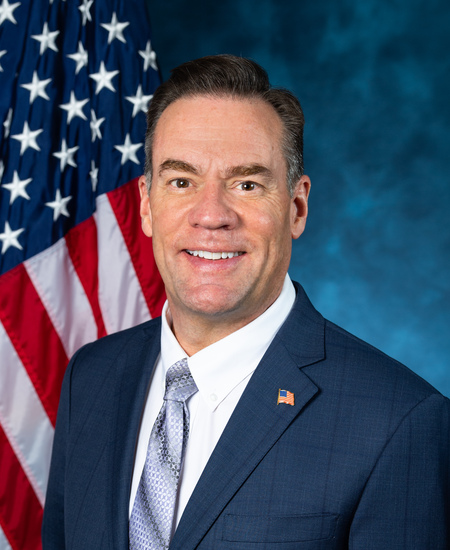
Rep. Russ Fulcher
Sponsored bills
This joint resolution proposes a constitutional amendment limiting Representatives to three terms and Senators to two terms. Terms beginning before the ratification of this amendment do not count towards these term limits.
This joint resolution proposes a constitutional amendment prohibiting total outlays for a fiscal year from exceeding total receipts for that fiscal year unless Congress authorizes the excess by a three-fifths roll call vote of each chamber. The prohibition excludes outlays for repayment of debt principal and receipts derived from borrowing. The amendment requires roll call votes of (1) three-fifths of each chamber of Congress to increase the public debt limit, and (2) a majority of each chamber for legislation increasing revenue. It also requires the President to submit a balanced budget to Congress annually. Congress is authorized to waive these requirements when a declaration of war is in effect or if the United States is engaged in a military conflict which causes an imminent and serious military threat to national security.
This joint resolution proposes an amendment to the Constitution to require that the Supreme Court consist of nine Justices.
This resolution honors Officers Brian Sicknick and Howard Liebengood of the U.S. Capitol Police, and it commends the bravery and service demonstrated by officers of the U.S. Capitol Police, the Metropolitan Police Department of the District of Columbia, and the other law enforcement agencies and protective entities that assisted in responding to the January 6, 2021, attack on the U.S. Capitol.
Hydropower Clean Energy Future Act This bill expands provisions related to renewable energy, including hydropower production, and revises the hydropower licensing process. The bill updates federal renewable purchase requirements. Specifically, the bill requires the federal government to purchase an increasing amount of renewable energy, including hydropower. By 2026, 25% of the total amount of electric energy the federal government consumes during any fiscal year must be renewable energy. In addition, the bill also provides an expedited licensing process for next-generation hydropower projects. The bill also revises requirements concerning the environmental review of certain hydroelectric power projects, including by designating the Federal Energy Regulatory Commission as the lead agency for the purposes of environmental reviews, allowing certain categories of projects to be exempted from such reviews, and establishing deadlines to complete such reviews. Finally, the bill establishes requirements about resolving (1) inconsistent or conflicting license terms, and (2) federal interagency disputes or disputes among federal and state agencies.
Hearing Protection Act This bill removes silencers from the definition of firearms for purposes of the National Firearms Act. It also treats persons acquiring or possessing a firearm silencer as meeting any registration and licensing requirements of such Act. The Department of Justice must destroy certain records relating to the registration, transfer, or making of a silencer. The bill also revises the definitions of firearm silencer and firearm muffler under the federal criminal code and includes such items in the 10% excise tax category.
Concealed Carry Reciprocity Act This bill establishes a federal statutory framework to regulate the carry or possession of concealed firearms across state lines. Specifically, an individual who is eligible to carry a concealed firearm in one state may carry or possess a concealed handgun (other than a machine gun or destructive device) in another state that allows its residents to carry concealed firearms. It sets forth requirements for the lawful concealed carry across state lines. The bill preempts most state and local laws related to concealed carry and establishes a private right of action for a person adversely affected by interference with a concealed-carry right established by this bill.
PPP Flexibility for Farmers and Ranchers Act This bill expands eligibility for agricultural producers under the Paycheck Protection Program, established to support small businesses in response to COVID-19 (i.e., coronavirus disease 2019), to include certain agricultural producers organized as partnerships. Currently, only certain agricultural producers that are sole proprietorships, independent contractors, or self-employed individuals may receive support under the program.
Keystone XL Pipeline Construction and Jobs Preservation Act This bill authorizes the TransCanada Keystone Pipeline to construct, connect, operate, and maintain the pipeline facilities in Phillips County, Montana, for the import of oil from Canada to the United States.