Emergency Tribal Housing Assistance Act of 2021 This bill provides additional FY2021 funding for tribal communities to prevent, prepare for, and respond to COVID-19 (i.e., coronavirus disease 2019). Specifically, the bill provides funding for federal housing assistance through the Native American Housing Block Grant, Native Hawaiian Housing Block Grant, and Indian Community Development Block Grant programs. The bill also reserves funds for technical assistance and administrative costs.
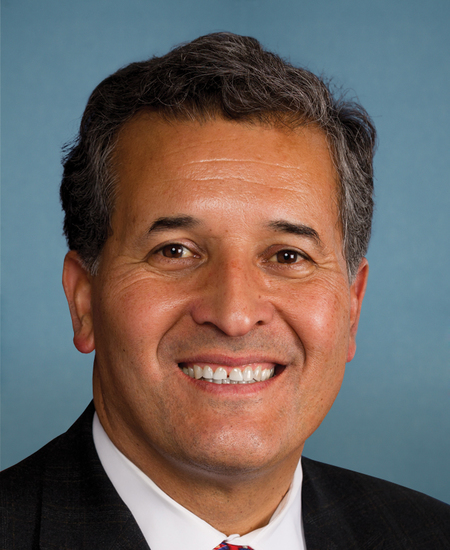
Rep. Juan Vargas
Sponsored bills
COVID-19 Medical Production Act This bill provides additional funding for FY2021 to acquire medical supplies, vaccines, and other equipment to combat COVID-19 (i.e., coronavirus disease 2019) using authorities under the Defense Production Act of 1950. That act confers on the President a broad set of authorities to influence domestic industry to provide essential materials and goods for the national defense. This funding is available through FY2025. Beginning in FY2023, it may be used to meet public health needs to address any pathogen determined by the President to have the potential to create a public health emergency.
George Floyd Justice in Policing Act of 2021 This bill addresses a wide range of policies and issues regarding policing practices and law enforcement accountability. It increases accountability for law enforcement misconduct, restricts the use of certain policing practices, enhances transparency and data collection, and establishes best practices and training requirements. The bill enhances existing enforcement mechanisms to remedy violations by law enforcement. Among other things, it does the following: lowers the criminal intent standard—from willful to knowing or reckless—to convict a law enforcement officer for misconduct in a federal prosecution, limits qualified immunity as a defense to liability in a private civil action against a law enforcement officer, and grants administrative subpoena power to the Department of Justice (DOJ) in pattern-or-practice investigations. It establishes a framework to prevent and remedy racial profiling by law enforcement at the federal, state, and local levels. It also limits the unnecessary use of force and restricts the use of no-knock warrants, chokeholds, and carotid holds. The bill creates a national registry—the National Police Misconduct Registry—to compile data on complaints and records of police misconduct. It also establishes new reporting requirements, including on the use of force, officer misconduct, and routine policing practices (e.g., stops and searches). Finally, it directs DOJ to create uniform accreditation standards for law enforcement agencies and requires law enforcement officers to complete training on racial profiling, implicit bias, and the duty to intervene when another officer uses excessive force.

This resolution supports the goals of a feminist foreign policy (i.e., a foreign policy that requires analysis of and challenges to power structures and inequalities that are based on systems of discrimination), and it supports the adoption of policies that promote gender equity and women's participation in public life.
Give Our Athletes Level Salaries Act or the GOALS Act This bill prohibits the use of funds for the 2026 World Cup until the U.S. Soccer Federation agrees to provide equitable pay to the members of the U.S. Women's National Team and the U.S. Men's National Team.
Northern Mariana Islands Legal Residents Relief Act of 2021 This bill expands eligibility for obtaining Commonwealth of the Northern Mariana Islands (CNMI) Resident status, provides a path for holders of such status to obtain U.S. permanent resident status, and makes CNMI-only transitional workers eligible to receive government relief or assistance in connection with a declared emergency. CNMI Resident status was available to qualifying individuals who applied for such status between February 19, 2020, and August 17, 2020. Among other requirements, a qualifying individual must have (1) been lawfully present in the CNMI on certain dates, and (2) continually and lawfully resided in the CNMI from November 28, 2009, through June 25, 2019. The bill reopens the period for applying for such status for 180 days and authorizes the Department of Homeland Security to waive this deadline in certain instances. The bill allows additional classes of individuals to qualify for CNMI Resident status, including an individual who (1) was admitted as a transitional worker during FY2015 and each subsequent fiscal year through FY2018, (2) is a qualified investor, or (3) resided in the CNMI as a guest worker for certain periods and is currently a transitional worker. The bill also waives the continual residence requirement for certain individuals and allows an individual lawfully present on December 31, 2020, to qualify. A qualifying alien with CNMI Resident status may obtain U.S. permanent resident status after holding CNMI Resident status for five years or after this bill has been enacted for five years, whichever is later.
New Way Forward Act This bill makes changes to immigration enforcement, including ending mandatory detention in certain cases. The Department of Homeland Security (DHS) shall not enter into or extend any contract with any public or private for-profit entity to own or operate a facility to detain aliens in DHS custody. The bill provides for various protections related to detaining aliens, such as (1) requiring DHS to make an initial custody determination and establish probable cause within 48 hours of taking an alien into custody, (2) establishing in hearings related to such determinations a presumption that the alien be released, and (3) requiring immigration judges to impose the least restrictive detention conditions necessary. A DHS officer may not interrogate a person as to immigration status based on factors such as the person's race, religion, sexual orientation, or spoken language. The bill removes mandatory detention requirements for certain aliens, such as asylum seekers with a credible fear of persecution. Removal proceedings against certain aliens previously admitted into the United States must commence within five years of the alien becoming deportable or inadmissible. The bill also removes certain crime-related grounds of inadmissibility and deportability. The bill gives immigration judges discretion to provide relief from removal if the removal is not based on certain crime-related grounds. State or local officers are prohibited from performing certain immigration enforcement functions, such as apprehending aliens. The National Crime Information Center database shall not contain an alien's immigration information. The bill repeals provisions providing criminal penalties for improper entry or reentry into the United States.
Jakelin Caal Death in Custody Reporting Act of 2021 This bill requires an investigation and reports for each death of an alien in Department of Homeland Security or Department of Health and Human Services custody. Within 24 hours of such a death, the relevant department shall provide to Congress a publicly available report containing (1) the name, gender, race, ethnicity, and age of the deceased; (2) the date, time, and location of the death; and (3) the circumstances surrounding the death. The relevant department shall conduct an investigation within 30 days of the death of an alien in its custody, including an analysis of (1) the root cause of the death, and (2) any policy or systemic changes that could reduce the possibility of such a death in the future. The results of such an investigation shall be reported to Congress and made publicly available on the internet.
Correcting Hurtful and Alienating Names in Government Expression (CHANGE) Act This bill prohibits any executive agency from using the term alien to refer to an individual who is not a U.S. citizen or national, or i llegal alien to refer to such an individual who is unlawfully present in the United States or lacks lawful immigration status. This prohibition does not apply when quoting certain texts. The bill (1) establishes a uniform definition for the term foreign national when used in acts of Congress and agencies; (2) replaces alien with foreign national in federal government documents, including statutes and regulations; and (3) replaces illegal alien with undocumented foreign national in such documents. Under the bill, a foreign national is any individual other than an individual (1) who is a citizen of the United States; or (2) though not a citizen of the United States, who owes permanent allegiance to the United States.
Insurrection Financing Transparency Act of 2021 This bill authorizes a law enforcement agency to require a reporting company (i.e., a corporation, limited liability company, or similar entity, subject to exceptions) to provide information about its beneficial owners if such information is required for an investigation into the attack on the U.S. Capitol on January 6, 2021. It imposes penalties for failing to report such information.