Violence Against Women Extension Act of 2021 This bill reauthorizes for FY2022 various programs and activities authorized by the Violence Against Women Act of 1994 and subsequent legislation and administered by the Office on Violence Against Women within the Department of Justice.
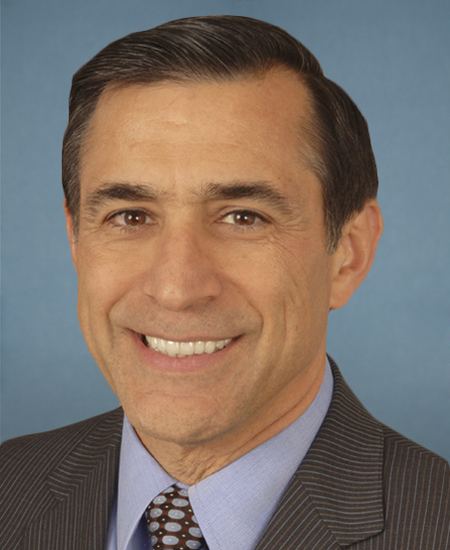
Rep. Darrell Issa
Sponsored bills
Regulations from the Executive in Need of Scrutiny Act of 20 21 This bill revises provisions relating to congressional review of agency rulemaking. Specifically, the bill establishes a congressional approval process for a major rule. A major rule may only take effect if Congress approves of the rule. A major rule is a rule that results in (1) an annual effect on the economy of $100 million or more; (2) a major increase in costs or prices for consumers, individual industries, government agencies, or geographic regions; or (3) significant adverse effects on competition, employment, investment, productivity, innovation, or the ability of U.S.-based enterprises to compete with foreign-based enterprises. In addition, the bill establishes a congressional disapproval process for a nonmajor rule. A nonmajor rule may only take effect if Congress does not disapprove of the rule.
Iran Sanctions Relief Review Act of 2021 This bill restricts the President's authority to unilaterally undertake certain actions with respect to Iran and increases congressional oversight of those actions. Specifically, the President must report to Congress before terminating or waiving sanctions related to Iran or taking a licensing action that significantly alters U.S. foreign policy with respect to Iran. Each report must (1) describe the proposed action and its rationale, and (2) indicate whether or not the action is intended to significantly alter foreign policy concerning Iran. If the intention is to alter that policy, the report must provide additional information about the policy objectives and anticipated effects of the action. After the President submits a report, the bill provides Congress with a 30-day period to review it; this period is extended to 60 days for reports submitted between July 10 and September 7. During this period, Congress may enact a joint resolution approving or disapproving the action. During the review period, the President may not take the action unless Congress passes a joint resolution of approval; if Congress enacts a joint resolution of disapproval, the bill prohibits the President from taking the action. The bill also outlines procedures for the introduction and consideration of these types of joint resolutions.
Foreign Influence Transparency Act This bill addresses foreign influence in higher education and in certain other academic, religious, and artistic pursuits. Current law exempts from foreign agent registration requirements a person engaging in activities in furtherance of religious, scholastic, academic, or scientific pursuits or of the fine arts. The bill specifies that this exemption applies only to those activities that do not promote the political agenda of a foreign government. Under current law, an institution of higher education (IHE) must disclose to the Department of Education (ED) a gift or contract that is from a foreign source and is valued at $250,000 or more, considered alone or in combination with all other gifts from or contracts with the foreign source. The bill instead requires an IHE to disclose such a gift or contract that is valued at $50,000 or more, considered alone or in combination with all other gifts or contracts. An IHE must include in its disclosure report the contents of any such contract and make the contents available for public disclosure. Additionally, an IHE that enters into an agreement with a Confucius Institute (i.e., a cultural institute directly or indirectly funded by the Chinese government) must immediately make available the full text of the agreement to the public, ED, and Congress. Finally, the bill prohibits an IHE that does not comply with these disclosure requirements from enrolling foreign students under the Student and Exchange Visitor Program.

This resolution calls on the Office for Civil Rights within the Department of Education and state attorneys general to assist elementary and secondary schools in complying with existing civil rights laws and investigate and enforce such laws. In addition, the resolution condemns the practice of requiring teachers to receive education in critical race theory as a condition of certification.
This bill prohibits any executive agency from contravening Executive Order 13950 (Combating Race and Sex Stereotyping), except as such order relates to contractors and grant recipients.
Save Local Business Act This bill provides that a person may be considered a joint employer in relation to an employee under federal labor law only if such person directly, actually, and immediately (and not in a limited and routine manner) exercises significant control over the essential terms and conditions of employment. Such control may by demonstrated by hiring and discharging employees, determining individual employee rates of pay and benefits, day-to-day supervision of employees, assigning individual work schedules, positions, and tasks, and administering employee discipline.
Freedom to Work Act This bill requires federal agencies to review and reduce occupational licensing requirements. Specifically, each executive agency must review relevant laws, policies, and regulations that institute occupational licensing requirements for agency positions, or that cause a state, local, or tribal government to adopt licensing requirements for positions within their jurisdictions, and identify possible changes to eliminate such requirements or to provide alternatives that are the least restrictive while also maintaining consumer protection. Agencies must implement changes to the extent permissible under law. The bill also requires states to describe their plans to reduce occupational licensing barriers as part of their unified state plans for programs under the Workforce Innovation and Opportunity Act. Several executive orders have required similar review of occupational licensing requirements. For example, the executive order titled Increasing Economic and Geographic Mobility, which was issued on December 14, 2020, outlined certain principles for occupational licensing requirements, including that such requirements should be the least restrictive to competition while also maintaining consumer protection; the order directed executive agencies to review and identify changes to their regulations, guidance, and policies in accordance with these principles. Additionally, the executive order titled Promoting Competition in the American Economy , which was issued on July 9, 2021, directs the Federal Trade Commission to consider addressing practices that inhibit competition, including unfair occupational licensing restrictions, through regulations.
Let Veterans Honor the Fallen Act This bill requires the Department of Defense to authorize a veterans service organization to use the parking lot at the Pentagon as a staging area for the Rolling to Remember Memorial Day Remembrance Ride. The veterans service organization must assume full responsibility for all expenses and liabilities arising from event activities.
TRICARE Retiree Protection Act This bill authorizes a covered beneficiary who is enrolled in TRICARE Select to reenroll in TRICARE Select at any time during 2021. Covered beneficiaries are those in the retired category who (1) enrolled in TRICARE Select as of December 31, 2020, (2) did not establish a monthly enrollment fee payment during the 2020 TRICARE Open Season, and (3) submit an assertion that they did not receive notice regarding the process to enroll in and establish a monthly enrollment fee payment for TRICARE Select for 2021. A covered beneficiary who reenrolls in TRICARE Select must, at the time of enrollment, pay a portion of the annual enrollment fee and establish a monthly enrollment fee payment for the remaining months of 2021.