

Prison Camera Reform Act of 2021 This bill establishes various requirements to ensure that the security camera, radio, and public address systems used by the Bureau of Prisons (BOP) have the capabilities necessary to (1) ensure the health and safety of staff and inmates; and (2) ensure the documentation and accessibility of video evidence pertaining to misconduct, maltreatment, or criminal activity within correctional facilities. Among the requirements, the BOP must evaluate the systems currently in use at its facilities and implement a plan that addresses deficiencies in and makes upgrades to the systems.
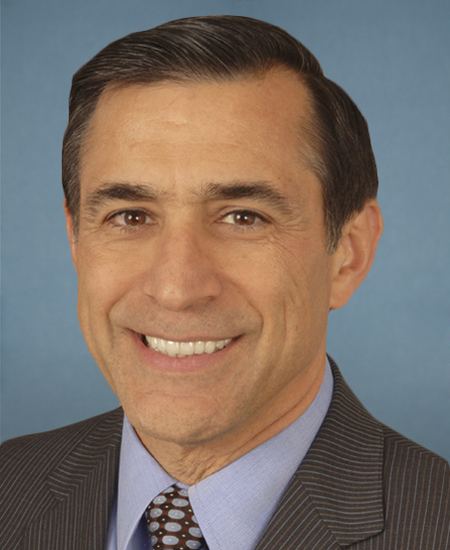
Rep. Darrell Issa
Sponsored bills
Conducting Legally Efficient Administration and Resolution of Patents Act of 2021 or the CLEAR Patents Act of 2021 This bill establishes that a federal agency proceeding pertaining to a patent shall, in certain instances, be stayed while certain administrative validity challenges to that patent are pending. Specifically, if the U.S. Patent and Trademark Office institutes an inter partes review (IPR) or a postgrant review (PGR) of a patent and the cancellation of one of the patent's claims would materially affect a federal agency proceeding, that proceeding must be stayed until the IPR or PGR has been decided or otherwise terminated.
Illegal Immigrant Payoff Prohibition Act This bill prohibits the payment of a settlement to an alien for a civil action brought against the United States in connection with the alien's inadmissibility to, or unlawful presence in, the United States.
Open Courts Act of 2021 This bill requires the Administrative Office of the U.S. Courts to establish a single electronic system for all public court records that is publicly accessible for free. Under the existing Public Access to Court Electronic Records (PACER) system, users are charged fees for accessing court documents. To fund the development of the new consolidated system, the Judicial Conference must temporarily establish a schedule of additional fees for higher-volume nongovernmental users of PACER. To fund the operations of the new system, the Judicial Conference shall collect an annual fee from each federal agency equal to that agency's PACER fees in 2018, adjusted for inflation. The Judicial Conference may also establish reasonable filing fees based on specified factors, including the extent of a person's use and the interests of justice.
Stop Settlement Slush Funds Act of 2021 This bill prohibits the federal government from entering into or enforcing a settlement agreement on behalf of the United States that provides for a payment to any person or entity other than the United States. The bill provides exceptions to allow payments that (1) remedy actual harm (including to the environment) caused by the party making the payment, or (2) constitute a payment for services rendered in connection with the case. Government officials or agents who violate this prohibition may be removed from office or required to forfeit to the government any money they hold for such purposes to which they may otherwise be entitled. Agencies must report annually for seven years to the Congressional Budget Office about the parties, funding sources, and distribution of funds for their settlement agreements permitted by the exceptions in this bill. The Office of Inspector General for each agency must also report annually on any settlement agreements that violate the bill's requirements.
Foreign Merger Subsidy Disclosure Act of 2021 This bill requires entities to disclose in their premerger notification filings to federal antitrust regulators a detailed accounting of any economic support they received from a foreign state.
Judicial Understaffing Delays Getting Emergencies Solved Act or the JUDGES Act This bill requires the appointment of additional U.S. district court judges, converts certain temporary district court judgeships into permanent judgeships, and requires the Government Accountability Office to report on vacant or underused federal courthouses. Specifically, the bill requires the appointment of 39 district court judges on or after January 21, 2025, in specified judicial districts in Arizona, California, Colorado, Delaware, Florida, Georgia, Idaho, Indiana, Iowa, New Jersey, New Mexico, New York, and Texas. Further, 38 district court judges must be appointed on or after January 21, 2029, in specified judicial districts in Arizona, California, Colorado, Delaware, Florida, Georgia, Indiana, New Jersey, New York, and Texas. Additionally, the bill converts certain temporary district court judgeships to permanent judgeships in specified judicial districts in Alabama, Arizona, California, Florida, Kansas, Missouri, New Mexico, North Carolina, and Texas.
Daniel Anderl Judicial Security and Privacy Act of 2021 This bill generally prohibits federal agencies and private businesses from publicly posting the personally identifiable information (e.g., home addresses) of federal judges and their immediate family members. It also (1) requires information to be removed upon written request from the federal judge concerned, (2) prohibits data brokers from purchasing or selling such information, and (3) establishes programs to protect such information at the state and local level and to enhance security for judges.
Stars and Stripes Act of 2021 This bill prohibits the Department of State from displaying any flag or banner at a diplomatic or consular post other than specified flags. Such flags are (1) the U.S. flag; (2) the flag of the country wherein the post is located; (3) the flag of a state, territory, or possession of the United States; (4) a departmental or secretarial flag; (5) the flag of an Armed Force; or (6) a flag to honor prisoners of war or those missing in action.
Save Money on Auto Repair Transportation Act or the SMART Act This bill limits design patent infringement liability for component parts used to repair the exterior of a motor vehicle. Specifically, the bill limits liability for infringement of a design patent that claims the appearance of a component part of a motor vehicle's exterior, such as a hood or fender. The act of making, offering to sell within the United States, or importing into the United States an article of manufacture (such as an exterior component part from an aftermarket manufacturer) that would otherwise infringe such a design patent shall not constitute infringement if the purpose of the article of manufacture is to repair and restore a motor vehicle to its original appearance. In addition, 30 months after a motor vehicle with an exterior component part covered by a design patent is offered for sale in any country, it shall not constitute design patent infringement to use or sell within the United States an otherwise-infringing article of manufacture if the purpose of that article of manufacture is to repair and restore the motor vehicle to its original appearance.