

Institutional Grants for New Infrastructure, Technology, and Education for HBCU Excellence Act or the IGNITE HBCU Excellence Act This bill establishes a grant program to support long-term improvements of historically Black colleges and universities (HBCUs) and graduate programs at HBCUs. Specifically, the bill requires the Department of Education (ED) to award grants to HBCUs to improve campus facilities. A recipient must use grant funds for certain activities, such as constructing or renovating facilities, carrying out major repairs, and strengthening the safety and security of a campus. Any new construction, modernization, or renovation projects must meet building code and energy and water conservation requirements. Further, HBCUs must seek to procure contracts from certain small businesses, including those owned and controlled by veterans and service-disabled veterans. The bill prohibits the use of grant funds for specified activities, including for the payment of routine and predictable maintenance costs, minor repairs, and utility bills. The Government Accountability Office must study the implementation of the grant program. The bill also requires ED to repay the outstanding balance of principal, interest, fees, and costs and any related reimbursements for certain capital financing loans.
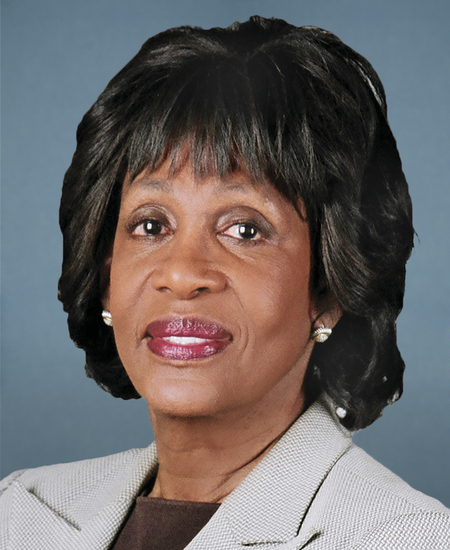
Rep. Maxine Waters
Sponsored bills
Medicare for All Act of 2021 This bill establishes a national health insurance program that is administered by the Department of Health and Human Services (HHS). Among other requirements, the program must (1) cover all U.S. residents; (2) provide for automatic enrollment of individuals upon birth or residency in the United States; and (3) cover items and services that are medically necessary or appropriate to maintain health or to diagnose, treat, or rehabilitate a health condition, including hospital services, prescription drugs, mental health and substance abuse treatment, dental and vision services, and long-term care. The bill prohibits cost-sharing (e.g., deductibles, coinsurance, and copayments) and other charges for covered services. Additionally, private health insurers and employers may only offer coverage that is supplemental to, and not duplicative of, benefits provided under the program. Health insurance exchanges and specified federal health programs terminate upon program implementation. However, the program does not affect coverage provided through the Department of Veterans Affairs or the Indian Health Service. The bill also establishes a series of implementing provisions relating to (1) health care provider participation; (2) HHS administration; and (3) payments and costs, including the requirement that HHS negotiate prices for prescription drugs. Individuals who are age 18 or younger, age 55 or older, or already enrolled in Medicare may enroll in the program starting one year after enactment of this bill; other individuals may buy into the program at this time. The program must be fully implemented two years after enactment.
Hate Crimes Commission Act of 2021 This bill establishes the United States Commission on Hate Crimes. The commission must investigate and report on whether hate crimes have increased; factors that contributed to an increase in hate crimes, if one is determined to exist; policies or actions by law enforcement agencies to reduce the commission of hate crimes; the impact of underreporting on hate crimes statistics and prevention; and successful community bias prevention responses.
COVID - 19 Hate Crimes Act This bill requires a designated officer or employee of the Department of Justice (DOJ) to facilitate the expedited review of COVID-19 (i.e., coronavirus disease 2019) hate crimes and reports of COVID-19 hate crimes. It defines COVID-19 hate crime as a violent crime that is motivated by two things: (1) the actual or perceived characteristic (e.g., race or ethnicity) of any person, and (2) the actual or perceived relationship to the spread of COVID-19 of any person because of that characteristic. The bill requires DOJ to issue guidance for state and local law enforcement agencies on (1) the establishment of online hate crime reporting processes and the availability of online reporting in multiple languages, and (2) the expansion of culturally competent education campaigns. Additionally, DOJ and the Department of Health and Human Services must issue guidance on best practices for mitigating racially discriminatory language in describing the COVID-19 pandemic.
Fair Housing Enforcement Emergency Act of 2021 This bill provides funds for fair housing organizations and state and local civil rights agencies to respond to and investigate fair housing complaints and housing discrimination resulting from the COVID-19 (i.e., coronavirus disease 2019) pandemic.
Workforce Justice Act of 2021 This bill creates a new condition of eligibility for funds under the Edward Byrne Memorial Justice Assistance Grant (JAG) program. Specifically, to be eligible for grant funds under the JAG program, a state must prohibit private employers from requiring a job applicant to disclose a criminal record, asking about the criminal record of a job applicant prior to making a conditional offer, and conducting a criminal background check prior to making a conditional offer.
Comprehensive Debt Collection Improvement Act This bill generally provides additional financial protections for consumers and places restrictions on debt collection activities. Regarding additional consumer protections, the bill expands certain protections currently applicable to federally backed student loans to private student loans, including by requiring the discharge of a private student loan in the event of the borrower's death or total and permanent disability; prohibits a consumer reporting agency from adding any information related to a debt arising from a medically necessary procedure to a consumer credit report and places restrictions on the reporting of other types of medical debt; and applies certain consumer protections regarding debt collection to debt owed to a federal agency, states, debt buyers, and businesses engaged in nonjudicial foreclosures. It also prohibits certain loan conditions that limit a borrower's opportunity to be heard in court in the event of default. Additionally, the bill restricts debt collectors and debt collection practices by prohibiting a debt collector from representing to a service member that failure to cooperate with a debt collector will result in a reduction of rank or similar action, limiting a debt collector's electronic communications with a debtor without the debtor's permission, and requiring a debt collector to provide advance notice to a consumer of the intent to take legal action to collect a debt. The Government Accountability Office must report on the impact of debt collection on service members and on the use of debt collectors by federal and state agencies.
I am Vanessa Guillén Act of 2021 This bill addresses the policies and procedures of the Department of Defense (DOD) for cases or allegations of sex-related offenses.
Renewable Energy Investment Act This bill allows taxpayers, including certain pass-thru entities such as partnerships and S corporations, to elect to receive tax excludable payments in lieu of amounts attributable to the tax credits for energy property and for electricity produced from certain renewable resources.
This bill increases the applicable threshold amount for heads of household in 2021 to $150,000 for purposes of the income phaseout in the child tax credit (thus making it equal to the threshold amount for married individuals filing joint tax returns).