This resolution honors the suppliers of the National Aeronautics and Space Administration (NASA) for the work they are doing on the Artemis missions.
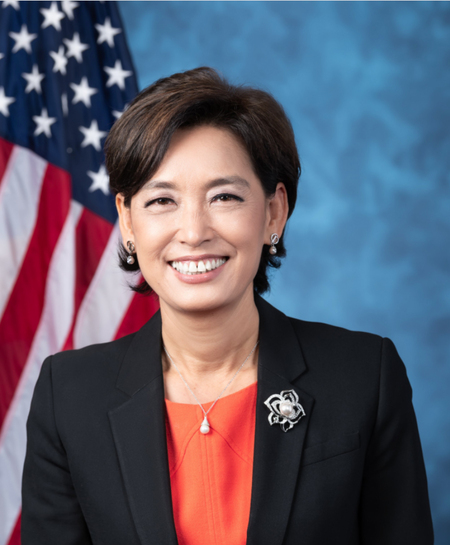
Rep. Young Kim
Sponsored bills
Federal Retirement Fairness Act This bill modifies the federal civilian service that is creditable service under the Federal Employees Retirement System (FERS). Specifically, it expands the nondeduction service that may be creditable under FERS. Nondeduction service is federal service where an employee's pay is not subject to retirement deductions (e.g., service under a temporary appointment). Currently, nondeduction service performed before January 1, 1989, is creditable under FERS so long as a deposit is made into the retirement fund to cover the period of nondeduction service. This bill allows nondeduction service performed on or after January 1, 1989, to be creditable under FERS so long as a deposit is made into the retirement fund.
Taskforce Recommending Improvements for Unaddressed Mental Perinatal & Postpartum Health for New Moms Act of 2021 or the TRIUMPH for New Moms Act of 2021 This bill temporarily establishes within the Department of Health and Human Services the Task Force on Maternal Mental Health. The task force must develop a national strategy for maternal mental health and report on best practices, policies, and programs to prevent, screen for, diagnose, treat, and reduce disparities in maternal mental health conditions. The report must identify opportunities for state- and local-level partnerships to address maternal mental health, and the task force must share those opportunities with state governors.
This resolution urges the President to facilitate private medical supply donations and to deliver urgently needed medical supplies, including oxygen generator plants, to India and countries neighboring India that are facing the spread of COVID-19.
This resolution calls on the Russian government to immediately release Trevor Reed, a U.S. citizen, and all other political prisoners. It also condemns the Russian government's use of politically motivated imprisonment.
Essential Caregivers Act of 2021 This bill requires skilled nursing facilities, nursing facilities, intermediate care facilities for the intellectually disabled, and nearby inpatient rehabilitation facilities to establish an essential caregivers program during a public health emergency. Under the program, facilities must allow each resident to select up to two essential caregivers to provide daily living assistance, emotional support, or companionship during the emergency. Facilities must afford such caregivers 12 hours of access to residents each day (or unlimited access for end-of-life care), and caregivers must agree to follow facility protocols for staff safety. Facilities may deny access to caregivers who violate protocols, subject to certain notification requirements; the Centers for Medicare & Medicaid Services must establish an appeals process relating to such decisions and may take specified enforcement actions against facilities that violate the bill's requirements.
Pandemic Unemployment Assistance Fraud Protection Act This bill creates several requirements for states to address fraudulent claims for Pandemic Unemployment Assistance (PUA), temporarily increases penalties for fraud related to PUA, and requires each state to establish a hotline for victims of unemployment fraud. Specifically, the bill requires states to cross reference PUA claims with federal and state prison records and E-Verify to ensure that claimants are eligible for PUA, submit to the Department of Labor plans to recover fraudulently obtained PUA, develop an anti-fraud task force to investigate and recover fraudulently obtained PUA, make restitution to Labor for the amount of any overpayment of PUA made by the state, and establish a hotline designed to encourage individuals who are victims of unemployment fraud and have received an incorrect statement of unemployment compensation to report that fraud. The bill also temporarily enhances the maximum penalty for fraud related to PUA through December 31, 2021, so that the offense is classified as fraud in relation to a presidentially declared major disaster or emergency and punishable by up to 30 years imprisonment, a fine of up to $1,000,000, or both.

Improving Opportunities for New Americans Act of 2021 This bill requires the Department of Labor to study and report on the factors affecting employment opportunities for immigrants and refugees with professional credentials obtained in other counties, including policy recommendations for assisting those individuals in obtaining skill-appropriate employment in the United States.
Promotion and Expansion of Private Employee Ownership Act of 2021 This bill expands tax incentives and federal assistance for employee stock ownership plans (ESOPs) that are sponsored by S corporations. The bill provides additional tax incentives for ESOPs by (1) extending to all domestic corporations, including S corporations, provisions allowing deferral of tax on gain from the sale of employer securities to an ESOP; and (2) allowing a tax deduction for 50% of the interest received by a bank on loans to S corporation-sponsored ESOPs for the purchase of employer securities. The Department of the Treasury must establish the S Corporation Employee Ownership Assistance Office to foster increased employee ownership of S corporations. The bill defines an ESOP business concern for purposes of the Small Business Act as a business concern that was eligible for a loan, preference, or other program under such Act before more than 49% of the business concern was acquired by an ESOP.
Telemental Health Care Access Act of 2021 This bill eliminates certain restrictions relating to Medicare coverage of mental health services that are provided through telehealth. Current law allows for coverage of such services regardless of the geographic location of the originating site (i.e., the location of the beneficiary) after the end of the COVID-19 public health emergency, as long as the beneficiary previously received in-person services and continues to receive in-person services at specified intervals. The bill eliminates these in-person requirements.