

Civilian Climate Corps for Jobs and Justice Act This bill establishes a Civilian Climate Corps Program and generally revises benefits provided to national service program participants. The bill establishes a Civilian Climate Corps to operate (1) a national climate service program; and (2) a national climate service grant program to help communities respond to climate change and transition to a clean economy, including through reducing carbon emissions. The bill also provides for allowances for participants in certain national service programs, including the Volunteers in Service to America (VISTA) program and the National Civilian Community Corps. The bill expands the exclusion from gross income, for income tax purposes, to exclude amounts received as educational awards or benefits and income attributable to discharges of student loan debt under the National and Community Service Act of 1990.
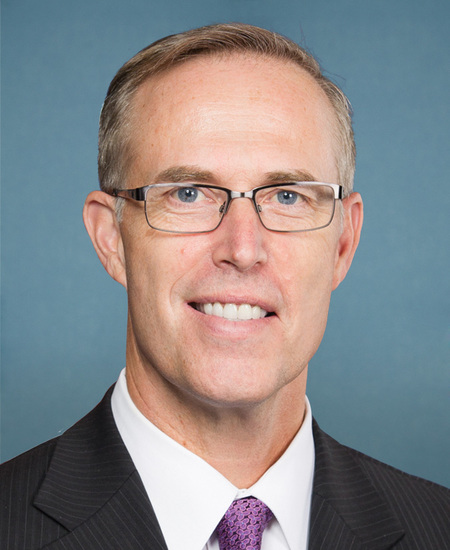
Rep. Jared Huffman
Sponsored bills
Restoring Offshore Wind Opportunities Act This bill authorizes the Department of the Interior to grant leases on the Outer Continental Shelf for activities that produce or support production, transportation, or transmission of energy from sources other than oil and gas (e.g., wind energy) in certain areas of the Gulf of Mexico and the South Atlantic and Straits of Florida Planning Areas. In September of 2020, presidential memorandums placed a moratorium on all energy leases in those areas for a 10-year period. This bill allows energy leases from such sources in those areas during that time.
Secure and Fair Enforcement Banking Act of 2021 or the SAFE Banking Act of 2021 This bill generally prohibits a federal banking regulator from penalizing a depository institution for providing banking services to a legitimate cannabis-related business. Prohibited penalties include terminating or limiting the deposit insurance or share insurance of a depository institution solely because the institution provides financial services to a legitimate cannabis-related business and prohibiting or otherwise discouraging a depository institution from offering financial services to such a business. Additionally, proceeds from a transaction involving activities of a legitimate cannabis-related business are not considered proceeds from unlawful activity. Proceeds from unlawful activity are subject to anti-money laundering laws. Furthermore, a depository institution is not, under federal law, liable or subject to asset forfeiture for providing a loan or other financial services to a legitimate cannabis-related business. The bill also provides that a federal banking agency may not request or order a depository institution to terminate a customer account unless (1) the agency has a valid reason for doing so, and (2) that reason is not based solely on reputation risk. Valid reasons for terminating an account include threats to national security and involvement in terrorist financing, including state sponsorship of terrorism. Finally, the bill decreases the cap on the surplus funds of the Federal Reserve banks. (Amounts exceeding this cap are deposited in the general fund of the Treasury.)
Offshore Wind Jobs and Opportunity Act This bill authorizes the Department of the Interior to award offshore wind career training grants to institutions of higher education or labor organizations to develop, offer, or improve educational or career training programs that provide skills necessary for employment in the offshore wind industry.
Green New Deal for Public Housing Act This bill addresses energy efficiency and workforce development in the context of public housing. Specifically, the Department of Housing and Urban Development (HUD) must award grants to public housing agencies (PHAs) and other eligible entities under a variety of new programs, including programs for facilitating workforce development and high-income employment transition; conducting physical needs assessments and subsequent energy efficiency retrofits; and making upgrades, replacements, and improvements for energy efficiency, building electrification, and water quality upgrades. Recipients of these grants must provide relocation assistance for residents who are displaced during construction and must ensure that they can return to their homes once retrofitting is completed. A certain percentage of the employment positions generated by these grant programs and other specified federal grant programs must be filled by low-income individuals, and a specified percentage of certain contracts associated with these programs must be awarded to businesses owned by residents of public housing. The bill also repeals a provision that prohibits a PHA from using HUD funds to construct or operate new public housing units if doing so would result in the PHA owning or operating more units than it did on October 1, 1999.
Workplace Violence Prevention for Health Care and Social Service Workers Act This bill requires the Department of Labor to address workplace violence in health care, social service, and other sectors. Specifically, Labor must issue an interim occupational safety and health standard that requires certain employers to take actions to protect workers and other personnel from workplace violence. The standard applies to employers in the health care sector, in the social service sector, and in sectors that conduct activities similar to those in the health care and social service sectors. In addition, Labor must promulgate a final standard within a specified time line.
FDA Modernization Act of 2021 This bill allows an applicant for market approval for a new drug to use methods other than animal testing to establish the drug's safety and effectiveness. Under this bill, these alternative methods may include cell-based assays, organ chips and microphysiological systems, sophisticated computer modeling, and other human biology-based test methods.
Fire Fighters and EMS Employer-Employee Cooperation Act This bill requires the Federal Labor Relations Authority to determine whether a state substantially provides fire and emergency medical services (EMS) personnel the right to form and join a labor organization; recognition by fire and EMS employers of the employees' labor organization, agreement to bargain with the organization, and reduction of any agreements to writing in a contract or memorandum of understanding; the right to bargain over hours, wages, and terms and conditions of employment; and arbitration or other mechanisms to resolve an impasse in collective bargaining negotiations. The bill makes the authority responsible for (1) determining the appropriateness of units for labor representation; (2) supervising elections; (3) conducting hearings and resolving complaints of unfair labor practices; and (4) protecting the right of employees to form, join, or assist any labor organization, or to refrain from doing so. An employer, fire and EMS personnel, or labor organization may not engage in a lockout, sickout, work slowdown, strike, or any other organized job action that will measurably disrupt the delivery of emergency services and is designed to compel an employer, fire and EMS personnel, or labor organization to agree to the terms of a proposed contract.
Tax Fairness for Workers Act This bill allows an above-the-line tax deduction for union dues and expenses. (An above-the-line deduction is subtracted from gross income and is available whether or not a taxpayer itemizes other deductions.) The bill also reinstates the miscellaneous itemized tax deduction for unreimbursed expenses attributable to the performance of services as an employee (Under current law, all miscellaneous itemized deductions are suspended through 2025).
Defending the Human Rights of Palestinian Children and Families Living Under Israeli Military Occupation Act This bill limits U.S. assistance to Israel and establishes reporting requirements related to Israel's activities in the West Bank and its expenditures for offshore procurement. Specifically, the bill prohibits the use of any funds that are made available for assistance to Israel in support of (1) military detention, interrogation, abuse, or ill treatment of Palestinian children; (2) seizure, appropriation, or destruction of Palestinian property and forcible transfer of civilians in the West Bank; or (3) unilateral annexation by Israel of West Bank territory. The Department of State must report on the nature and extent of such activities carried out by Israel. Further, the Government Accountability Office must submit a report identifying and analyzing Israel's expenditures for offshore procurement, including (1) specific programs and items to which funds for offshore procurement in Israel have been allocated, and (2) identifying all end-use monitoring to which Israel is subject with respect to U.S.-origin defense articles.