

This resolution expresses the sense that it is the federal government's duty to develop and implement a Roadmap to Freedom immigration reform plan by (1) promoting full citizenship, (2) protecting and strengthening a fair process centered on family unity, (3) promoting and preserving diversity by encouraging immigration from underrepresented countries, and (4) establishing a just and humane system to uphold immigration laws.
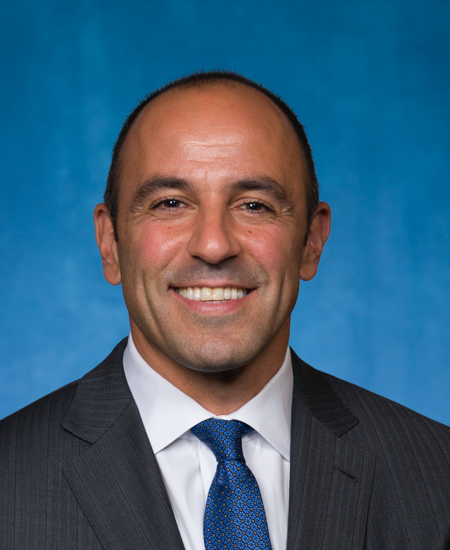
Rep. Jimmy Panetta
Sponsored bills
This resolution mourns the death of U.S. Capitol Police Officer Brian D. Sicknick, and it honors his lifelong commitment to service and his selfless acts of heroism on January 6, 2021.
This joint resolution honors the contributions of school counselors to the success of students in elementary and secondary schools. The resolution encourages the observation of National School Counseling Week with ceremonies and activities that promote awareness of the crucial role school counselors play in preparing students for fulfilling lives as contributing members of society.
This resolution calls for the federal government to establish a national biodiversity strategy, which must include a goal of conserving at least 30% of U.S. lands and waters to protect biodiversity and address climate change by 2030 and other goals necessary to reduce the threats to biodiversity.
Keeping the Lights On Act of 2021 This bill allows an eligible employer a payroll tax credit equal to 50% of a limited amount of qualified fixed expenses paid by such employer in a calendar quarter. Qualified fixed expenses include a mortgage, rent, or a utility payment. An employer is eligible for such payroll credit if the employer was carrying on a trade or business that had not more than 1,500 full-time employees or not more than $41.5 million in gross receipts in 2019. The employer's business must have been suspended in a calendar quarter due to COVID-19 (i.e., coronavirus disease 2019) and have experienced a significant decline in gross receipts due to that pandemic. The credit may not be claimed by the federal government or by any state or tribal government, or by U.S. possessions, but may be claimed by tax-exempt organizations.
Global Health, Empowerment and Rights Act This bill establishes that a foreign nongovernmental organization shall not be disqualified from receiving certain U.S. international development assistance solely because the organization provides medical services using non-U.S. government funds if the medical services are legal in both the United States and the country in which they are being provided. Such foreign organizations shall not be subject to requirements relating to their use of non-U.S. funds for advocacy or lobbying activities, other than those that apply to U.S. nongovernmental organizations. Current U.S. policy prohibits various foreign assistance from going to a foreign nongovernmental organization unless it agrees to not perform or actively promote abortions.
Pre-Apprenticeships To Hardhats Act or the PATH Act This bill directs the Department of Labor to provide grants to eligible entities to develop pre-apprenticeship programs in the building and construction trades that serve underrepresented populations, including individuals from low income and rural census tracts.
Securing Access to Lower Taxes by ensuring Deductibility Act or the SALT Deductibility Act This bill repeals the temporary restrictions in taxable years 2018 through 2025 on the deductibility of state and local taxes.
Special Districts Provide Essential Services Act This bill makes special districts eligible for the Coronavirus Relief Fund and the Municipal Liquidity Facility program. Specifically, the bill makes special districts eligible for payments from amounts paid to states from any new appropriations to the fund. A special district must submit a request for payment to the state with information demonstrating that the special district has experienced or is likely to experience during the COVID-19 (i.e., coronavirus disease 2019) emergency reduced revenue or operational funding derived from provided services, taxes, fees, or other sources of revenue; reduced indirect funding from the federal government, the state, or a unit of general government below the state level; or as a result of the COVID-19 emergency, increased expenditures necessary to continue operations. The Board of Governors of the Federal Reserve System shall include special districts as eligible issuers in the Municipal Liquidity Facility program, which was created in response to the COVID-19 emergency to buy municipal securities.
Green Bus Tax Credit Act of 2021 This bill allows a manufacturer a zero-emission bus tax credit through 2026. The credit is equal to 10% of the sales price of a zero-emission bus. The credit only applies to the first $1 million of a vehicle's sales price and to buses used primarily in the United States and its possessions. The bill defines zero-emission bus as a motor vehicle that has a gross vehicle weight rating of not less than 14,000 pounds, is not powered or charged by an internal combustion engine, is propelled solely by an electric motor that draws electricity from a battery or fuel cell, and is designed to carry 15 or more passengers.