

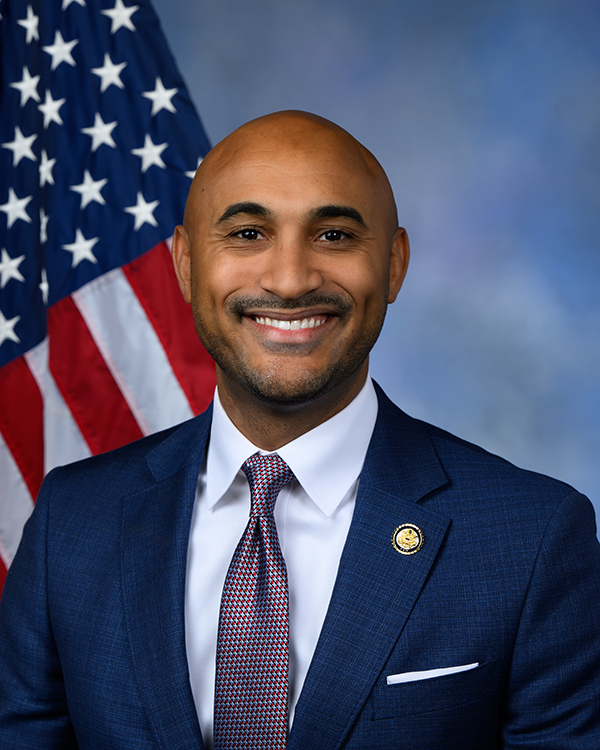
Photo of Shomari Figures
D United States House · District 2 · Alabama On the 2026 ballot

Rep. Shomari Figures

Compare
Total votes
650
all sessions
Attendance
98%
11 missed
Near the chamber average
With party
96%
of cast votes
Near the chamber average
Bipartisan score
2%
crosses aisle rarely
Near the chamber average
Sponsored
394
bills & resolutions
Near the chamber average
Committees
7
assignments
394 bills and resolutions

Sponsored bills

Total
394
Primary
25
Co-sponsor
369
This page
394
matching current filters
Co-sponsor HR 801
In committee · Delaware House · Co-sponsor
Charitable Act

Maddy summaryHR 801, the Charitable Act, creates a new tax deduction for individuals who do not itemize deductions on their federal tax returns. It allows these taxpayers to deduct up to one-third of their standard deduction amount for charitable contributions in 2026 and 2027. The bill directly affects non-itemizing individual taxpayers by providing a limited, direct deduction for charitable giving without requiring them to itemize. The deduction is capped at 1/3 of the standard deduction amount for those tax years, effective for returns filed in 2027 and 2028.

In committee Jan 28, 2025 1 co-sponsor
Co-sponsor HR 738
In committee · Delaware House · Co-sponsor
Universal Right To Vote by Mail Act of 2025

Maddy summaryHR 738, the Universal Right To Vote by Mail Act of 2025, would require all states to allow any voter to request and cast a mail-in ballot for federal elections without needing to provide a reason, directly affecting all voters in states holding federal elections. The bill prohibits states from adding extra conditions beyond ballot request and return deadlines, and mandates that election officials must notify voters of signature discrepancies or missing information within one business day, giving them three days to correct errors before ballots are rejected. It explicitly preserves states' ability to maintain in-person polling places and applies to federal elections starting in 2026. The bill cites findings that universal mail-in voting increases participation, reduces poll wait times, and has no proven fraud risk, while eliminating requirements for personal justification or notarization.

In committee Jan 24, 2025 1 co-sponsor
Co-sponsor HR 608
In committee · Delaware House · Co-sponsor
COVER Now Act

Maddy summaryThe COVER Now Act allows cities, counties, or other local governments in states that have not expanded Medicaid to provide health coverage to Medicaid-eligible residents. Local governments in non-expansion states can apply for a federal demonstration project to cover these residents, with the federal government paying 90-100% of costs over seven years (starting at 100% for the first three years). The bill prohibits states from retaliating against localities that participate, such as by shifting costs, reducing funding, or blocking healthcare provider participation. This directly affects uninsured residents in non-expansion states and local governments seeking to fill coverage gaps.

In committee Jan 22, 2025 1 co-sponsor
Co-sponsor HR 539
In committee · Delaware House · Co-sponsor
Chiropractic Medicare Coverage Modernization Act of 2025

Chiropractic Medicare Coverage Modernization Act of 2025 This bill expands Medicare coverage of chiropractic services to include all services provided by chiropractors, rather than only subluxation corrections through manual manipulation of the spine.

In committee Jan 16, 2025 1 co-sponsor
Co-sponsor HR 516
In committee · Delaware House · Co-sponsor
To amend the Internal Revenue Code of 1986 to modify the railroad track maintenance credit.

This bill increases the annual limit on the tax credit for qualified railroad track maintenance expenses (also referred to as the short line railroad tax credit) and expands eligibility for claiming the credit. Under current law, the tax credit is limited each tax year to $3,500 multiplied by the sum of the number of miles of railroad track owned or leased by the taxpayer (miles owned or leased) and the number of railroad track miles assigned to the taxpayer by a Class II or III railroad (miles assigned). This bill increases the annual limit to $6,100 multiplied by the sum of miles owned or leased and miles assigned. The $6,100 amount used in the calculation of the tax credit limit is adjusted for inflation for tax years beginning after 2025. The bill also expands eligibility for the tax credit to include gross expenses for maintaining railroad tracks owned or leased as of January 1, 2024. Under current law, the tax credit is limited to gross expenses for maintaining railroad tracks owned or leased as of January 1, 2015.

In committee Jan 16, 2025 1 co-sponsor
Co-sponsor HR 485
In committee · Delaware House · Co-sponsor
Muhammad Ali Congressional Gold Medal Act

Maddy summaryHR 485, the Muhammad Ali Congressional Gold Medal Act, authorizes Congress to award a gold medal in recognition of Muhammad Ali's lifetime contributions to sports, civil rights, and humanitarian causes. The bill directs the Treasury Secretary to strike the medal and present it to Ali's widow, Lonnie Ali, following his death in 2016. It also permits the sale of bronze duplicates to cover costs, with proceeds going to the U.S. Mint. This is a commemorative measure with no policy impact, solely honoring Ali's legacy through a symbolic medal.

In committee Jan 16, 2025 1 co-sponsor
Co-sponsor HR 486
In committee · Delaware House · Co-sponsor
Young Americans Financial Literacy Act

Maddy summaryHR 486, the Young Americans Financial Literacy Act, authorizes $27.5 million to $55 million annually through 2029 to fund competitive grants for centers of excellence focused on financial literacy education for individuals aged 8-24. These centers, established by eligible institutions like schools, nonprofits, or financial organizations, must develop research-based programs covering budgeting, debt management, student loan guidance, and avoiding pitfalls like predatory lending. The bill specifically requires programs to address at-risk populations, include evidence-based teaching methods, and serve groups such as high school graduates, college students, young families, and military personnel. It mandates annual reporting to Congress on grant recipients and the populations they serve, with funding ending in 2029.

In committee Jan 16, 2025 1 co-sponsor
Co-sponsor HR 429
In committee · Delaware House · Co-sponsor
Rosie the Riveter Commemorative Coin Act

Maddy summaryHR 429, the Rosie the Riveter Commemorative Coin Act, authorizes the U.S. Treasury to mint and sell three types of commemorative coins ($5 gold, $1 silver, and half-dollar) to honor women who worked on the U.S. home front during World War II. The coins will be sold at face value plus surcharges ($35 for gold, $10 for silver, $5 for half-dollar), with all surcharge revenue directed to the Rosie the Riveter Trust to support the Rosie the Riveter WWII Home Front National Historical Park and related educational programs. The coins must be issued between January 1, 2028, and December 31, 2028, in specified quantities (50,000 gold, 400,000 silver, 750,000 half-dollar), with all costs covered by the sales revenue to avoid net government expense.

In committee Jan 15, 2025 1 co-sponsor
Co-sponsor HR 433
In committee · Delaware House · Co-sponsor
Department of Education Protection Act

Maddy summaryHR 433, the Department of Education Protection Act, prohibits the use of federal funds to reorganize the Department of Education. Specifically, it blocks any spending from current fiscal year appropriations on activities that would decentralize the department, reduce staffing, or alter its structure, responsibilities, or authority relative to its organization as of January 1, 2025. The bill directly affects the Department of Education by preventing structural changes to its existing offices and operations. This is a procedural measure focused solely on preserving the current departmental framework, not on changing education policy or funding.

In committee Jan 15, 2025 1 co-sponsor
Co-sponsor HRES 23
In committee · Delaware House · Co-sponsor
Proxy Voting for New Parents Resolution

Maddy summaryThe Proxy Voting for New Parents Resolution (HRES 23) would allow U.S. House Members who have given birth or whose spouse has given birth to appoint another Member as a proxy to cast their vote or record their presence in the House and committees for up to 12 weeks after childbirth. To use this, the new parent must submit a signed letter to the Clerk detailing the birth or medical condition and naming the proxy; the proxy must vote exactly as instructed and announce the vote as "by proxy." The proxy vote does not count toward quorum, and the new parent can revoke the proxy at any time by submitting a new letter or casting their own vote. This resolution applies to all House Members, including Delegates and the Resident Commissioner, though they cannot cast votes for the House itself.

In committee Jan 9, 2025 1 co-sponsor
Showing 381 to 390 of 394 bills