

This Act prohibits food establishments from providing consumers with ready-to-eat food or beverages in polystyrene foam containers or with single-service plastic coffee stirrers, cocktail picks, or sandwich picks. It also prohibits food establishments from providing single-service plastic straws, unless requested by a consumer. These restrictions take effect on July 1, 2025. This Act provides the following exemptions to the prohibitions on single-service plastic implements and polystyrene foam containers: 1. The definition of "polystyrene foam food service packaging" excludes coolers or ice chests used for the processing or shipping of seafood and containers used to contain, transport, or package raw, uncooked, or butchered meat, poultry, fish, seafood, eggs, fruits, or vegetables. 2. The prohibition on plastic straws does not apply to patients or residents of hospitals or long-term care facilities and for plastic straws that are attached to pre-packaged goods, such as juice boxes. 3. The restriction on providing ready-to-eat food in polystyrene foam food service packaging does not apply to any of the following: • Fire companies. • Health-care providers that provide long-term, acute, and outpatient health-care services. • Nonprofit organizations, including religious institutions. This Act also makes technical corrections to conform existing law to the standards of the Delaware Legislative Drafting Manual.
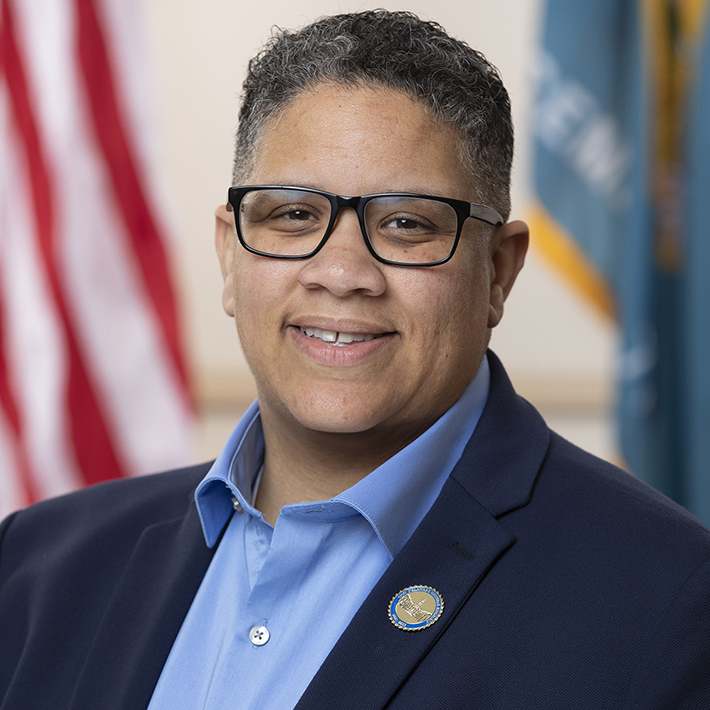
Rep. Kerri Harris
Sponsored bills
This Act amends Chapter 25, Title 24 of the Delaware Code relating to the Practice of Pharmacy. The amendments authorize pharmacists to engage in “collaborative pharmacy practice” with one or more “practitioners” meaning individuals who are authorized by law to prescribe drugs in the course of professional practice. Pharmacists may also do so pursuant to a “collaborative pharmacy practice agreement,” which means a written and signed agreement between one or more pharmacists and one or more practitioners that provides for a collaborative pharmacy practice.
The National Suicide Hotline Designation Act of 2020 established 988 as the universal phone number for "the national suicide prevention and mental health crisis hotline system operating through the National Suicide Prevention Lifeline." This Act provides the framework to maximize the benefits of 988 and provide crucial support to Delawareans in need through the implementation of a practical, modern, and comprehensive, integrated crisis care system. This Act is a second substitute for House Bill No. 160. Like House Bill No. 160 this Act does the following: (1) Created the Behavioral Health Crisis Services Board (“Board”) to provide oversight and input on the development of an integrated behavioral health crisis care system in this State. (2) Imposes a behavioral health crisis intervention services surcharge on business and residential telephone services, wireless telephone services, and prepaid wireless telephone services. The surcharge will create a dedicated funding source for behavioral health crisis services. The Behavioral Health Crisis Intervention Services Fund is created to receive the surcharge funds. Specifically, this Act establishes a 60-cent per month per line fee on phone lines and a 60-cent one-time fee on prepaid services. Like House Substitute No. 1 to House Bill No. 160, this Act does all of the following: (1) Models the behavioral health crisis intervention services surcharge after the existing E-911 surcharge and prepaid wireless E911 surcharge created under Chapter 101 of Title 16 of the Delaware Code. (2) Removes the creation of the Behavioral Health Crisis Communication Center and instead directs the Board to develop and recommend a plan for establishing, operating, and maintaining a behavioral health crisis communications center. The Board must submit the plan to the Governor and General Assembly within 12 months from the effective date of this Act. (3) Makes changes to the definition of “mobile crisis team”. (4) Makes changes to the composition of the Board to add the Executive Director of the Ability Network of Delaware and the Executive Director of each of Delaware’s Lifeline Centers. This Act differs from House Substitute No. 1 to House Bill No. 160 as follows: (1) Exempts State government from the behavioral health crisis intervention services surcharge. (2) Removes a provision that would permit an increase in the behavioral health crisis intervention services surcharge collected for prepaid wireless telecommunication services if the General Assembly increased the behavioral health crisis intervention services surcharge collected for residential and business telephone service, wireless service, and nontraditional communication service. (3) Removes the “crisis intervention service” definition. (4) Removes "Providing crisis intervention services." from the list of eligible expenditures for the Behavioral Health Crisis Intervention Services Fund and replaces it with "Establishing, operating, or contracting for crisis teams for adults and children.". This Act requires a greater than majority vote for passage because § 11 of Article VIII of the Delaware Constitution requires the affirmative vote of three-fifths of the members elected to each house of the General Assembly to impose or levy a tax or license fee
This Act permits an individual who is a reproductive health care services provider or employee to apply for participation in Delaware's Address Confidentiality Program, which allows participants to keep their actual address confidential by applying to the Department of Justice for a substitute address to which all mail will be delivered. This Act also makes technical corrections to conform existing law to the standards of the Delaware Legislative Drafting Manual.
This Act directs the State’s current needle exchange program to take a needs-based approach. This Act also makes technical corrections to conform existing law to the standards of the Delaware Legislative Drafting Manual.
This Act requires that each county reassess the value of real property in the county at least once every 5 years. The first 5-year period starts when the reassessment currently being conducted by each county is completed. This Act also makes revisions to conform existing law to the standards of the Delaware Legislative Drafting Manual and for consistency with current law and terminology as follows: 1. Because boards of assessment are not responsible for assessing property in any of the counties under current law, this Act repeals the penalty under § 8306 of Title 9 against a board of assessment that knowingly and wilfully assesses property at an incorrect value and corrects references to a county Department of Finance instead of the board of assessment in § 8307 of Title 9. 2. Requires that real property be assessed at its “present fair market value” instead of at its “true value in money.” Delaware courts have established that the “true value in money” for real property means its “present fair market value”, which is the terminology that is currently used.
This Act allows a practitioner with the authority to prescribe medication to give the unused portion of topical medication used during treatment to a patient upon discharge or the conclusion of the visit. This Act is based on the Model Act created by the American Academy of Ophthalmology, which has been adopted in Illinois. During a procedure, practitioners may use only a few drops or small amount of medication from a container. Because regulations governing the ability to dispense the remaining portion of stock-item medications can be unclear or appear overly burdensome, many facilities do not allow the practitioner to dispense that container to the patient to take home with them. Instead, the practitioner must write a prescription for the patient and the medication that remains in the container is discarded. By allowing patients to take home provider-dispensed medication, this Act reduces waste and health-care costs and by eliminating the extra burden of going to the pharmacy to fill a prescription, this Act will better ensure medication compliance. This Act is known as "The Topical Medical Waste Reduction Act". This Act also makes technical corrections to conform existing law to the standards of the Delaware Legislative Drafting Manual.
This Act requires that doula services be covered by Medicaid in Delaware by January 1, 2024. It follows up on HB 343 from the 151st General Assembly which required the Division of Medicaid and Medical Assistance to submit a plan for implementing this coverage, and draws on that completed report.
This Act requires physicians who are discontinuing business, leaving the State, or terminating a patient-physician relationship for any other reason to notify affected patients at least thirty days prior to the discontinuation of services via first class mail and an electronic message if electronic communication is available. It removes the requirement that physicians ending a patient-physician relationship publish a notice in a newspaper of daily circulation. Notice sent to patients must include information about how the patient may obtain their medical records and information about other physician services in the area that are available to patients who will require continued medical care. This Act further adds that a patient receive notice by electronic message, if available, when a physician dies and has not transferred patient records to another health-care provider. Finally, this Act makes technical changes to create consistency with those sections being amended by SB 74 of the 152nd General Assembly, relating to the transfer of medical records in other health-care professions.
This Act revamps the Council on Police Training, by changing the name of the Council to the Police Officer Standards and Training Commission (or POST) and amending its powers and duties to: (1) more accurately reflect the dual role of establishing training standards for Delaware police officers as well as overseeing allegations of police officer misconduct and conducting hearings for possible suspensions or de-certifications; (2) untethering the Council from the Delaware State Police by deleting the requirement that the Director of the Delaware State Police Academy is responsible for education and training in connection with the Council’s duties and responsibilities; (3) removing the requirement that discipline proceedings be tied to whether the employing department takes action against the officer and increasing the instances when discipline can be issued; (4) advising the Delaware Police Accreditation Commission regarding statewide accreditation standards; (5) issuing guidelines for local police oversight commissions or boards. The Bill improves transparency by increasing required meetings from two to four per year, clarifying that decisions of disciplinary panels are public documents, requiring that departments form public accountability commissions with non-officer members, and requiring a public comment period and an official website with publication of pertinent records and documents of the POST. By amending the definition of “police officer,” the bill also requires that officers employed only part-time are subject to the regulatory oversight of the POST. The Bill proposes that the Council’s day-to-day functions be provided through professionals retained by the Department of Safety and Homeland Security. Finally, the Bill makes minor technical and other non-substantive changes, including deleting outdated provisions of the Code. This includes striking the provision that required body-worn camera standards to be in place by 2022 – since those regulations are now in place – and instead requiring the POST to “periodically review and propose updates as needed to regulations and standards” for body-worn cameras in cooperation with other stakeholders. Sections 2 through 16 make conforming changes to other parts of the Code that referenced the Council on Police Training.