

This Act creates a new Delaware Nursing Advancement Fund (Fund) for purposes of funding a nonprofit that will maintain information and conduct studies about the nursing workforce, advance the profession of nursing, monitor trends in the nursing applicant pool, facilitate partnerships, educate the public about opportunities and careers in nursing, and distribute information about the nursing workforce. Money for the Fund will come from a $10 fee on initial and renewal applications to the Board of Nursing, as well as any disciplinary fines. The Division of Professional Regulation will make a grant award to a nonprofit to accomplish the purposes of the Fund. This Act requires a three-fourths majority vote for passage because of the requirements of Section 4, Article VIII of the Delaware Constitution.
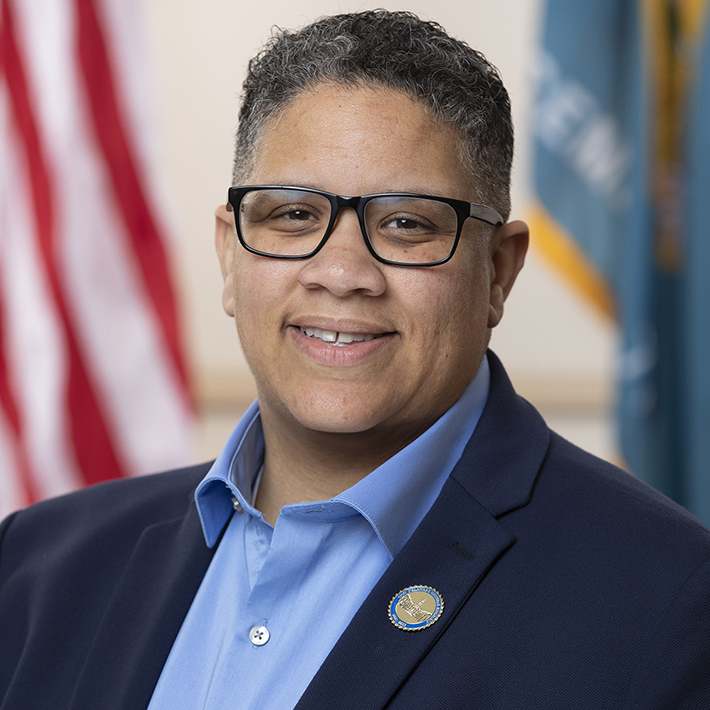
Rep. Kerri Harris
Sponsored bills
This Act extends the Clean Air Act Title V Operating Permit Program annual fees for facilities in Delaware, which have historically expired and been reauthorized by the General Assembly every 3 years. Existing statutory authorization to collect fees sunsets December 31, 2026. This legislation updates the fee assessments based on the work of the Title V Operating Permit Program Advisory Committee and makes additional clarifying updates. For 2027-2029, the total fee will be comprised of a base fee, user fee, and a program fee. Base fees are based on the number of staff hours spent on the source’s permitting, compliance, and enforcement activities, while the user fee is based on the source’s air emissions. The program fee will be assessed based on the total base and user fees. This Act authorizes the Department of Natural Resources and Environmental Control to collect Title V annual fees for calendar years 2027 through 2029 at which point the authority sunsets and would need to be reauthorized.
In December 2025, the Code Revisors provided the General Assembly with a list of potential technical corrections that they identified as they revised the Delaware Code to reflect legislation that was enacted by the 153rd General Assembly in 2025 or as they reviewed titles of the Code. While technical in nature, these changes are beyond the authority of the Code Revisors to make and can only be done by the General Assembly through legislation. This Act also includes technical corrections identified outside of the list provided by the Code Revisors. This Act requires a greater than majority vote for passage to err on the side of caution because some of the sections of the Delaware Code being revised may require a super-majority vote under the Delaware Constitution. This Act also makes also makes basic technical corrections to conform existing law to the standards of the Delaware Legislative Drafting Manual. Section 1. This section corrects an error in § 1354(b)(4) of Title 4 from House Bill No. 110 of the 153rd General Assembly by deleting an extraneous “and” to make it clear that the specified limitations regarding marijuana establishment license applicant eligibility apply to any of among the directors, officers, board members, or such other person who holds an ownership interest of 10% or more in a licensed marijuana establishment or a business entity that is an applicant for a marijuana establishment Section 2. This section corrects an error in § 811(a)(3) of Title 11 from Senate Substitute No. 1 for Senate Bill No. 356 of the 126th General Assembly in misidentifying a paragraph reference from the Criminal Code of 1953 as a subsection reference. Section 3. This section corrects an error in § 917(a)(1) of Title 11 from House Bill No. 284 of the 142nd General Assembly by updating an internal reference to a defined term in 25 Del. C. § 7003(13) and by making a technical correction to conform existing law to the standards of the Delaware Legislative Drafting Manual style. Section 4. This section corrects an error in § 1301(d)(1) of Title 11 from Senate Bill No. 48 of the 153rd General Assembly by making clear that neither paragraph (a)(3)b.1. nor (a)(3)b.1. of that statute are violated if a parent of a student with and individualized education program is addressing a health or safety concern involving their student. Section 5. This section corrects an error in § 4201(c) of Title 11 from Senate Bill No. 285 of the 139th General Assembly by correcting the impression that rape crimes, as defined by present statutes, are not violent felonies. Section 6. This section corrects an error in § 9423(3)b. of Title 11 from Senate Substitute 1 for Senate Bill No. 17 of the 153rd General Assembly by inserting the missing words “have a right” in order to match context in introductory paragraph (3) of that statute. Section 7. This section corrects an error in § 1703(d)(3) of Title 14 from House Bill No. 1 from the 146th General Assembly by inserting a missing introductory paragraph for paragraph (d)(3)b. Section 8. This section corrects errors in § 3480(a)(7) and (g) of Title 14 from House Bill No.160 of the 153rd General Assembly by correcting syntax and punctuation in (a)(7) and revising grammar in (g) to prevent use of a double negative. Section 9. This section corrects a grammar error in the introductory paragraph of § 3124 of Title 16 from Senate Bill No. 273 of the 136th General Assembly. Section 10. This section inserts use of the Oxford comma in § 4908B of Title 16 as missing in Senate Bill No. 129 of the 153rd General Assembly. Section 11. This section adds § 5196B(d) of Title 16 which was inserted by House Bill No. 225 of the 153rd General Assembly without appropriate underlining. Section 12. This section corrects a style error in § 402(3) of Title 18 from Senate Bill No. 462 from the 138th General Assembly by deleting “(1)” following “§ 5901” as directed by the Delaware Legislative Drafting Manual. Section 13. This section corrects errors in § 3371 of Title 18 from House Bill No. 381 of the 148th General Assembly by making clear that the defined terms apply to the entire subchapter and by making stylistic changes as directed by the Delaware Legislative Drafting Manual. Section 14. This section corrects errors in § 3401 of Title 18 from Senate Bill No. 160 of the 135th General Assembly by inserting an introductory paragraph to this defined terms statute, and inserting Oxford commas, as directed by the Delaware Legislative Drafting Manual. Section 15. This section corrects a copy and paste error in § 3565A(b) of Title 18 from Senate Bill No. 207 of the 147th General Assembly by properly substituting “group and blanket” for “individual” and by making stylistic changes as directed by the Delaware Legislative Drafting Manual. Section 16. This section corrects errors in § 5901 of Title 18 from Senate Bill No. 46 of the 146th General Assembly and Senate Bill 154 of the 147th General Assembly by placing the defined terms in alphabetical order, redesignating them accordingly, standardizing language, and inserting Oxford commas as directed by the Delaware Legislative Drafting Manual. Section 17. This section adjusts internal references in § 5920(a) of Title 18 based upon corrections in Section 15 of this Act, which placed the defined terms in § 5901 of Title 18 in alphabetical order and redesignated them accordingly. Section 18. This section corrects an outdated reference in § 3116(a)(1) of Title 20, from House Bill No. 263 from the 139th General Assembly by substituting “Secretary of the Department of Safety and Homeland Security” for “Secretary of Public Safety.” Section 19. This section corrects an error in § 3102(d)(1) of Title 21 from Senate Bill No. 325 of the 140th General Assembly by updating a U.S. Code citation to the registration provisions in § 3 of the federal Military Selective Services Act. Section 20. This section makes grammar corrections, as directed by the Delaware Legislative Drafting Manual, to § 1799H(1), (2), (4), (7), and (8) of Title 24 as originally enacted by Senate Bill No. 259 of the 145th General Assembly. Section 21. This section corrects an error in § 2817(6)b. of Title 24 from House Bill No. 81 of the 153rd General Assembly by inserting the missing words “registrant status” following “the applicant’s IntPE” in the penultimate sentence. Section 22. This section corrects errors in § 7013(g)(1) of Title 25 from Senate Substitute 2 for Senate Bill No. 56 of the 153rd General Assembly by inserting language, regarding transactions to terminate the right to transfer manufactured home leases, which had been added in the bill without appropriate underlining of new insertions. Section 23. This section deletes stray language in § 8814(g) of Title 29 to correct an error which was created when House Substitute 1 for House Bill No. 1 of the 153rd General Assembly amended the subsection without taking into account prior amendments to the subsection by both House Bill No. 437 of the 152nd General Assembly and Senate Bill No. 169 of the 153rd General Assembly. Section 24. This section corrects a punctuation error in the Charter of the Town of Dewey Beach from Senate Bill No. 121 of the 153rd General Assembly. Section 25. This section corrects an insertion underlining error in the Charter of the City of Harrington from Senate Bill No. 183 of the 153rd General Assembly. Section 26. This section corrects strike-through and underline errors in the Charter of the Town of Houston from Senate Bill No. 171 of the 153rd General Assembly. Section 27. This section corrects an insertion underlining error in the Charter of the City of Milford from House Bill No. 146 of the 153rd General Assembly. Section 28. This section corrects an insertion underlining error in the Charter of the Town of Millsboro from House Bill No. 25 of the 153rd General Assembly.
This Act clarifies that penalties associated with section 4512 of Title 21, relating to truck parking, are applicable to parking violations in both residence and non-residence districts. This Act further clarifies that truck tractors (with and without attached trailers) may be prohibited from stopping, standing, or parking on highways in the same manner as trailers and semitrailers.
This Substitute differs from Senate Bill No. 289 by retaining the State Treasurer as a member of the State Employee Benefits Committee (Committee) and making the Secretary of the Department of Human Resources a nonvoting member. Like SB 289, this Act allows the appointed members of the Committee to select designees to attend Committee and subcommittee meetings, as is currently allowed for Committee members serving by virtue of position. This change does not apply to meetings of the Retiree Healthcare Benefits Advisory Subcommittee. The authority that appointed the member must approve the appointed member’s proposed designee and the appointed member must provide that written approval to the Committee chair or subcommittee chair, as applicable. In addition, this Act makes the Controller General a voting member of the Committee. This Act also adds the Chair of the Delaware Health Care Commission to the Committee and designates that individual as the Chair of the Committee. Further, this Act makes the Director of the Office of Management and Budget, who currently chairs the Committee, a regular voting member. This Act clarifies that proposal review committees are subcommittees and clarifies that the membership or attendance of a quorum of Committee members on or at a subcommittee meeting does not constitute a meeting of the Committee. The Act requires that official action by a subcommittee requires a roll call vote.
This Act clarifies that security film is distinct from ballistic-resistant materials, and adds that school construction will satisfy the requirements of § 2306(b) if ballistic-resistant materials are used in the required locations. This Act also makes technical corrections to conform existing law to the standards of the Delaware Legislative Drafting Manual.
This Act safeguards elections in this State by strengthening fairness and impartiality in both the conduct of elections and the enforcement of election laws. Election protections are strengthened because this Act updates Title 15 so that the terms and procedures reflect modern vocabulary, technology, and best practices. Most of the revisions in this Act are technical, clarifications, or conform existing law to current practices in regard to determining an individual’s place of residence, requirements for electronic voting system software, performing audits of election results, and adjudicating or curing deficient absentee ballots. Section 1 revises the terms and definitions for Title 15 as follows: • Repeals obsolete terms. • Revises current terms and definitions to accurately reflect the organization of the Department of Elections (Department), the use of electronic voting systems, and conform to drafting standards. • Adds additional defined terms that are already used in Title 15, to provide consistency and clarity in this State’s election laws. Section 1 also codifies how the Department determines residency for purposes of registering to vote and to be a candidate for office in a new § 103 of Title 15. This new section provides that an individual’s place of residence is fixed and is a place that the individual physically inhabits and requires that residence be broadly construed to provide all eligible voters with the opportunity to participate in the democratic process. This section specifically provides for all the following: • An individual’s place of residence when the individual’s sleeping area or place of habitation is not a traditional residence associated with real property. • An individual does not lose their place of residence if the individual intends to return after an absence, such as for education, military service, incarceration, or obtaining or providing medical care. • If an individual maintains possession of the individual’s place of residence, obtaining a secondary residence is not prima facia evidence of a change in residence. • An individual’s residence changes and the individual forms a new residence if the individual inhabits a new location with the intent to remain there indefinitely, registers to vote based on residence at a new location, or votes based on residence at a new location. • How a dispute regarding an individual’s place of residence is determined and appealed. Section 2 updates the requirements for electronic voting systems to incorporate best practices and increase the clarity of these requirements. The increased clarity provides transparency regarding both the Department’s compliance with these requirements and the accuracy of election results. The current requirements were enacted in 2019 (82 Del. Laws, c. 170) to provide a framework to use when the current electronic voting devices were first acquired. These voting devices have now been used in several election cycles so the requirements can be updated to reflect that experience and the ongoing improvements to voting technology. Specifically, these updates: • Transfers Chapter 50A of Title 15 to Chapter 50 of Title 15. • Provide for the designation of the software, which includes the version of that software, that must be installed on voting devices before each statewide general election. • Expands the criteria that must be considered when designating the software that must be used on voting devices, including the experiences of other jurisdictions that have already used the software. The expanded criteria also provides certainty and stability instead of relying on the continued existence of a federal certifying entity. • Requires that no later than July 1 of an odd numbered calendar year, the State Election Commissioner (Commissioner) must designate the software required for the next statewide general election and that this software can be used for elections held during the next 2 years. • Explicitly allows the Commissioner to change the designated version of voting device software if necessary to address a material security flaw in the previously designated software. • Transfers the requirements under § 4508 of Title 15 to § 5010(a)(1)b. of Title 15. • Consolidates notice requirements under § 5010 of Title 15 for when voting devices will be tested and repeals language about party designees that is obsolete because this testing is open to the public. • Revises current law that is confusing or imprecise, including dividing the current audit section into 4 sections. The first audit section, § 5014, provides the audit requirements that are applicable to all audits of elections results (audits). The following 3 sections provide the requirements for audits after elections for specific offices: § 5015 applies to state or county offices, § 5016 applies to City of Wilmington offices, and § 5017 applies to school district elections. • Repeals provisions that unnecessarily repeat requirements in other sections. Section 3 updates § 4972(b) of Title 15 to align with the use of modern scanning devices, to reflect that absentee ballots are the only hand-marked paper ballots that are used in all elections, and to use the updated defined terms in Section 1 of this Act. Section 3 also codifies the current procedure used to adjudicate votes on an absentee ballot if the ballot scanning device is unable to determine the voter’s intent and connects the rules under § 4972(b) with the procedures for tabulating absentee ballots under § 5510 of Title 15. Section 4 revises Chapter 55 of Title 15 to codify the procedures the Department currently follows under Regulation 200 of Title 15 of the Delaware Administrative Code when an absentee ballot is deficient. This procedure requires that the Department indicate on the ballot envelope that the ballot is deficient and to offer the voter an opportunity to cure certain deficiencies before the polls close on the day of the election, allowing the ballot to be counted. Section 4 also revises § 5510(d)(1)b. by adding a reference to the rules for adjudicating absentee ballots under § 4972(b) of Title 15. Sections 5 through 9 of this Act make corresponding changes to other sections in Title 15 to align with the revisions made under Sections 1 and 2 of this Act and modern election practices. Specifically, Section 5 makes corresponding changes to the defined terms regarding candidate residency in § 3114 of Title 15 to align with the revisions under Section 1 of this Act. Section 6 repeals the sentence in § 4508 of Title 15 because it is transferred to § 5010(a)(1)b. of Title 15. Section 7 aligns the language regarding an individual voter’s place of residence in § 4941 of Title 15 with the revisions under Section 1 of this Act. Section 8 revises § 4948 of Title 15, regarding provisional ballots, as follows: • Makes corresponding changes to the defined terms to align with the revisions in Section 1 of this Act. • Makes technical changes to be consistent with existing law, such as clarifying where a different procedure is followed for primary elections and repealing confusing language. • Repeals the requirement that provisional ballots are required when a court orders a polling place to be kept open beyond the normal time for closing so that people voting under that court order can vote for all offices on the ballot. Section 9 revises § 4980 of Title 15 to reference the transferred and revised audit requirements in Chapter 50 of Title 15. Finally, all Sections of this Act include technical corrections to conform existing law to the standards of the Delaware Legislative Drafting Manual.
This Act provides that the Director of the Office of Management and Budget must designate 1 or more reserved parking spaces for pregnant persons at certain designated state buildings and facilities. It also prohibits stopping, standing, or parking in the pregnant person’s space. Violations of this Act are exempted from the civil penalty for parking violations that exists in Title 21. This Act takes effect 6 months after its enactment into law. This Act also makes technical corrections to conform existing law to the standards of the Delaware Legislative Drafting Manual.
This Act adds any act that contains the characteristics of a hate crime to the definitions of crimes for the purposes of the Victims Compensation Assistance Program.
This Act increases the voting membership of the State Farmland Advisory Committee from 3 members to 7 members. The Act also adds 3 non-voting members to the Committee who are officials with the Assessment Divisions/Departments of New Castle, Kent, and Sussex Counties. The Delaware State Department of Finance shall provide reasonable staff support to assist the Committee in performing its duties. The Committee shall, at least once every 2 years, review its valuation formula and methodology utilized to determine the ranges of fair values for agricultural, horticultural, and forestry land and make such changes and revisions as are required to ensure that the objectives of the Act are met. The formula used by the Committee shall be based on not less than the preceding 20 years of land values. The Committee must publish an annual report containing its determinations and any review of its farmland valuation formula and methodology.