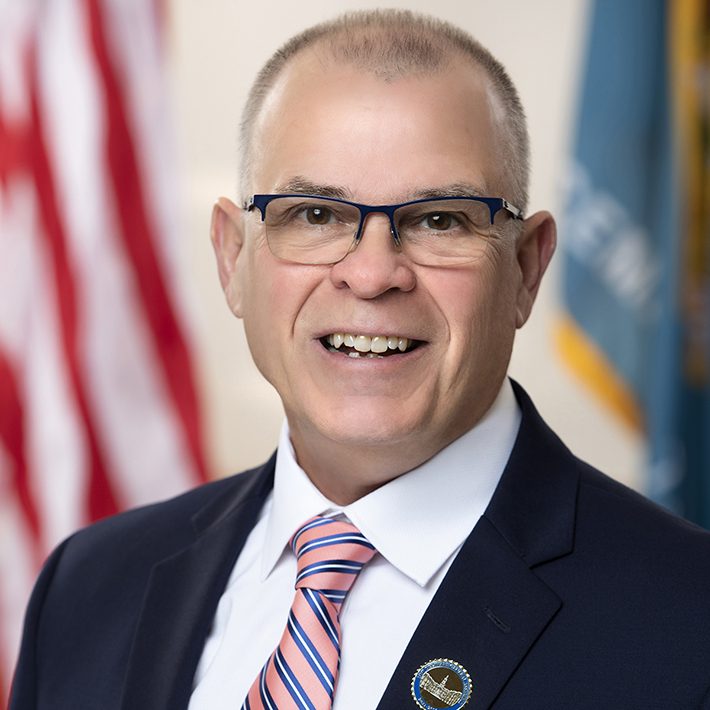
Photo of Ed Osienski
D Delaware House · District 24 On the 2026 ballot

Rep. Ed Osienski

Compare
Total votes
2,772
all sessions
Attendance
99%
18 missed
Higher than 91% of chamber peers
With party
99%
of cast votes
Higher than 90% of chamber peers
Bipartisan score
0%
crosses aisle rarely
Lower than 91% of chamber peers
Sponsored
1,277
bills & resolutions
Higher than 80% of chamber peers
Committees
8
assignments
1,277 bills and resolutions

Sponsored bills

Total
1,277
Primary
749
Co-sponsor
528
This page
1,277
matching current filters
Primary SCR 125
Passed · Delaware Senate · Lead sponsor
RECOGNIZING JANUARY 9, 2026, AS "LAW ENFORCEMENT APPRECIATION DAY" IN THE STATE OF DELAWARE.

Maddy summarySCR 125 is a ceremonial resolution designating January 9, 2026, as "Law Enforcement Appreciation Day" in Delaware. It formally recognizes and honors law enforcement officers across the state through a designated day of acknowledgment. This resolution does not create new laws or alter policies; it solely serves to express state-level appreciation. The measure passed unanimously in both legislative chambers on January 13, 2026.

Passed Jan 13, 2026 0 co-sponsors
Primary HB 255
Signed into law · Delaware House · Lead sponsor
AN ACT TO AMEND TITLE 30 OF THE DELAWARE CODE RELATING TO CORPORATE AND PERSONAL INCOME TAX.

This Act decouples select provisions of Delaware’s tax code from provisions of Public Law 119-21, also known as the federal “One Big Beautiful Bill Act” (OBBBA). Absent legislative action, most provisions of federal tax law are automatically incorporated into Delaware’s tax law. This Act does not eliminate depreciation of property or expensing, but instead modifies the timing of deductions that were impacted by the OBBBA. For corporations taxed as separate entities, commonly called “C corporations,” this Act does the following: (1) Continues expensing provisions for domestic research and experimental expenditures made after December 31, 2021, but on or before December 31, 2025, under the provisions in place before the OBBBA. (2) Decouples from the OBBBA provision for full expensing of certain business property acquired and placed in service after January 19, 2025. (3) Decouples from the special depreciation allowance for qualified production property. For individuals with business income such as an S corporation or a partnership, the following changes are made to Delaware’s personal income tax code, beginning January 1, 2026: (1) Decoupling from the OBBBA allowance for full expensing for certain business property acquired and placed in service after December 31, 2025. (2) Decoupling from the special depreciation allowance for qualified production property acquired and placed in service after December 31, 2025.

Signed into law Nov 19, 2025 0 co-sponsors
Primary SB 206
Signed into law · Delaware Senate · Lead sponsor
AN ACT TO AMEND CHAPTER 135 OF VOLUME 85 OF THE LAWS OF DELAWARE RELATING TO THE DEADLINE FOR PAYMENT OF PROPERTY TAX BILLS FOR THE 2025-2026 TAX YEAR.

An extension of the deadline for payment of property tax bills in New Castle County for the 2025-2026 tax year established under Chapter 135 of Volume 85 of the Laws of Delaware (House Bill No. 242, as amended by House Amendment 1, of the 153rd General Assembly) is required because property tax invoices could not be timely delivered due to subsequent, unforeseen expedited litigation before the Court of Chancery (Newark Property Association, et al. v. State of Delaware, et al., C.A. No. 2025-1031-LWW). The current deadline is November 30, 2025, however this Act changes the deadline to December 31, 2025, to ensure that taxpayers have a commercially reasonable period to review and pay property tax invoices and to help prevent the inequitable imposition of statutorily-mandated penalties and interest.

Signed into law Nov 14, 2025 0 co-sponsors
Primary HR 19
Passed · Delaware House · Lead sponsor
AMENDING THE RULES OF THE HOUSE OF REPRESENTATIVES OF THE 153RD GENERAL ASSEMBLY RELATING TO REMOTE PARTICIPATION IN SPECIAL SESSION.

This House Substitute for House Resolution No. 19, like the original, changes the Rules of the House of Representatives of the 153rd Assembly by permitting remote attendance and participation by members at a special session, so long as a quorum of the House is physically present in Dover. Authorization of the Speaker of the House is required for remote participation. The definition of “special session” in this substitute differs in that for purposes of remote participation by a member, it is only allowed “during any portion of the calendar year that does not fall between the second Tuesday in January and the first day of July.” The original House Resolution would have included a special session after 5:00 p.m. on June 30 as well. The definition of “special session” includes a convening of the General Assembly under § 16 of Article III of the Delaware Constitution. This substitute also differs from the original in that if the Speaker denies a request to participate remotely, the Speaker must include the reason for the denial in the Speaker’s written response. It also requires that a member participating remotely must appear on camera when voting or responding to an attendance roll call.

Passed Nov 13, 2025 0 co-sponsors
Primary SB 102
Signed into law · Delaware Senate · Lead sponsor
AN ACT TO AMEND TITLE 24 OF THE DELAWARE CODE RELATING TO THE BOARD OF ELECTRICAL EXAMINERS.

This Act would limit the opportunity to remain as a licensed apprentice electrician after an individual has already completed an apprentice program approved by the Board of Electrical Examiners. Apprenticeship is meant to be a first step on a career journey, not a destination. Since the apprentice electrician license was created, the ranks of apprentices have steadily swollen, but a significant number of those apprentices have not moved forward toward more advanced licensing. As the number of these apprentices grows beyond the capacity for more senior licensees to supervise their work, the situation is likely to create confusion among and to threaten the safety of consumers of electrical services in Delaware and the general public. This bill also makes technical corrections to conform existing law to the standards of the Delaware Legislative Drafting Manual.

Signed into law Sep 25, 2025 0 co-sponsors
Primary HB 67
Signed into law · Delaware House · Lead sponsor
AN ACT TO AMEND TITLE 21 OF THE DELAWARE CODE RELATING TO THE REMOVAL OF MOTOR VEHICLES FROM PRIVATE OR PUBLIC PROPERTY BY PRIVATE TOW COMPANIES.

This Act creates a new chapter in Title 21 pertaining to the towing of vehicles without the consent of the owner or operator. It makes violations of the chapter an unlawful practice enforceable by the Consumer Protection Unit of the Department of Justice. The Act creates the following requirements for the towing and storage of vehicles without the consent of the owner or operator: Photographic evidence must be taken to document the unauthorized parking of a vehicle before it may be towed, and written authorization to tow a specific vehicle is required before the vehicle may be towed from a private parking area. Tow companies and storage facilities must publicly display their rates. Towing and storage rates must be reasonable, with reasonableness calculated in relation to the fees imposed by the companies for consensual towing and storage or based on average rates in the county. A maximum total towing rate of $250 and daily storage rate of $50 is imposed. Tow companies must decouple or drop vehicles that have not been removed from parking areas if the owner returns before removal. The drop fee may not be more than 50% of the tow fee. Storage facilities must be open or accessible to the public from 8 a.m. to 6 p.m. five days a week, and tow companies must make reasonable accommodations to redeem vehicles after-hours. Individuals must be allowed to retrieve at no cost during business hours personal belongings from vehicles held in storage. Storage facilities may charge a fee of up to $50 for after-hours access to or retrieval of a vehicle. Tow companies and storage facilities must accept credit cards, or have an ATM available with a reasonable access or service fee. Where a tow is completed in violation of the chapter, the owner or operator is entitled to both reimbursement of the tow and storage fees as well as damages incurred to retrieve an illegally towed vehicle. Tow companies may not patrol for illegally parked cars, unless they have a contract to do so and comply with the requirements applicable to any other unauthorized towing of a vehicle. Tow companies may not pay or give other benefits to obtain information about cars parked without authorization.

Signed into law Sep 25, 2025 0 co-sponsors
Primary SB 143
Signed into law · Delaware Senate · Lead sponsor
AN ACT TO AMEND TITLE 12 OF THE DELAWARE CODE RELATING TO FIDUCIARY ACCESS TO DIGITAL ASSETS AND DIGITAL ACCOUNTS.

Ohio recently adopted “Braden’s Law”, named after Braden Markus. Braden, a high school student, tragically took his own life after being coerced into sharing sensitive photographs online and then threatened with release of the photographs on social media if he did not pay money. Braden’s parents, Jenn and Jarod, endured months of anguish after being denied access to Braden’s personal cell phone records. In response, part of Braden’s Law requires courts to adjudicate a parent or legal guardian’s request for an order directing access to a deceased minor’s digital assets and digital accounts within 30 days. In Delaware, a fiduciary can access to digital assets and digital accounts under Chapter 50 of Title 12. A fiduciary must send to the custodian of digital assets or digital accounts a valid written request for access. The custodian must comply with the valid written request within 60 days. If the custodian fails to comply, the fiduciary can ask the Court of Chancery (the “Court”) for an order directing the custodian to grant access to the digital assets. If the fiduciary seeking access to a digital asset or digital account is a parent or legal guardian of a minor deceased account holder, this Act requires the Court to treat the application as expedited and aim to resolve the application within 30 days after the application is filed. This Act also makes technical corrections to conform existing law to the standards of the Delaware Legislative Drafting Manual.

Signed into law Sep 19, 2025 0 co-sponsors
Primary SB 142
Signed into law · Delaware Senate · Lead sponsor
AN ACT TO AMEND TITLE 11 AND TITLE 14 OF THE DELAWARE CODE RELATING TO SEXUAL EXTORTION.

This Act is a Substitute for SB 142 and differs from SB 142 in the following ways: 1. Specifies that schools must provide age-appropriate training to students about the dangers and warning signs of sexual extortion, including online safety. 2. Delays implementation of employee training and student instruction to August 1, 2027. 3. Makes additional technical corrections to § 4163 of Title 14. In 2022, the FBI reported that law enforcement received over 7,000 reports related to the financial sexual extortion of minors, resulting in 3,000 victims and more than a dozen suicides. In 2023, South Carolina adopted “Gavin’s Law” in honor of Gavin Guffey, the son of Representative Brandon Guffey. Gavin was victim of sexual extortion, which led him to tragically take his own life at only 17 years old. Gavin’s Law created the crime of sexual extortion in South Carolina. In Delaware, sexual extortion is a crime under § 774 of Title 11. It is classified as a Class E felony punishable by up to 5 years in prison. This Act increases the penalty for sexual extortion to a Class B felony, which is punishable by a minimum of 2 years in prison up to a maximum of 25 years in prison, under the following circumstances: 1. The defendant is an adult and the victim is a child, as defined in § 1100 of Title 11, or a vulnerable adult, as defined in §1105 of Title 11. 2. The defendant’s sexual extortion of the victim causes the victim to suffer serious physical injury or death. Gavin’s Law also requires school districts to educate students, and their parents or guardians, about the crime of sexual extortion. South Carolina’s Department of Education recommended including the required education in the Erin’s Law curriculum. Delaware has adopted its own version of Erin’s Law, under § 4163 of Title 14, that requires school districts and charter schools to provide appropriate training to employees and students, and to provide information to parents, about personal body safety, child safety, and how to detect and report child abuse. This Act specifies that information about the crime of sexual extortion must be included in the educational programming required by Erin’s Law. This Act also makes technical corrections to conform existing law to the standards of the Delaware Legislative Drafting Manual, including restructuring § 774 of Title 11.


Signed into law Sep 19, 2025 0 co-sponsors
Primary SB 72
Signed into law · Delaware Senate · Lead sponsor
AN ACT TO AMEND TITLE 16 OF THE DELAWARE CODE RELATING TO PUBLIC DRINKING WATER SYSTEMS.

This Act requires the Division of Public Health (“Division”) to create a website where Delaware residents can find out the level of PFAS, also known as “forever chemicals,” in their public drinking water systems. This Act also requires the Division to notify public water utilities if the PFAS in their water exceeds certain limits, known as maximum containment levels, or MCLs. Water companies receiving this notice from the Division must then notify their customers that the PFAS levels in their water exceed the MCLs. There is a growing body of evidence suggesting that PFAS, which are a class of chemicals that do not break down naturally, are linked to certain cancers, liver problems, thyroid issues, low birth weights and birth defects, decreased immunity, and other serious health issues. Children may be particularly susceptible to negative health outcomes from PFAS exposure, with some research linking high PFAS levels in children to developmental problems and reduced effectiveness of vaccines. Although Delaware is currently working toward making PFAS information available to consumers as required by the U.S. Environmental Protection Agency, the federal rule that requires water systems to report on PFAS does not require them to do so until 2027, and water systems will not face consequences for exceeding MCLs until 2029. By providing everyone who uses public drinking water systems with the ability to determine the level of PFAS in their water prior to 2027, and to be notified when levels exceed MCLs, this Act empowers Delaware residents to advocate for safer water. This Act takes effect 90 days after its enactment into law.

Signed into law Sep 19, 2025 0 co-sponsors
Showing 151 to 160 of 1,277 bills
Previous 1 15 16 17 128 Next