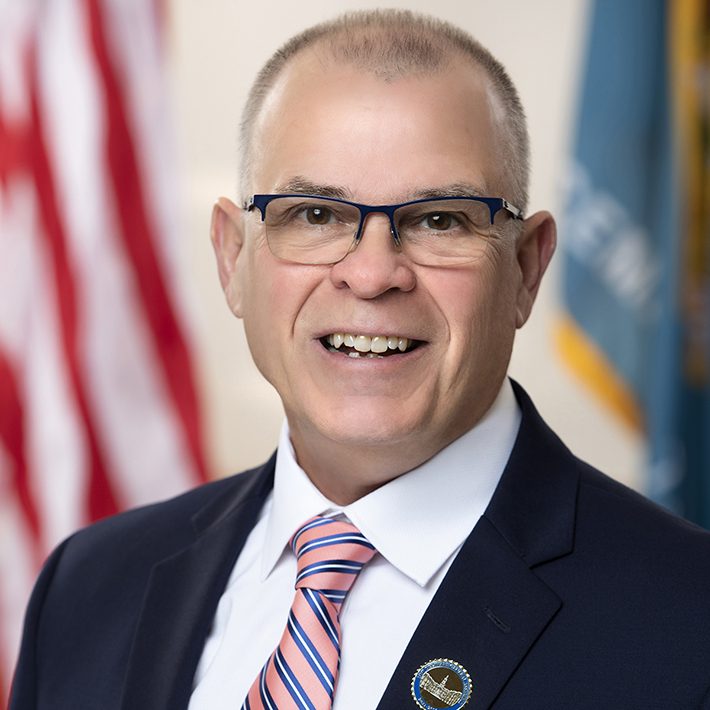
Photo of Ed Osienski
D Delaware House · District 24 On the 2026 ballot

Rep. Ed Osienski

Compare
Total votes
2,772
all sessions
Attendance
99%
18 missed
Higher than 91% of chamber peers
With party
99%
of cast votes
Higher than 90% of chamber peers
Bipartisan score
0%
crosses aisle rarely
Lower than 91% of chamber peers
Sponsored
1,277
bills & resolutions
Higher than 80% of chamber peers
Committees
8
assignments
1,277 bills and resolutions

Sponsored bills

Total
1,277
Primary
749
Co-sponsor
528
This page
1,277
matching current filters
Co-sponsor SCR 69
Passed · Delaware Senate · Co-sponsor
CREATING THE DELAWARE YOUTH DRUG PREVENTION CURRICULUM TASK FORCE.

This Senate Concurrent Resolution creates a Delaware Youth Drug Prevention Curriculum Task Force to examine available drug prevention programs and to recommend a course of action to educate our youth about the dangers of drug, alcohol, and tobacco use to reduce the chance that youth will experiment with these substances.

Passed Jun 28, 2018 1 co-sponsor
Co-sponsor SB 177
Signed into law · Delaware Senate · Co-sponsor
AN ACT TO AMEND TITLE 11 OF THE DELAWARE CODE RELATING TO REGISTRATION OF SEXUAL OFFENDERS.

This Act brings Delaware sex offender registration laws into compliance with the federal Sex Offender Registration and Notification Act ("SORNA") by standardizing the tier designation of sex offenders are assigned based upon offense of conviction. This Act removes discretion previously granted to the Board of Parole to redesignate sex offenders and standardizes designation in a manner consistent with established Superior Court precedent. See State v. Brown, 2013 WL 2149882 (Del. Super. 2013); Lane v. Board of Parole, 2012 WL 5509711 (Del. Super. 2012). Finally, this Act streamlines the designation process by directing review to the Superior Court in the first instance.

Signed into law Jun 27, 2018 1 co-sponsor
Primary HB 369
Signed into law · Delaware House · Lead sponsor
AN ACT TO AMEND TITLE 11 OF THE DELAWARE CODE RELATING TO THE FALSIFICATION OF BUSINESS RECORDS.

This Bill expands the offense of falsifying business records by including the act of altering or modifying and creating false medical records. Currently, no specific statute exists to prevent a person from falsely creating, altering, or modifying a medical record. Expanding the offense of falsifying business records to include medical records will be a useful tool for combating healthcare provider fraud, protecting patients, and assisting patients in ensuring the integrity of their medical records.

Signed into law Jun 27, 2018 0 co-sponsors
Co-sponsor HB 110
Failed · Delaware House · Co-sponsor
AN ACT TO AMEND TITLE 16 AND TITLE 30 OF THE DELAWARE CODE CREATING THE DELAWARE MARIJUANA CONTROL ACT.

The Delaware Marijuana Control Act regulates and taxes marijuana in the same manner as alcohol. It allows adults over the age of 21 to legally possess and consume under 1 ounce of marijuana for personal use. It does not permit people to grow their own marijuana. Section 1: Amends Chapter 47 of Title 16 to provide that the offenses and penalties under Uniform Controlled Substances Act do not apply to marijuana-related conduct allowed under the Delaware Marijuana Control Act or the Delaware Medical Marijuana Act, Chapter 49A of Title 16. Section 2: Amends § 4764 of Title 16 to eliminate any penalty for possessing 1 ounce or less of marijuana for individuals over the age of 21 but maintains the existing civil penalty for possession of 1 ounce or less for adults age 18 to 21. Section 3: Amends § 4902A of Title 16 so that the definition of a registered safety compliance facility includes not just marijuana produced for medical use but also marijuana produced under the Delaware Marijuana Control Act. Section 4: This Act creates the Delaware Marijuana Control Act. Subchapter I contains definitions and general provisions. Where definitions or analogous provisions exist in the Delaware Code, the definitions are referenced and the language from existing statutes is used. This section of the Act permits individuals over age 21 to possess, use, purchase, or transport 1 ounce (28 grams) or less of marijuana, no more than 5 grams of which may be concentrated, by individuals 21 years of age or older if the individuals are in compliance with this chapter. It permits the operation of marijuana businesses if they operate under licenses granted under this chapter but imposes the same limits on hours and holiday sales as apply to sales of alcohol. It prohibits the use of marijuana in public, by drivers or passengers in vehicles, and prohibits the smoking of marijuana anywhere that smoking tobacco or ecigarettes is not permitted. Marijuana may not be sold in an establishment licensed to sell alcohol. Employers and some owners of residential housing can prohibit the use of marijuana. There are specific provisions imposing the same penalties as with alcohol sales, for individuals under the age of 21 using false identification to purchase marijuana, and for businesses that fail to verify the age of marijuana consumers. This Act creates the Delaware Marijuana Control Act Oversight Committee. This Oversight Committee will coordinate the implementation of this Act with the Medical Marijuana Program, the Division of Public Health, the Division of Substance Abuse and Mental Health, and the public. The Oversight Committee will review the effectiveness of the Delaware Marijuana Control Act in regard to the safe operation of facilities licensed under this Act, the impact of this Act on public safety, and the impact of this Act on public health. The Commissioner must submit an annual report to the Governor and the members of the General Assembly setting forth all matters of interest and all statistics concerning marijuana regulation and control in the State including: the number of licenses of each variety issued with the State; including the name and address of each person licensed to cultivate, manufacture, or sell marijuana or marijuana products in the State; the amount of marijuana and marijuana products sold within the State; and the number of licenses of each kind granted and the number cancelled during the year. Subchapter II creates the Division of Marijuana Control and Enforcement in the Department of Safety and Homeland Security. The powers and duties granted to this Division are substantially the same as those in Title 4 creating the Division of Alcohol and Tobacco Enforcement but revised to conform to the standards of the Delaware Legislative Drafting Manual. This includes the identical power to conduct hearings if neighbors protest the license application of establishments that sell marijuana and subpoena power. It requires the Commissioner to coordinate with the Delaware Economic Development Office so that potential businesses licensed under this Act have access to programs, particularly those that support small businesses owned by minorities, women, and veterans. Subchapter III provides the Marijuana Commissioner the authority to adopt regulations to implement this Act and includes specific requirements that marijuana establishments must meet to obtain licenses. Regulations must require that products containing marijuana use of a symbol and a standard measurement to be used on all marijuana products so they are easily identified as containing marijuana and consumers can identify the amount of marijuana in different products; be in opaque, child-resistant packaging; and contain a warning label explaining evidence-based harms from consuming marijuana, including the impact on developing brains. The regulations must also contain security requirements, testing requirements, advertising restrictions, and require that food products comply with State food safety laws. There are separate licensing requirements for retail marijuana stores, marijuana testing facilities, marijuana cultivation facilities, and marijuana product manufacturing facilities. The application fee for licenses is up to $5000, which is the same as the application fee for facilities under the Delaware Medical Marijuana program. There is a $10,000 biennial fee for each license issued under this Act, which is lower than the fee for compassion center under the Delaware Medical Marijuana program. Within 10 months of the effective date of this Act, applications will be accepted from compassion centers and safety compliance facilities registered under Chapter 49A of Title 16 to operate as retail marijuana stores, marijuana cultivation facilities, marijuana product manufacturing facilities, and marijuana testing facilities. Localities have the ability to license and set rules for marijuana establishments. The procedure for appeals and grounds to deny a license are the same as for applications to sell alcohol under Title 4, except that instead of prohibiting someone with any substance abuse felony from obtaining a license, the language from § 4902A(7)(b) of Title 16, is used, permitting an exception if the conviction and sentence served was 10 years or more in the past or the conviction was for something that would be legal under this Act. Subchapter IV creates the Marijuana Regulation Fund. This fund will consist of fees collected, penalties imposed, and taxes collected under this Act. It creates an excise tax on marijuana and apportions the revenue as follows: first to the administrative costs and expenses of the Division of Marijuana Control and Enforcement and then, of the amount that remains, 20% to the Department of Education, 10% to the Department of Health and Social Services for distribution to nonprofit organizations to address barriers to reentry for communities that have been disproportionally affected by past federal and state marijuana prohibition policies, 10% to the Department of Health and Social Services for use in evidence-based, voluntary programs for the prevention or treatment of alcohol, tobacco, and marijuana abuse, and 10% to the Department of Health and Social Services for a public education campaign educating youth and adults about the health and safety risks of alcohol, tobacco, and marijuana. Section 5: Creates a State tax deduction for all ordinary and necessary expenses paid or incurred by a marijuana establishment to reflect the inability of a business licensed under this Act to deduct these expenses from federal taxes and thus state taxes. This creates a more level playing field with other businesses. Section 6: Provides that the initial regulations required under this Act be adopted not later than 9 months after the effective date of this Act.


Failed Jun 27, 2018 1 co-sponsor
Co-sponsor HB 310
Signed into law · Delaware House · Co-sponsor
AN ACT TO AMEND TITLE 6 OF THE DELAWARE CODE RELATING TO THE CERTIFICATION OF ADOPTION OF SUSTAINABILITY AND TRANSPARENCY STANDARDS BY DELAWARE ENTITIES.

The Certification of Adoption of Sustainability and Transparency Standards Act (the “Act”) establishes a voluntary disclosure regime to foster dialogue around sustainability and responsibility among participating Delaware business entities and their various stakeholders. Because issues relating to sustainability and responsibility are fact-specific and fact-intensive and may vary greatly depending on, among other things, the size of the entity, the nature of its business and operations, and the industry in which it operates, the Act does not prescribe specific standards, measures of performance or criteria for evaluating performance. Rather, consistent with the enabling approach of Delaware business laws generally, the Act requires the governing body of each entity seeking certification under the Act to adopt principles, guidelines and standards to guide its business activities in a sustainable and responsible manner, as well as metrics for assessing whether it has met its objectives. Although Section 5003D of the Act grants the Secretary of State of the State of Delaware (the “Secretary of State”) the authority and discretion to provide the form of application for certification under the Act, the Act does not contemplate that State officers will make qualitative judgments regarding the standards or metrics that an entity adopts. The Act also does not contemplate or require that State officers determine qualitatively whether an entity has been operated in a sustainable and responsible manner. The Secretary of State's certification is focused on information acknowledged by an authorized representative of the entity regarding its adoption of procedures to operate sustainably and responsibly and its commitment to disclose, at least annually, such procedures. To that end, Section 5003D of the Act requires an entity applying for certification under the Act to make disclosures regarding the sustainability and responsibility standards it has adopted, the metrics it uses to evaluate whether it has met those standards, and its performance in meeting those standards. The Act is entirely voluntary. The decision whether to seek certification is in the sole discretion of each entity. The Act imposes no obligations on any Delaware entities that have not elected certification. (Of course, any person or entity that misrepresents an entity's certified status may be subject to civil or criminal fines or penalties.) The Act does not impose fines or penalties on entities that elect not to seek certification, nor does it impose penalties or fines on entities that, having become certified, fail to satisfy their own performance standards. Moreover, the Act specifies that fiduciary liability shall not be imposed as a result of, among other things, the decision whether or not to seek certification or the failure to meet specific sustainability and responsibility standards.

Signed into law Jun 27, 2018 1 co-sponsor
Co-sponsor HB 222
Signed into law · Delaware House · Co-sponsor
AN ACT TO AMEND TITLES 10 AND 11 OF THE DELAWARE CODE RELATING TO LETHAL VIOLENCE PROTECTION ORDERS.

This Substitute Act incorporates House Bill No. 222, and also makes the following changes to House Bill No. 222: (1) Creates a new Chapter of Title 10, which permits a family member or a law enforcement officer to obtain a lethal violence protective order. (2) Permits a family member or law enforcement officer to obtain an emergency lethal violence protective order in Justice of the Peace Court if the Court finds probable cause to believe that a respondent poses an immediate and present danger of causing physical injury to self or others by owning, possessing, controlling, purchasing, having access to, or receiving a firearm. The order requires the relinquishment of firearms to law enforcement and may prohibit the individual from residing with others who possess firearms, and grant permission to law enforcement to search for and seize firearms. If an emergency order is issued, the Superior Court must hold a full hearing within 15 days. (3) Makes clear that the Justice of the Peace Court and the Superior Court may, as part of an lethal violence protective order, order an individual not to reside with a individual who owns, possesses, or controls firearms. However, the Courts may not impair or limit the right to keep and bear arms of an individual who is not subject to an order. (4) Permits a respondent to request termination of the order in Superior Court wherein the respondent has the burden of proving by clear and convincing evidence that the respondent does not pose a danger of causing physical injury to self or others by controlling, owning, purchasing, possessing, having access to, or receiving a firearm. (5) Creates sanctions for a person who provides false information in the affidavit or verified pleading in order to obtain a lethal violence protective order. (6) Creates sanctions for a person who violates a lethal violence protective order by adding lethal violence protective order to Section 1271A of Title 11, making a violation of the order Criminal contempt. (7) Changes the effective date of this Act to 6 months after its enactment.

Signed into law Jun 27, 2018 1 co-sponsor
Co-sponsor HB 71
Passed · Delaware House · Co-sponsor
AN ACT TO AMEND TITLE 29 OF THE DELAWARE CODE RELATING TO FINANCIAL DISCLOSURE FOR PUBLIC OFFICERS.

This bill was previously recommended by the Joint Sunset Committee in the 147th General Assembly. The bill adds appointed members of the Cash Management Policy Board to the definition of “public officers.” This designation would subject the appointed members of the Board to annual financial disclosure requirements.

Passed Jun 26, 2018 1 co-sponsor
Primary SB 257
In committee · Delaware Senate · Lead sponsor
AN ACT TO AMEND TITLE 29 OF THE DELAWARE CODE RELATING TO COMPENSATION PAYMENTS FOR CERTAIN EXEMPT PROPERTIES OWNED BY THE STATE.

This Act changes the program for distributing payments to county seats with tax-exempt properties owned by the State. Section 8318 of Title 29 directs compensatory payments for exempt properties owned by the State to the county seats, Wilmington, Dover, and Georgetown. This Act authorizes these compensatory payments to any municipality with a population over 25,000 and more than 20% tax exempt property owned by the State. This Act also raises the annual cap on the amount distributed under this section by $500,000 and adjusts the formula under which these distributions are made. This Act improves the formulas to enable the elimination of specific dollar earmarks and to treat all higher education institutions in the State equally. The Act increases the compensatory payments under this section to each of the 3 county seats, and adds Newark to the program at a much lower payment than the payment provided to the county seats. This Act also makes technical corrections to conform existing law to the standards of the Delaware Legislative Drafting Manual.

In committee Jun 26, 2018 0 co-sponsors
Co-sponsor HB 400
Passed · Delaware House · Co-sponsor
AN ACT TO AMEND TITLE 15 OF THE DELAWARE CODE RELATING TO ELECTIONS.

This bill provides for election day registration for presidential primary, primary, special, and general elections whereas currently the deadline is the fourth Saturday prior to the date of the election. Moreover, same day registration at polling places will be permitted with submission of valid government issued identification or other generally accepted proof of identification.

Passed Jun 21, 2018 1 co-sponsor
Showing 1,141 to 1,150 of 1,277 bills