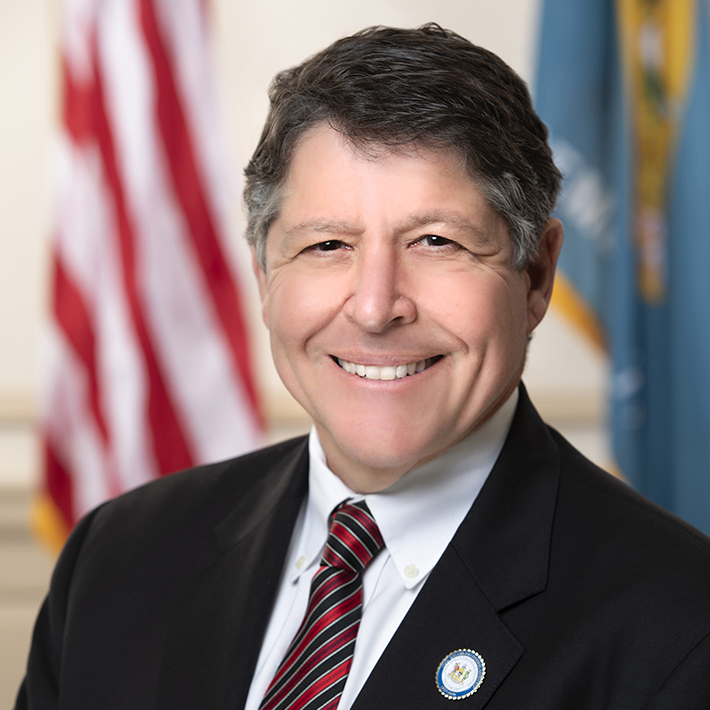
Photo of Paul Baumbach
D Delaware House · District 23

Rep. Paul Baumbach

Contact Email
Compare
Total votes
2,122
all sessions
Attendance
99%
14 missed
Higher than 95% of chamber peers
With party
99%
of cast votes
Near the chamber average
Bipartisan score
0%
crosses aisle rarely
Near the chamber average
Sponsored
1,430
bills & resolutions
Higher than 88% of chamber peers
Committees
0
assignments
1,430 bills and resolutions

Sponsored bills

Total
1,430
Primary
633
Co-sponsor
797
This page
1,430
matching current filters
Primary HCR 120
Passed · Delaware House · Lead sponsor
HONORING THE MEN AND WOMEN OF THE NATIONAL GUARD ASSOCIATION OF DELAWARE FOR THEIR SERVICE IN ADVOCATING, ORGANIZING, TRAINING, AND EQUIPPING THE NATIONAL GUARD IN SUPPORT OF THE DEFENSE OF OUR STATE AND NATION.

This Resolution pays tribute to the men and women of the Delaware National Guard for their service and sacrifices in support of defending our state and nation, and recognizes the outstanding advocacy provided by the National Guard Association of Delaware.

Passed Apr 23, 2024 0 co-sponsors
Primary SB 21
In committee · Delaware Senate · Lead sponsor
AN ACT TO AMEND TITLE 29 OF THE DELAWARE CODE RELATING TO OFFICE OF INSPECTOR GENERAL.

Like Senate Bill No. 21, Senate Substitute No. 1 for Senate Bill No. 21 {this Act) establishes an independent and nonpartisan Office of the Inspector General (OIG) and the position of the Inspector General. Under this Act, the OIG would be unique in state government as a non-political agency with a sole mission to investigate and prevent fraud, waste, mismanagement, corruption, and other abuse of governmental resources. The OIG will protect the health and safety of Delaware residents, assist in the recovery of misspent or inappropriately paid funds, and strengthen government integrity and the public trust in government operations by doing all of the following: 1. Investigating the management and operation of state agencies, including the General Assembly, to determine if there has been waste, fraud, abuse, mismanagement, corruption, or other abuse of governmental resources that is harmful to the public interest. 2. Coordinating with other investigative and law-enforcement agencies, including the Attorney General and the Auditor of Accounts (Auditor). 3. Recommending corrective actions and statutory revisions, and, if necessary, make referrals to other law-enforcement agencies. 4. Providing reports to the Governor, Attorney General, and General Assembly, and these reports will be available to the public on the OIG website. The Inspector General will not duplicate the work of the Auditor, Attorney General, Public Integrity Commission, or other investigative or law-enforcement agencies and will work collaboratively, including through memoranda of understanding, with these agencies for the purposes of efficiency and coordination. Specifically, the Inspector General can be distinguished from these agencies as follows: • Under the generally accepted government auditing standards in the Yellow Book produced by the U.S. Government Accountability Office, both financial and performance audits are only designed to detect fraud, illegal activity, noncompliance, abuse, and waste. An auditor determines whether the subject matter meets criteria, reaches reasonable assurance, and follows directive standards. If an auditor detects fraud or other bad behavior, they must report it to an investigation agency. • The OIG will be an entirely independent investigation agency, charged with gathering evidence to identify the individual responsible for the bad behavior identified through an audit and prove that it occurred. For complaints the received from other sources, the OIG will investigate to determine if there is or has been bad behavior. In addition to proving instances of bad behavior, these investigations may also prove that an allegation is false or incorrect. • The OIG will not duplicate the work of existing ombudsperson offices because the OIG is primarily concerned with detecting and preventing fraud, waste, mismanagement, corruption, and abuse of governmental resources while ombuds programs are concerned with violations of the rights and treatment of specific populations. • If the OIG believes, based on an investigation, that there has been or continues to be significant problem regarding fraud, waste, mismanagement, corruption, or evidence of a crime, the Inspector General must report the finding to the Department of Justice (DOJ). If the DOJ does not take action on a referral, the OIG may pursue a civil action on behalf of the State. • The OIG will be unique in State government because the Inspector General is not elected and will be an entirely independent agency. The Inspector General will be selected through a process that requires a Selection Panel to provide 3 names to the Governor for consideration. The Governor will select a nominee from these 3 names for appointment as Inspector General and submit the nominee to the Senate for confirmation. Once confirmed, the Inspector General serves a term of 5 years. In addition, the DOJ is not responsible for providing legal advice, counsel, services, and representation to the OIG. In other states, the financial impact of investigations by the Office of Inspector General has exceeded the annual budget for that office by millions of dollars. Some examples of conduct that have been identified in states where an Inspector General has responsibilities similar to those under this Act include the following: • In Georgia, an agency administrator who faked multiple pregnancies, receiving 265 hours of leave for which she was not otherwise eligible to receive. • Massachusetts has recovered more than $245,000 from 13 former troopers within the State Police for overtime pay they received for hours they did not actually work. • In Indiana, a Department of Child Services worker was found to have falsified case notes regarding child welfare assessments. • In Louisiana, state agencies were found to have wasted more than $500,000 in non-refundable airline tickets that were allowed to expire and lose value. Under this Act, the selection process for the Inspector General begins upon enactment and the work of the Office of the Inspector General must begin upon the appointment and confirmation of an Inspector General or March 1, 2025, whichever occurs earlier. Senate Substitute No. 1 for Senate Bill No. 21 differs from SB 21 as follows: 1. Revises § 9001E(4) of Title 29 so that the General Assembly’s purpose in establishing the OIG aligns with the requirement under § 9005E(b) of Title 29 that the Inspector General work collaboratively with other investigative and law-enforcement agencies, not just the Auditor, for the purposes of efficiency, coordination, and avoiding duplication of work. 2. Clarifies that there is not a preference under § 9003E(d)(1) of Title 29 for OIG staff to have experience with a law-enforcement agency. 3. Adds paragraph (d)(5) to § 9008E of Title 29 to clarify that the Inspector General may reveal information to comply with a court order or subpoena.


In committee Apr 17, 2024 0 co-sponsors
Primary HCR 112
In committee · Delaware House · Lead sponsor
CONDEMNING FORCED ORGAN HARVESTING PRACTICES IN THE PEOPLE’S REPUBLIC OF CHINA.

This resolution calls on the General Assembly to encourage the Delaware medical community to educate the citizens of Delaware about the forced organ harvesting that occurs in China, in the event they decide to travel to China for an expedited transplant. This resolution also calls on the United States Government to pass laws and regulations prohibiting American medical and pharmaceutical companies from collaborating with Chinese groups that are found to have involvement with forced organ harvesting, as well as banning entry into the United States individuals who have participated in the forced organ harvesting, and allowing prosecution of those persons involved.

In committee Apr 17, 2024 0 co-sponsors
Primary SB 263
In committee · Delaware Senate · Lead sponsor
AN ACT AMENDING TITLE 7 OF THE DELAWARE CODE RELATING TO SOLID WASTE RECYCLING.

This Act limits the use of plastic and other beverage container rings, as well as plastic shrink wraps and plastic tops used to connect beverages, by expanding the definitions of “beverage” and “beverage container” and prohibiting beverages from being sold in containers connected to each other with plastic, ring, or ring-like connectors. Juice boxes and other aseptic containers are not defined as beverage containers and are not included in the ban. By prohibiting the use of rings or plastic connectors to package or connect beverage containers, this Act reduces waste and furthers the State’s sustainability goals. It also supports the use of beverage packaging alternatives, which are already being used widely. This Act also updates the findings of the General Assembly to reflect the importance of aluminum and glass as recyclables and the need for increased rates of reuse, circularity, and recycling of these valuable materials. This Act takes effect on July 1, 2025. This Act makes technical corrections to conform existing law to the standards of the Delaware Legislative Drafting Manual.

In committee Apr 11, 2024 0 co-sponsors
Primary SB 132
In committee · Delaware Senate · Lead sponsor
AN ACT TO AMEND TITLE 6 OF THE DELAWARE CODE RELATING TO THE STUDENT LOAN BORROWER BILL OF RIGHTS ACT.

Over the past decade, an increasing number of states have passed legislation establishing a Student Loan Borrower Bill of Rights. At least 18 states have passed such legislation. Of these 18 states, 12 states have a Student Loan Ombudsperson and 13 have a licensing program, with another two states having a registration program instead of a licensing program. This Act is a Substitute for Senate Bill No. 132. Like Senate Bill No. 132, this Act enacts a Student Loan Borrower Bill of Rights for this State that does all of the following: (1) Requires student loan servicers to engage in certain practices related to communications with student loan borrowers and cosigners of student education loans and handling of transactions by student loan borrowers and cosigners of student education loans. (2) Prohibits student loan servicers from engaging in certain practices including unfair or deceptive practices or abusive practices. (3) Requires student loan servicers to retain records related to student loan transactions for 7 years and to yearly report non-identifying information about student education loans serviced in this State, including default and delinquency rates, to the Student Loan Ombudsperson. (4) Establishes the Office of the Student Loan Ombudsperson which shall, among other duties, receive, investigate, and attempt to resolve complaints from student loan borrowers. This Act differs from Senate Bill No. 132 as follows: (1) Makes a technical correction to correct an incorrect internal reference. (2) Excludes the State government from the definition of “student loan servicer”. (3) Makes clear the intent to exclude certain types of student loan servicers from the scope of this Act, as these student loan servicers are already regulated by state and federal regulators. (4) Removes an unnecessary “that”. (5) Adds “if applicable” to make clear the student loan servicer’s obligation to provide cosigner information applies only if applicable. (6) Moves from § 2504J of this Act certain requirements of student loan servicers related to cosigners and cosigner release to a new § 2511J of this Act containing protections related to cosigners and borrowers. (7) Specifies that a student loan servicer is only required to provide a written payment history to a student loan borrower or cosigner once each year. (8) Requires a student loan servicer to service a student education loan in conformity with § 2511J of this Act and to file a notice with the Student Loan Ombudsperson every 3 years, or on servicing the student loan servicer’s first student education loan in this State, that includes an address, email address, and phone number for the student loan servicer and an attestation that the student loan servicer understands the student loan servicer’s duties under this Act. (9) Clarifies that the Student Loan Ombudsperson (“Ombudsperson”) has certain powers, not that the Ombudsperson is required to exercise those powers in all cases. (10) Clarifies that the Consumer Protection Unit of the Department of Justice and other appropriate agencies are to have access to information available to the Ombudsperson to the extent necessary for investigation purposes. (11) Permits the Ombudsperson to meet regularly with a member of the Consumer Protection Unit to coordinate efforts. (12) Permits the Student Loan Ombudsperson to access, receive, and use any documents, information, or evidence the Ombudsperson deems relevant to the inquiry or investigation, including any documents, information, or evidence in the possession of a student loan servicer. (13) Replaces language related to whom the Student Loan Ombudsperson’s annual report is due with standard report language developed for the Delaware Legislative Drafting Manual and adds the Attorney General as a recipient of the report. (14) Delays the effective date of the Act until January 1, 2025.

In committee Apr 11, 2024 0 co-sponsors
Showing 171 to 180 of 1,430 bills
Previous 1 17 18 19 143 Next