

To establish more transparency in government, and to strengthen citizens' faith in the election and redistricting processes that serve as the foundation of democracy in Delaware, this bill establishes an Independent Redistricting Commission for the State of Delaware. The Commission will be responsible for drawing the boundaries of Delaware's legislative districts every ten years, following each decennial census. A pool of twenty-four potential Commission members shall be selected by a bipartisan judicial panel from applications filed with the Commissioner of Elections. The pool will consist of eight current or former Delaware attorneys or former Delaware judges and sixteen other citizens of Delaware. The pool must include eight candidates from each of the State’s two largest political parties and eight candidates that are not a member of either of the State’s two largest parties. Prior to selection of Commission members, the following individuals shall each have the opportunity to strike one candidate from the pool: the Speaker of the House, the House Minority Leader, the President Pro Tempore of the Senate, and the Senate Minority Leader. From the pool of remaining candidates, the Secretary of State will draw by lot until the following conditions are satisfied: 1) The Commission will have nine members, three of whom must be current or former attorneys or former Delaware judges, and six of whom must be other Delaware citizens. 2) Three members of the Commission shall be members of the State’s largest political party, three shall be members of the State’s second largest political party, and the remaining three shall not be a member of either of the State’s two largest political parties. Eligible candidates may not be, and may not have in the five years prior to appointment been, a federal or state lobbyist, an officer of a federal or state political party, an officer of a campaign committee, or an elected federal or state official. Commissioners are also prohibited from running for the General Assembly in the election following the redistricting, and from registering as a federal or state lobbyist for five years following the term as a Commissioner. A preliminary plan must be prepared by the Commission for public distribution, and four public hearings must be held before a Final Redistricting Plan and Report is approved by the Commission. The Delaware Supreme Court shall have original and exclusive jurisdiction to resolve challenges to the Final Redistricting Plan adopted by the Commission.
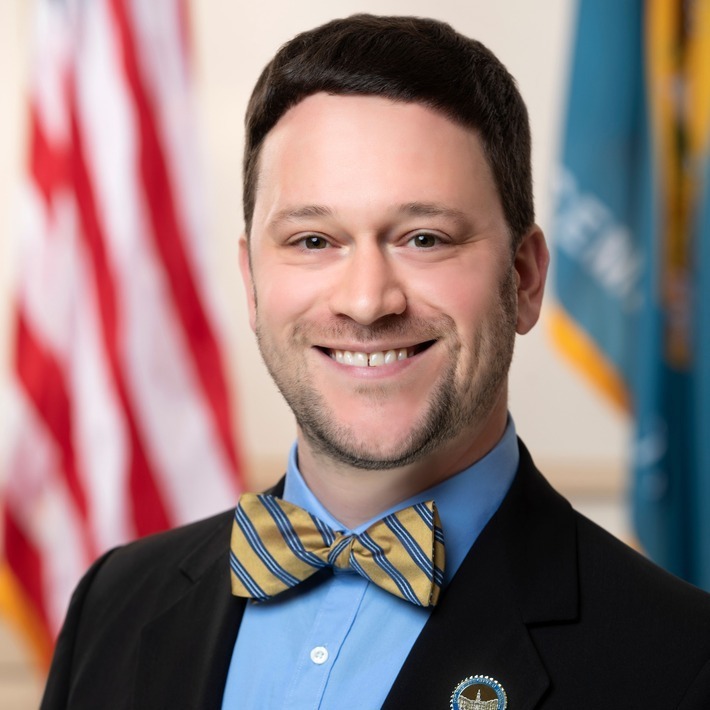
Rep. Jeff Spiegelman
Sponsored bills
This act creates a special license plate for veterans of Operation Desert Storm.
This Joint Resolution opposes the cost allocation of the Artificial Island Transmission Project as unfair and unduly burdensome to the ratepayers of Delaware and urges PJM to join with Delaware in contesting the cost allocation in the proceedings pending before FERC.
A minor child that is a qualifying patient may need, in addition to their parents, a designated caregiver who is not their parent when the parents work and cannot regularly get to school to administer medicine. This bill expands the class of persons who can be designated caregivers to a minor qualifying patient. This bill would allow grandparents, aunts, uncles, and siblings, all over age 21, as persons who may be designated caregivers for a minor patient.
This bill establishes a writ of attachment of tax refunds and lottery winnings. This bill provides a procedure for interception of tax refunds and lottery winnings by the Department of Finance for judgments resulting from a breach of a residential or commercial rental agreement. This bill provides for the opportunity to contest the amount owed in regards to funds seized pursuant to a writ of attachment of tax refunds or lottery winnings. The bill directs the Department of Finance to work with the Courts to develop an electronic system relating to the collection of judgments through tax refunds and lottery winnings. The bill also directs the Courts and Department of Finance to work together and make a recommendation as to the amount of a special fee that is meant to offset the development, implementation and administration of the collection of judgments through tax refunds and lottery winnings. The Department and Finance are directed to provide a report to the General Assembly by January 10, 2018 regarding the costs of administrating this provision and an appropriate off-setting fee to be charged for issuance of the writ described herein. Sections 1 and 2 of the bill will not take effect until ongoing funds are provided to develop, implement and administer Sections 1 and 2, and until legislation is passed implementing the new fee.
This Act is the first leg of a constitutional amendment that would require the same super-majority vote to amend a provision that results in the act's expiration on a certain date, also known as a "sunset" provision, as was required to pass the act in the first instance.
Subchapter III, Chapter 68, Title 7 of the Delaware Code (“Subchapter III”) was originally enacted in 1982. In 1996, President Clinton signed the Bill Emerson Good Samaritan Food Donation Act, 42 U.S.C. § 1791 (“Bill Emerson Act”). The Bill Emerson Act preempts Subchapter III to the extent of any conflict, known as “partial preemption”. This Act makes Subchapter III consistent with the Bill Emerson Act by protecting a “gleaner” from civil or criminal liability as it relates to their donation of the gleaned food. Since the Bill Emerson Act only partially preempts state law on this subject, the State is free to provide greater protection than the Bill Emerson Act. Therefore, this Act does all of the following: 1. Extends to those who, in good faith, donate food to state agencies the same immunity from civil or criminal liability that is granted to those who, in good faith, donate food to nonprofit organizations. 2. Specifically includes within the definition of “food” both perishable food and wild game to makes it clear that food, in all of its forms, is covered by this Act. Thus, under this Act, those donating deer to the Division of Fish and Wildlife’s Sportsmen Against Hunger program would be immune from civil or criminal liability as it relates to the donation. 3. Protects a person who, in good faith, provides services to a nonprofit organization or state agency related to the processing of wild game that is donated to a nonprofit organization or a state agency. The bill also clarifies the authority of Division of Public Health and Department of Agriculture relating to donated food.
This joint resolution rejects the report of the Delaware Compensation Commission in its entirety.
This bill creates the right for the parent or guardian of a child to opt out of the annual assessment, currently the Smarter Balanced Assessment System.
This bill provides State funding to kindergarten through third grade for basic special education. State funding already occurs for intensive and complex special education during these grades. Currently the basic special education funding runs from fourth through twelfth grade. This bill is an effort to promote earlier identification and assistance for basic special education needs which should then mitigate costs over the long term.Pursuant to its terms, funding for K-3 special education will be phased in gradually over 4 years.