

This Act is a substitute for House Bill No. 224. Like House Bill No. 224, this Act narrows the meaning of “firearm” for purposes of the Delaware Criminal Code by more closely aligning the definition of “firearm” with the definition in the federal criminal background check law. The reference to a BB gun is no longer necessary because a BB gun does not use an explosive force to propel a projectile. “Firearm” was defined in the Criminal Code for the first time in 1983 by Senate Bill No. 13, as amended, 132nd General Assembly, 64 Del. Laws, c. 17 (“Senate Bill No. 13”). Senate Bill No. 13 defined “firearm” to include “any weapon from which a shot, projectile or other object may be discharged by force of combustion, explosive, gas and/or mechanical means, whether operable or inoperable. It does not include a BB gun.” This definition is the same as the definition for “firearm” in the Delaware Criminal Code today. During the Senate floor debate on Senate Bill No. 13, Senator Berndt noted the expansive nature of the definition due to the inclusion of “by . . . mechanical means,” which he noted meant that the definition would include cross bows and slingshots. Because of Senate Bill No. 13’s placement of “firearm” in the general definition section for the Delaware Criminal Code, the definition applies throughout the Delaware Criminal Code. When the Delaware Criminal Code was adopted in 1972 there were 9 uses of “firearm” in the Delaware Criminal Code. Today, there are 194 uses of “firearm” in the Delaware Criminal Code (Part I of Title 11). As the number of uses of “firearm” has increased, it has done so with the definition of “firearm” as a backdrop, meaning that these new uses have intentionally or unintentionally adopted the definition of “firearm.” Research reveals no other state with a similar definition of “firearm” in its laws. While at least 2 states had previously had a similar definition, those definitions were removed by their legislatures in 2015. In 1 of those states, Michigan, legislative history indicates the definition was changed as part of the state’s efforts to align its definitions of firearms with the definition found in federal law governing the National Instant Criminal Background Check System (NICS), the system through which criminal history checks are performed. For purposes of NICS, firearm is defined to mean as follows: “(A) any weapon (including a starter gun) which will or is designed to or may readily be converted to expel a projectile by the action of an explosive; (B) the frame or receiver of any such weapon; (C) any firearm muffler or firearm silencer; or (D) any destructive device. Such term does not include an antique firearm.” See 18 U.S.C. 921(a)(3). This Act differs from House Bill No. 224 in that it makes additional changes to the definition of “firearm” to further align it with the definition of “firearm” used in the federal criminal background check law, by doing the following: (1) Using “means” instead of “includes”. (2) Including that a weapon is a firearm if it may readily be converted to discharge a shot by an explosive force. (3) Adding frame or receiver of a firearm.
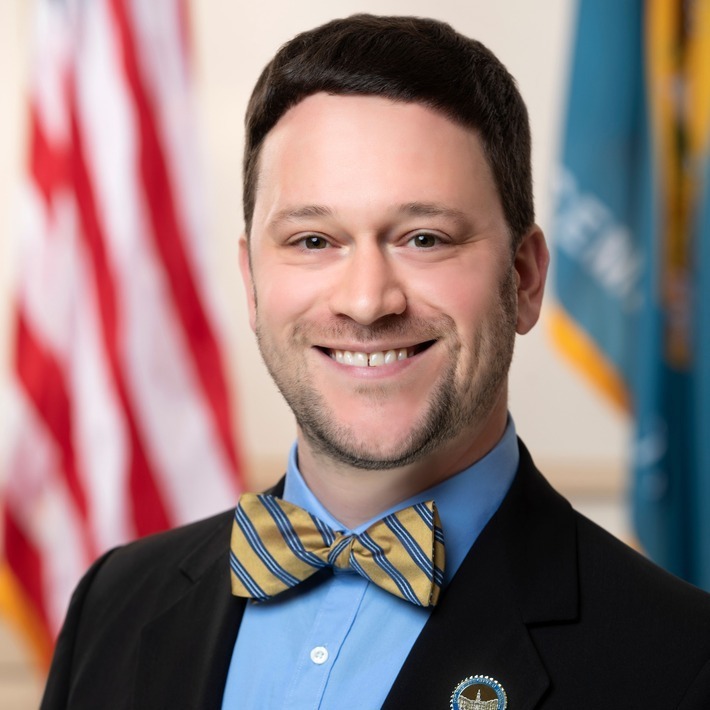
Rep. Jeff Spiegelman
Sponsored bills
This amendment to the House Rules requires a three-fifths vote of the members of the House in order to suspend the House Rules. The primary purpose of the House Rules is to establish a reasonable and orderly process for the consideration of legislative proposals to be addressed by the House of Representatives. Suspension of Rules should only be necessary in unusual situations. This change will require a broad consensus (three-fifths) of all members of the House of Representatives in order to suspend rules. Since a three-fifths requirement cannot be done via a simple voice vote, and must be performed with a roll call, this change will also increase transparency by ensuring that every legislator will have their vote on the action recorded and available for public review.
This Concurrent Resolution recognizes January 27th, 2023 as International Holocaust Remembrance Day.
At least 36 states allow for the medical use of marijuana. However, federal firearm laws have not kept pace and currently prohibit an individual who is “an unlawful user of or addicted to any controlled substance” from possessing or purchasing a firearm. It is still unlawful under federal law to use or possess marijuana. This Act makes clear that an individual is not disqualified under Delaware law from possessing a firearm because the individual is a registered qualifying patient under the Delaware Medical Marijuana Act, if the registered qualifying patient is not a person prohibited under § 1448 of Title 11 of the Delaware Code. This Act makes also clear that a registered qualifying patient may engage in a firearm transaction between unlicensed persons under § 1448B of Title 11 if the transaction is exempt under § 1448B(c) of Title 11 and the registered qualifying patient is not otherwise a person prohibited under § 1448 of Title 11. A registered qualifying patient’s purchase of a firearm through a federal firearms licensee (“FFL”) is still prohibited under federal law. This Act also makes technical corrections to conform existing law to the standards of the Delaware Legislative Drafting Manual.
This Act is a result of the Joint Legislative Oversight and Sunset Committee's ("JLOSC") review of the Delaware Interscholastic Athletic Association ("DIAA"). As part of JLOSC's review of DIAA, JLOSC recommended the following updates to the DIAA statute, which this Act fulfills: - Establish term limits for certain DIAA Board members of no more than 3, 3-year terms for a total of 9 years. - Add language to address the removal of a board member for gross inefficiency, neglect of duty, malfeasance, misfeasance, or nonfeasance. - Change DIAA Board member composition to add a third school district superintendent or assistant superintendent to create equitable representation among all 3 counties in this State; add a third nonpublic school representative; ensure that 1 of the 6 public members is a parent of a current or recent student athlete from a member school; and make the Department of Education member a voting member. - Clarify quorum and number of votes required to approve an act of the DIAA Board. - Authorize DIAA to pursue sponsorship opportunities and other non-tournament related revenue streams, and the purchase of general liability insurance relating to the rental of non-State venues for DIAA-sponsored events. - Clarify when a member's county of residence is a qualification versus the county in which the school the member is representing is a qualification. - Make technical corrections throughout DIAA's statute, to conform existing law to the standards of the Delaware Legislative Drafting Manual. Among the technical corrections is correction of references to the “state Board” when the references are intended to use the defined term “State Board” for the State Board of Education.
This Act is part of the Joint Legislative Oversight and Sunset Committee's ("JLOSC") review of the Delaware Nursing Home Residents Quality Assurance Commission ("DNHRQAC") and the recommendations that JLOSC approved during its review. This Act specifies the matters that DNHRQAC must include in its annual report, and makes technical corrections to conform existing law to the standards of the Delaware Legislative Drafting Manual.
This Act makes it easier to properly clear title to real property after a person dies if the person held real property jointly with the right of survivorship. With more frequency, a deceased person may die as a resident in a county that is different from the county in which the deceased owned real property. This Act provides relief to those who are the surviving joint owner of a person who died in a county that is different than the county where the real property is located. The surviving joint owner of real property may not have anything to do with the deceased person’s estate, or the probate of it, making it difficult for the surviving joint owner to obtain exemplified copies from different states or countries, which results in the loss of valuable time and money to the surviving joint owner.
This Act is a result of the Joint Legislative Oversight and Sunset Committee's ("JLOSC") review of the Water Infrastructure Advisory Council ("WIAC"). This Act clarifies quorum, removes a prohibition against WIAC members voting when attending a meeting virtually, and authorizes WIAC to adopt procedural rules to carry out its functions. This Act also makes technical corrections to conform existing law to the standards of the Delaware Legislative Drafting Manual.
This Act provides protection to homeowners from sellers that may have misled buyers (or their settlement attorneys) regarding a criminal judgment that attached to real property. It prevents innocent owners from potentially becoming a second victim by having a prior owner’s lien attach for more than 7 years after the settlement.
Delaware’s modern-day, statewide Family Court was established in 1971, unifying what had been multiple family law-related court systems throughout the state. In 1984, the Family Law Commission (“FLC”) was created to study and evaluate Delaware’s domestic relations, or family, laws and the Family Court’s rules and procedures; review legislation relating to family law and the Family Court; disseminate family law-related information to Delawareans; and engage in other related activities that it deemed appropriate. From its inception, FLC’s mandate and authority has been focused, limited to conducting public hearings, inviting written comments from the public, reviewing and commenting on family law-related legislation, and publishing information for the public. For many years, FLC served an important role in the progress and improvement of Family Court. Thirty-eight years after its creation, however, FLC is no longer serving a public need. Family Court celebrated its 50th anniversary in 2021; countless changes and improvements have been made to Family Court’s rules and procedures, as well as Delaware’s domestic relations laws. FLC, however, remains tasked with the same, limited duties as it first was tasked in 1984. This Act fulfills the Joint Legislative Oversight and Sunset Committee’s conclusion after a thorough review that FLC should be terminated. FLC’s role in the progress of the modern-day Family Court cannot be diminished, and it is a testament to its previous success that it is no longer needed to ensure a working Family Court in the State of Delaware.