

Maddy summaryThis bill updates Connecticut's campaign finance laws to clarify how candidates can form exploratory committees before officially announcing their candidacy. It allows candidates to raise small amounts of money, capped at $5,000, to gauge interest in running for public office without immediately establishing a full campaign committee. The bill requires candidates to convert these exploratory committees into official single-candidate committees within 15 days of publicly declaring their intent to seek office, with specific timing rules for state legislative and state office positions. Additionally, it mandates that any remaining funds from the exploratory committee be transferred to the official campaign committee or distributed to the Citizens' Election Fund under certain conditions. These changes aim to provide more structure and transparency for early-stage campaign fundraising while maintaining existing campaign finance regulations.
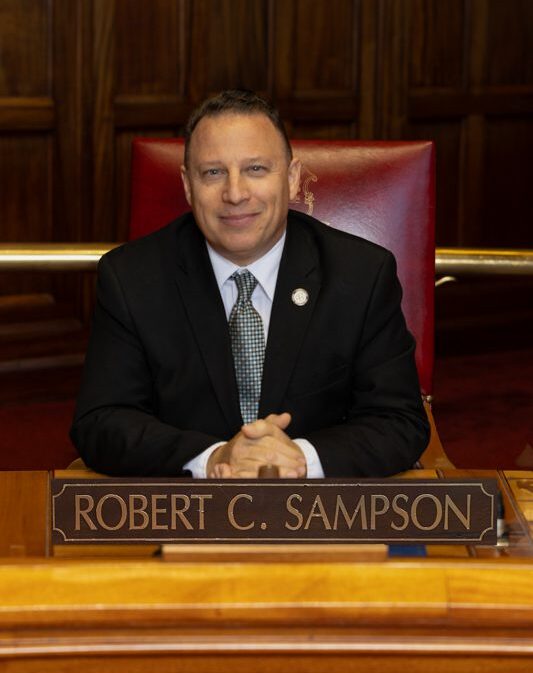
Sen. Rob Sampson
Sponsored bills
Maddy summarySB 392 requires minor political parties in Connecticut to follow their own established rules when nominating candidates for public office or selecting local town committee members and convention delegates, rather than merely having the option to do so. This bill amends Section 9-451 of the general statutes (effective January 1, 2027) to replace the permissive term "may" with the mandatory term "shall" in the statute. The change directly affects minor political parties by making compliance with their own filed rules a legal requirement for these specific electoral processes. The bill does not alter party membership requirements or election procedures beyond this procedural mandate.
Maddy summarySB 308 requires all local and regional school boards to post their approved curriculum online by July 1, 2026. Specifically, boards must make available the objectives and scope/sequence of all approved curriculum on their public websites each school year. This applies to every school district in the state and directly affects parents, students, and educators seeking transparency about course content. The law amends existing statute to mandate this annual online posting, building on existing requirements for curriculum materials under federal law.
Maddy summaryHB 5255 requires state agencies to implement standardized oversight for legislatively earmarked grants (funds specifically authorized by law). It mandates the Secretary of Policy and Management to create a standard contract template, establish training for agency staff on grant management, and require annual reporting of all grant awards and subawards by state agencies. The bill directly affects state agencies distributing grants and their subrecipients, requiring them to use the new template by January 1, 2027, and submit detailed reports by December 1 annually. Key provisions include standardized contract terms, verification of subrecipient eligibility, and annual reporting to legislative committees for transparency. (Effective October 1, 2026 for development, January 1, 2027 for implementation)
Maddy summarySB 324 establishes a permanent Office of Government Oversight and Efficiency to detect fraud, waste, and abuse in state agency operations, including personnel management, property use, and fund handling. It also creates a temporary 10-member working group (with legislative leaders, agency representatives, and auditors) to study cost-saving partnerships with private providers and recommend anti-fraud measures, requiring a report by December 31, 2026. The office will evaluate the efficiency of state agencies and private contractors providing government services, while the executive director - appointed by auditors with legislative approval - will lead these efforts. This bill directly affects all state and quasi-public agencies and their private contractors that handle public funds or services.
Maddy summarySB 251 expands the audit authority of the Auditors of Public Accounts, allowing them to set their own audit schedules and scope for state agencies, public bodies, and private contractors receiving $25,000+ annually in state funds for housing or human services. The bill requires annual audits of the Treasurer and Comptroller, biennial audits of state departments and agencies (with more frequent audits permitted if needed), and mandates that private contractors provide relevant information and allow office visits. Auditors must report findings to the Governor and legislative committees and submit an annual audit plan to the government oversight committee by July 1, 2026. This bill directly affects state government entities, public bodies, and qualifying private contractors.
Maddy summaryThis bill requires the Department of Administrative Services to hire a national consultant to conduct an impartial study of the state's energy regulation structure. The study will examine whether the current Department of Energy and Environmental Protection and Public Utilities Regulatory Authority are meeting legislative goals and compare the state's approach with other states that have deregulated utilities. The consultant must submit findings and recommendations by January 1, 2028, to relevant legislative committees. The bill authorizes up to $1.6 million in funding for this one-time evaluation, which aims to identify potential improvements to the state's energy policy framework.
Maddy summarySB 250 requires Connecticut's Office of Policy and Management to study how quickly state agencies respond to public records requests made under the Freedom of Information Act (FOIA). The study must track average response times, document complaints about unreasonable delays, and include recommendations for improving timeliness. The Office must submit a report to the legislature's government oversight committee by January 15, 2027, detailing these findings. This bill does not change FOIA rules but aims to identify potential delays in public access to government records.
Maddy summarySB 225 establishes requirements for police body-worn cameras and dashboard recordings in Connecticut. It mandates that officers use compliant body cameras during public interactions (except as specified) and requires departments to install dashboard cameras in patrol vehicles, all meeting jointly approved technical standards. The bill prohibits altering recordings and sets clear timelines for public disclosure - within 48 hours of an officer's review (or 96 hours after a disclosure request), with limited delays for medical or psychological reasons. It directly affects law enforcement agencies, officers, and the public seeking access to these recordings under the Freedom of Information Act.
Maddy summarySB 332 requires fair rent commissions in municipalities (with populations of 15,000+ per census) to provide clear written notice to hearing participants about their rights and the commission’s authority before hearings begin, and to announce this at the start of each hearing. The bill mandates that the Commissioner of Housing create and publish model notice templates on the Department of Housing website for local commissions to use. This applies directly to landlords, tenants, and other parties involved in fair rent commission hearings, as well as the commissions themselves. The law takes effect October 1, 2026, and focuses solely on improving procedural transparency.