

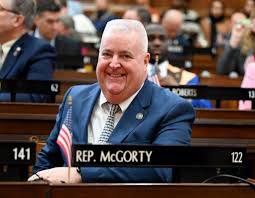
Photo of Ben McGorty
R Connecticut House · District 122 On the 2026 ballot

Rep. Ben McGorty

Compare
Total votes
3,153
all sessions
Attendance
97%
94 missed
Higher than 78% of chamber peers
With party
95%
of cast votes
Lower than 80% of chamber peers
Bipartisan score
2%
crosses aisle rarely
Higher than 79% of chamber peers
Sponsored
254
bills & resolutions
Higher than 78% of chamber peers
Committees
3
assignments
254 bills and resolutions

Sponsored bills

Total
254
Primary
254
Co-sponsor
0
This page
254
matching current filters
Primary SB 74
In committee · Connecticut Senate · Lead sponsor
AN ACT ESTABLISHING A TAX CREDIT FOR DAIRY FARMERS.

Maddy summarySB 74 would create a $20 million state tax credit for dairy farmers to help offset income losses during periods when milk prices drop. The credit directly affects dairy farmers in the state who experience cyclical price fluctuations in milk sales. The bill establishes this tax credit as a fixed pool, meaning it would provide financial relief to eligible farmers when milk prices fall below certain levels. This is a direct policy change to support dairy farm revenue stability, not a procedural measure.

In committee Feb 4, 2026 0 co-sponsors
Primary HB 5007
In committee · Connecticut House · Lead sponsor
AN ACT FULLY REIMBURSING MUNICIPALITIES FOR REVENUE LOSS ASSOCIATED WITH A VETERANS PROPERTY TAX CREDIT.

Maddy summaryHB 5007 requires the state to fully reimburse municipalities for revenue lost when veterans qualify for a property tax credit under subdivision (83) of section 12-81 of the general statutes. This directly affects municipalities that administer the veterans' property tax exemption, which reduces local tax revenue. The bill's key mechanism is a state-funded reimbursement to offset the financial impact of the exemption. It does not change the veterans' tax credit itself but ensures municipalities are compensated for the revenue loss. (Bill: HB 5007, LCO No. 288)

In committee Feb 4, 2026 0 co-sponsors
Primary HB 5006
In committee · Connecticut House · Lead sponsor
AN ACT CONCERNING THE SALES AND USE TAXES IMPOSED ON MEALS SOLD BY AN EATING ESTABLISHMENT, CATERER OR GROCERY STORE.

Maddy summaryHB 5006 eliminates a 1% sales and use tax on meals sold by restaurants, caterers, and grocery stores. The bill directly affects these businesses by removing an additional tax on food sales, reducing their operational costs. Key provision: it amends tax law to remove the specific 1% surcharge applied to meals at these establishments. The purpose is to simplify the tax structure for food service providers without changing general sales tax rates. This is a direct policy change affecting food retailers and their customers through lower prices.

In committee Feb 4, 2026 0 co-sponsors
Primary HB 5029
In committee · Connecticut House · Lead sponsor
AN ACT CONCERNING MEDICAID RATE INCREASES.

Maddy summaryHB 5029 increases Medicaid provider rates based on phase one of a required rate study (public act 23-186) to ensure rates are competitive with neighboring states and improve access to quality healthcare. It directly affects healthcare providers who treat Medicaid patients, such as hospitals and clinics. The bill mandates rate adjustments to align with regional market standards, aiming to prevent provider shortages and maintain service availability. This policy change focuses on stabilizing provider participation in Medicaid by addressing current rate disparities.

In committee Feb 4, 2026 0 co-sponsors
Primary HB 5005
In committee · Connecticut House · Lead sponsor
AN ACT CONCERNING THE SALES PRICE THRESHOLD OF MOTOR VEHICLES SUBJECT TO A HIGHER SALES AND USE TAXES RATE.

Maddy summaryHB 5005 increases the sales price threshold for motor vehicles subject to a 7.75% sales and use tax rate from $75,000 to "more than $75,000." This means vehicles priced at $75,000 or below will now pay the standard tax rate, while those exceeding $75,000 will be taxed at the higher rate. The bill directly affects high-end vehicle buyers and dealers selling vehicles above this new threshold. It makes no changes to the tax rate itself but adjusts which vehicles qualify for the higher rate.

In committee Feb 4, 2026 0 co-sponsors
Primary HB 5028
In committee · Connecticut House · Lead sponsor
AN ACT REMOVING THE PUBLIC BENEFITS CHARGE FROM ELECTRIC BILLS.

Maddy summaryHB 5028 removes the "Combined Public Benefits Charge" from electricity bills for residential and business customers of electric distribution companies. This bill directly affects all end-use electricity customers in the state by eliminating this specific fee from their monthly bills. The key mechanism shifts the funding source for these public benefits programs from customer bills to the state General Fund. The bill does not change existing public benefits programs but changes how their costs are paid. This is a direct billing change with no impact on program eligibility or service levels.

In committee Feb 4, 2026 0 co-sponsors
Primary SB 82
In committee · Connecticut Senate · Lead sponsor
AN ACT CONCERNING THE COST OF OCCUPATIONAL LICENSES.

Maddy summarySB 82 eliminates all application fees charged by state occupational licensing boards and caps annual license renewal fees at $100 for all professions requiring state licensing. This directly affects individuals seeking or renewing licenses for occupations like plumbers, cosmetologists, electricians, or contractors. The bill requires licensing boards to remove all upfront application costs and limits renewal fees to a maximum of $100 per year. It makes no exceptions for specific professions or fee structures, applying uniformly across all state-licensed occupations. The policy change aims to reduce upfront and recurring costs for workers entering or maintaining licensed careers.

In committee Feb 4, 2026 0 co-sponsors
Primary HB 5008
In committee · Connecticut House · Lead sponsor
AN ACT ESTABLISHING A SMALL BUSINESS TAX CREDIT.

Maddy summaryHB 5008 establishes a $2,080 tax credit per full-time equivalent employee for small businesses meeting the U.S. Small Business Administration's definition (typically businesses with fewer than 500 employees). This credit would directly reduce the state tax liability for qualifying small businesses, providing a concrete financial incentive tied to employee count. The bill amends state tax law to implement this credit, which applies to businesses that meet federal SBA criteria. This policy change specifically targets small business employment costs without altering broader tax structures.

In committee Feb 4, 2026 0 co-sponsors
Primary SB 50
In committee · Connecticut Senate · Lead sponsor
AN ACT ESTABLISHING A PERSONAL INCOME TAX DEDUCTION FOR STIPENDS PAID TO CERTAIN VOLUNTEER FIREFIGHTERS OR VOLUNTEER AMBULANCE MEMBERS.

Maddy summarySB 50 creates a personal income tax deduction for stipends paid to volunteer firefighters and volunteer ambulance members by municipalities, fire departments, or ambulance associations. It directly affects these volunteers who receive small stipends for their service, capping the deductible amount at $15,000 annually from any single organization. The bill amends tax law to allow these stipends to be excluded from taxable income, reducing the tax burden for qualifying volunteers. This policy change provides concrete financial relief for individuals who serve in these critical community roles without full-time compensation.

In committee Feb 4, 2026 0 co-sponsors
Primary SB 78
In committee · Connecticut Senate · Lead sponsor
AN ACT ELIMINATING THE QUALIFYING INCOME THRESHOLDS FOR THE PERSONAL INCOME TAX DEDUCTIONS FOR SOCIAL SECURITY BENEFITS.

Maddy summarySB 78 eliminates income limits that previously restricted who could deduct Social Security benefits from their personal income tax. It directly affects taxpayers receiving Social Security benefits who currently face income thresholds preventing the full deduction. The bill amends section 12-701 of the general statutes to remove these qualifying income thresholds, allowing all eligible Social Security benefit recipients to deduct their benefits regardless of their total income level. This change simplifies the tax deduction process for affected taxpayers without altering the deduction amount itself.

In committee Feb 4, 2026 0 co-sponsors
Showing 41 to 50 of 254 bills
Previous 1 … 4 5 6 … 26 Next