

Maddy summaryHB 5215 allows wrecker operators to use blue lights (in addition to standard yellow or amber lights) while preparing to tow disabled or damaged vehicles. This directly affects professional towing services clearing roadways of stalled vehicles. The bill modifies existing traffic light regulations to include blue lights as a safety measure during the preparation phase of towing. Its stated purpose is to improve visibility and safety for wreckers working on roadways.
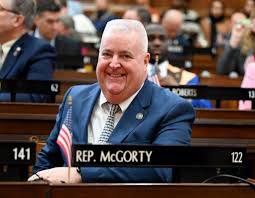
Rep. Ben McGorty
Sponsored bills
Maddy summaryHB 5072 names a section of Church Hill Road in Newtown (from Main Street to Commerce Road) to honor past, current, and future members of the Newtown Hook and Ladder Volunteer Fire Department. This is a ceremonial bill with no policy changes, solely recognizing the fire department's service through a road designation.
Maddy summaryHB 5056 allows municipalities to choose their own primary emergency medical services (EMS) responder from any organization licensed by the Office of Emergency Medical Services. This bill directly affects local governments and licensed EMS providers by replacing a default system with a municipal choice. The key provision amends state law to let each town or city assign a specific licensed EMS organization as its primary responder, rather than following a standard regional assignment. The goal is to give communities greater flexibility in tailoring emergency medical response to their specific needs.
Maddy summaryHB 5034 creates a personal income tax deduction of up to $2,000 for volunteer firefighters, fire police officers, and ambulance members who receive stipends from their local municipality, fire department, or ambulance association. This deduction directly affects volunteer emergency personnel who earn these stipends as part of their service. The bill amends tax code to allow these individuals to subtract the stipend amount (capped at $2,000 annually) from their taxable income. The policy provides a concrete tax benefit for qualifying volunteers without changing broader tax rates or requirements.
Maddy summaryHB 5028 creates a personal income tax deduction for volunteer firefighters and ambulance members who receive stipends from their municipality, volunteer fire department, or volunteer ambulance association. The deduction applies to stipends paid for "other duties performed," limited to $15,000 annually per recipient. This directly affects eligible volunteers whose income includes these stipends, reducing their taxable income. The bill modifies existing tax law to provide this specific deduction for qualifying volunteer service payments.
Maddy summaryThis bill reorganizes fire safety oversight by creating a new Division of Fire Services Administration within the Department of Emergency Services and Public Protection, which will consolidate existing fire-related offices. It also changes how the Commission on Fire Prevention and Control is formed, shifting from a purely governor-appointed body to one where members are selected by the governor, legislative leaders, and various fire service associations. Additionally, the legislation establishes a working group to study the division's operations and includes stricter background requirements for the deputy commissioner leading the emergency management division.
Maddy summaryThis bill creates a Sexual Assault Criminal Justice Response, Enhancement and Model Policy Advisory Council to evaluate and improve how Connecticut handles sexual assault cases. The council will examine current practices by law enforcement, prosecutors, courts, and correctional facilities, including data accuracy, risk assessments, and training for officials. It establishes a diverse group of members appointed by government leaders, including representatives from police, victim advocates, and community organizations, to guide these efforts. The council is tasked with developing a new model policy by July 2025 and updating it annually, which will then be distributed to all law enforcement units in the state.
Maddy summaryThis bill creates the Connecticut-Ireland Trade Commission, a new body within the state legislature dedicated to strengthening economic and academic ties between Connecticut and Ireland. The commission will consist of 20 members appointed by various legislative leaders, the governor, and representatives from higher education and business sectors, all of whom must have ties to Irish affairs or trade relations. Its primary duties include advancing bilateral trade and investment, initiating joint policy actions, and promoting business and academic exchanges between the two regions. Members will serve without pay but can be reimbursed for expenses, and the commission is required to submit annual reports on its activities to state officials. The commission is scheduled to hold its first meeting by November 1, 2024, with initial appointments to be made by October 1 of that year.
Maddy summaryThis bill requires individuals who intentionally injure or kill police animals or dogs in volunteer search and rescue teams to pay financial restitution. The law mandates that these payments cover veterinary costs for injuries and the expenses of purchasing and training a replacement animal if the original one is unable to work. Anyone found guilty of harming these working dogs faces felony charges, potential fines or imprisonment, and the obligation to reimburse the owning unit or individual. The financial penalties are designed to ensure that the costs of replacing injured or killed service animals are borne by the person responsible for the harm.
Maddy summaryThis bill protects farm operations and spring water collection sites from being labeled as nuisances due to common activities like livestock odors, farm noise, or dust, provided these operations follow accepted practices and have been active for at least one year. It also prevents state licensing boards from disciplining healthcare providers based on actions taken in other states that involve reproductive health care services permitted under Connecticut law. The legislation ensures that professionals are not penalized in Connecticut for providing legal medical services out of state, unless their conduct would also be punishable if it had occurred within Connecticut.