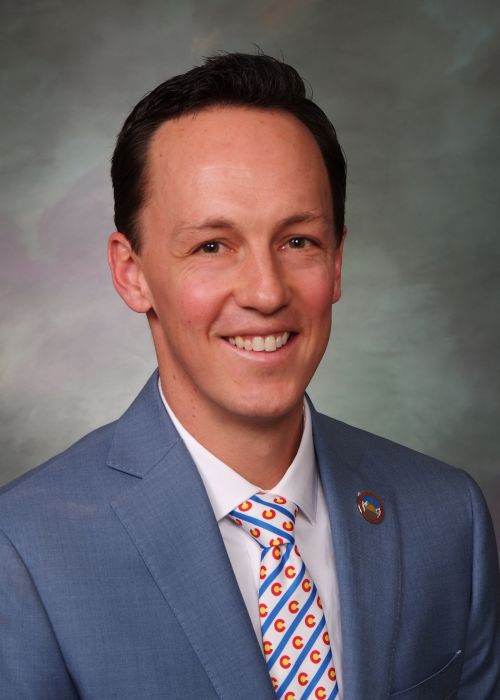
Photo of Dylan Roberts
D Colorado Senate · District 8 On the 2026 ballot

Sen. Dylan Roberts

Compare
Total votes
4,741
all sessions
Attendance
98%
86 missed
With party
94%
of cast votes
Lower than 95% of chamber peers
Bipartisan score
3%
crosses aisle rarely
Higher than 86% of chamber peers
Sponsored
635
bills & resolutions
Near the chamber average
Committees
7
assignments
635 bills and resolutions

Sponsored bills

Total
635
Primary
369
Co-sponsor
266
This page
635
matching current filters
Co-sponsor SJR 25-015
Passed · Colorado Senate · Co-sponsor
Officer Evan A. Dunn Memorial Highway

Maddy summarySenate Joint Resolution 25-015 designates a specific portion of Colorado State Highway 58 as the "Officer Evan A. Dunn Memorial Highway." This action honors Officer Evan A. Dunn, a Golden Police Department officer who died in the line of duty. The bill authorizes the Colorado Department of Transportation to accept donations for the initial placement of memorial signs and to explore a cooperative agreement with the City of Golden for their maintenance.

Passed May 2, 2025 1 co-sponsor
Co-sponsor HB 25-1135
Signed into law · Colorado House · Co-sponsor
Communication Devices in Schools

The act requires, on or before July 1, 2026, the Colorado school for the deaf and the blind, and each institute charter school, district charter school, and a local board of education for its schools that are not district charter schools, to adopt, implement, and post on its website a policy concerning student communication device possession and use during the school day. At a minimum, the policy must describe the prohibitions and exceptions, if any, regarding student communication device possession and use during the school day. (Note: This summary applies to this bill as enacted.)

Signed into law May 1, 2025 1 co-sponsor
Co-sponsor HB 25-1132
Signed into law · Colorado House · Co-sponsor
Military Family Behavioral Health Grant Program

The act expands the veterans mental health services program to provide grants to local nonprofit organizations to establish and expand community behavioral health programs that provide behavioral health services to service members, veterans, and family members of service members and veterans. The act reduces the reappropriated funds appropriation made in the long bill to the department of military and veterans affairs for use by the division of veterans affairs for veterans mental health services by $5,000,000; except that the reduction is not made if: The amount of reappropriated funds made in the long bill to the department of military and veterans affairs for use by the division of veterans affairs for veterans mental health is less than $5,000,000; or The long bill does not include an appropriation to the department of military and veterans affairs for use by the division of veterans affairs for veterans mental health.(Note: This summary applies to this bill as enacted.)

Signed into law May 1, 2025 1 co-sponsor
Co-sponsor HB 25-1185
Signed into law · Colorado House · Co-sponsor
Child Conceived from Sex Assault Court Proceedings

Under current law, a parent who wants to relinquish their child must satisfy certain requirements. If the parent who wants to relinquish their child is a victim of sexual assault that resulted in the conception of the child to be relinquished, the act: Allows the relinquishment petitioner (petitioner) to provide the juvenile court with documentation concerning the sexual assault or conception, including a sworn affidavit; Exempts the petitioner from having to satisfy certain relinquishment requirements if the court finds that the petitioner is a victim of sexual assault that resulted in the conception of the child to be relinquished; and Exempts the petitioner of all legal obligations they may have with respect to the child if the court grants a final order of relinquishment. On or before January 1, 2026, the state court administrator shall develop a, or modify an existing, standardized form for a petitioner to file to terminate another person's parent-child legal relationship because the child was conceived as a result of sexual assault. (Note: This summary applies to this bill as enacted.)

Signed into law May 1, 2025 1 co-sponsor
Co-sponsor HB 25-1116
Signed into law · Colorado House · Co-sponsor
Department of Corrections Search Court Records Before Offender Release

The act requires the department of corrections (department) to search all information available to the department to determine whether an offender held at a correctional facility is subject to an outstanding warrant or if the offender has a pending case in a Colorado court. The department is required to conduct the search when the department conducts the initial comprehensive evaluation of the offender's sentence and 3 to 8 months prior to the offender's community correction eligibility date. The act requires the department to establish guidelines and policies that address requests for additional searches as may be needed by the public defender liaison to the department. If the department determines that an offender is subject to a warrant or has a pending case in a Colorado court, the department shall notify the offender, the public defender liaison to the department, and the court that issued the warrant or in which the case is pending, as applicable. The general assembly encourages a court to ensure the offender appears before the court, is assigned counsel if the defendant is eligible for court-appointed counsel, allows the offender to resolve the warrant in a timely manner, and facilitates virtual appearance for the offender. The act does not prohibit the department from searching for outstanding warrants at any other time. The act requires the office of state public defender to designate an email address for the public defender liaisons to the department of corrections to receive notifications from the department. (Note: This summary applies to this bill as enacted.)

Signed into law Apr 30, 2025 1 co-sponsor
Primary SB 25-031
Signed into law · Colorado Senate · Lead sponsor
Single Point of Contact Wireless Services

Under current law, the Colorado broadband office provides technical assistance to grant applicants related to grants to deploy broadband services. The act expands the technical assistance to grant applicants to include assistance related to grants to deploy wireless service. The act requires an emergency alert sent by the state or a county, municipality, or alerting authority to be sent in a predominant minority language if the county has at least 2,000 citizens who are 18 years of age or older and who speak the predominant minority language and speak English less than very well, as defined by the United States bureau of the census American community survey or comparable census data. The state, counties, municipalities, and alerting authorities are encouraged to use available technology to issue emergency alerts in as many languages as possible in the same method as an English alert. Each alerting authority that is required to send emergency alerts in a predominant minority language is encouraged to conduct community outreach to inform people with limited English proficiency of the availability of language interpretation and translation options for emergency alerts. Alerts must comply with the act by July 1, 2027. The act allows the 911 services enterprise to distribute grants to local alerting authorities to implement language and accessibility services for emergency alerts. The act imposes the 911 prepaid wireless charge and 988 surcharge to prepaid wireless telecommunication services. (Note: This summary applies to this bill as enacted.)

Signed into law Apr 30, 2025 0 co-sponsors
Primary HB 25-1303
Passed · Colorado House · Lead sponsor
Funding for Motor Vehicle Collision Prevention

Section 1 of the bill creates the crash prevention enterprise (enterprise) in the department of transportation (CDOT) for the purpose of lowering automobile insurance costs by providing funding for transportation system infrastructure improvements and other data-driven strategies that reduce the number of collisions that involve a motor vehicle, particularly collisions between a motor vehicle and a vulnerable road user or wildlife (eligible projects). Beginning January July 1, 2026, the enterprise is authorized to impose a crash prevention fee (fee) of up to a specified maximum amount on the policyholder of each automobile insurance policy issued in the state on a per-policy basis for each vehicle insured under an automobile insurance policy other than a motor vehicle that weighs 26,000 pounds or more or a motorcycle. Each insurer that issues an automobile insurance policy must collect the fee from the policyholder and pay the fee to the enterprise. Fee revenue is credited to a newly created crash prevention enterprise fund (fund) and continuously appropriated to the enterprise. The specified maximum amount of the fee adjusts annually on July 1, 2027, and on each July 1 thereafter for inflation, as measured by the rolling 5-year average of the national highway construction cost index published by the federal highway administration in the United States department of transportation. Fee revenue is credited to a newly created crash prevention enterprise fund (fund) and continuously appropriated to the enterprise. The enterprise is authorized to expend 80% 70% of its available revenue the money in the fund to issue grants to eligible entities, which are local governments, state or federally recognized tribal entities, public entities that are not part of the state, and private entities, for eligible projects that reduce motor vehicle collisions with vulnerable road users, as defined by the bill, and 20% 30% of its available revenue the money in the fund to fund eligible projects that reduce motor vehicle collisions with wildlife. In addition to an annual reporting requirement, the enterprise is required, no later than January 31, 2031, to present a report to specified legislative committees that includes, at a minimum, any recommendations that the enterprise may have for statutory changes with respect to the imposition of the fee and the funding of eligible projects; assessments as to whether the bill's definition of "vulnerable road user" remains appropriate and whether the fee is being imposed on the correct types of motor vehicles; and a cumulative account of the enterprise's revenue, applied for and awarded grants, and projects funded and completed between July 1, 2026, and June 30, 2030. Section 2 authorizes the division of insurance in the department of regulatory agencies, upon receiving notice from the enterprise of an insurer's failure to collect the fee from its automobile insurance policyholders and pay the fee to the enterprise, to institute an enforcement proceeding and seek specified civil penalties from the insurer. (Note: Italicized words indicate new material added to the original summary; dashes through words indicate deletions from the original summary.) (Note: This summary applies to the reengrossed version of this bill as introduced in the second house.)


Passed Apr 29, 2025 0 co-sponsors
Co-sponsor SB 25-121
Passed · Colorado Senate · Co-sponsor
Medicaid Reimbursement for Vagus Nerve Stimulation

Beginning July 1, 2025 No later than January 1, 2026 , the bill requires the department of health care policy and financing (HCPF) to seek federal authorization to reimburse acute care hospitals and ambulatory surgery facilities that provide vagus nerve stimulation therapy to members diagnosed with drug-resistant epilepsy at a rate that is equal to 75% 60% of the cost for acquiring the vagus nerve stimulator device, which reimbursement is in addition to and does not supplant the reimbursement for any necessary surgical procedure associated with implanting the device. Beginning January 1, 2029, the bill requires HCPF to increase the reimbursement to a rate that is equal to 75% of the cost for acquiring the vagus nerve simulator device. (Note: Italicized words indicate new material added to the original summary; dashes through words indicate deletions from the original summary.) (Note: This summary applies to the reengrossed version of this bill as introduced in the second house.)
Passed Apr 28, 2025 1 co-sponsor
Co-sponsor SB 25-240
Signed into law · Colorado Senate · Co-sponsor
Electronic Discovery in Criminal Cases Task Force

The act creates the electronic discovery in criminal cases task force (task force), which consists of 11 task force members. The purpose of the task force is to study the costs and management of electronic discovery in criminal cases. On or before November 1, 2025, the act requires the task force to submit a report to the joint budget committee and the joint technology committee describing the work of the task force, findings and recommendations regarding the issues and topics considered by the task force, and legislative proposals and expected costs. The act repeals the task force, effective January 1, 2027. (Note: This summary applies to this bill as enacted.)

Signed into law Apr 28, 2025 1 co-sponsor
Co-sponsor SJR 25-022
Passed · Colorado Senate · Co-sponsor
Holocaust Memorial

Maddy summarySenate Joint Resolution 25-022 is a commemorative resolution concerning the remembrance of the Holocaust. It declares the General Assembly's commitment to remembering the Holocaust and encourages school districts and universities to promote antibias, bullying prevention, and Holocaust and genocide education programs to prevent antisemitic incidents, particularly those targeting Jewish students.

Passed Apr 25, 2025 1 co-sponsor
Showing 301 to 310 of 635 bills
Previous 1 30 31 32 64 Next