

Current law requires the division of administration (division) within the department of public health and environment to report annually to the water quality control commission (commission) and to include in the report any regulatory or legislative recommendations the division may have. The act requires the report to also include: Information on the division's timing in considering and issuing water quality permits (permits); and For the report submitted in 2026, a detailed discussion of how the division has prioritized reducing the permit backlog, implemented recommendations from water quality permittees (permittees) for permitting efficiency, and increased safe drinking water program inspections. The act requires the division, upon receipt of an application to modify a permit, to limit its review and its approval or denial of the application to the scope of the specific requests contained in the application. The act requires the commission to adopt rules on or before December 31, 2026, that establish procedures whereby the division, prior to giving public notice of a complete permit application for an individual permit and the division's preliminary analysis of the application, may provide a period of public notice and review of a preliminary draft prepared by the division. If a period of public notice and review is required by rules of the commission, the period of public notice and review may not exceed 14 days, and the purpose of the review is limited to identifying errors in the division's preliminary draft. On or before December 31, 2027, the division must propose rules to the commission that establish a time frame during which the division will either grant or deny applications for each type of permitting action. On or before June 30, 2028, the commission shall adopt rules based on the division's proposal. The rules must establish the time frames for permitting actions. The act requires the division to consider current debt service on existing local government water infrastructure when developing schedules of compliance for new effluent limits in local government permits. Any schedule of compliance for new effluent limits in local government permits must, consistent with state and federal law, consider the local government's financial capability to repay existing debt on water infrastructure or to fund water infrastructure upgrades before requiring new water infrastructure upgrades. To the extent allowable under federal law, the division may issue compliance schedules in a local government permit for a new effluent limit in excess of 20 years. The act states that, on and after May 1, 2026, after an application for permit modification or permit renewal has been pending before the division for 60 days, or for any application for permit modification or permit renewal that is pending before the division as of May 1, 2026, or if the division informs an applicant that the division will not process an application for preliminary effluent limitations, the applicant and the division may mutually agree to use a qualified and independent nongovernmental contractor (contractor) under the direction of the division to provide the division with technical assistance in completing the permit action. An applicant shall bear the contractor's costs for any technical assistance provided by the contractor and shall pay the contractor for such costs. The division may charge an applicant an additional fee in an amount not exceeding 10% of the contract amount for contract administration, technical review, and additional permit processing, which fee is credited to the clean water cash fund. The act requires the division, upon a permittee's request, to make available to the permittee all documents, data, and information the division relied upon in developing the permittee's permit modification or permit renewal, except to the extent that such materials are protected by an applicable privilege or exception. The act makes the following transfers of money: On July 1, 2025, $111,000 from the water quality improvement fund to the drinking water cash fund; On July 1, 2025, $3,518,564 from the perfluoroalkyl and polyfluoroalkyl substances cash fund to the clean water cash fund; On July 1, 2026, $3,002,435 from the perfluoroalkyl and polyfluoroalkyl substances cash fund to the clean water cash fund; and On July 1, 2026, $516,129 dollars from the perfluoroalkyl and polyfluoroalkyl substances cash fund to the drinking water cash fund. For the 2025-26 state fiscal year, the act appropriates $2,904,599 to the department of public health and environment. This appropriation consists of $446,315 from the drinking water cash fund and $2,458,284 from the clean water cash fund. For the 2025-26 state fiscal year, the act appropriates $160,611 to the department of law. This appropriation is from reappropriated funds received from the department of public health and environment. The act also makes and reduces certain appropriations as adjustments to the 2025 general appropriations act. (Note: This summary applies to this bill as enacted.)
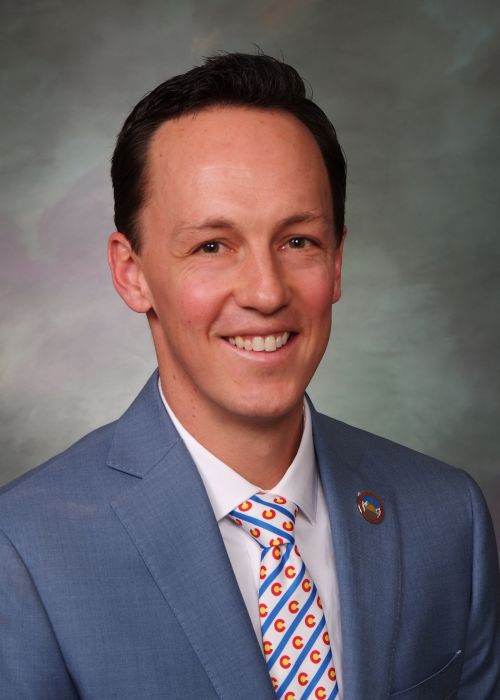
Sen. Dylan Roberts
Sponsored bills
The office of legislative workplace relations (OLWR) was established in 2019 as an entity within the office of legislative legal services to provide services to the general assembly, its members and employees, and the legislative services agencies. Specifically, the OLWR is directed to provide services related to employee relations, training, compliance, workplace culture, and workplace harassment, including investigations of complaints under the general assembly's policies on workplace expectations and workplace harassment. The act rebrands the OLWR as the legislative human resources division and directs the division to provide human resource services to the legislative branch, which includes the existing services required by law and additional services, such as benefits administration, compensation and classification, hiring and recruitment, and new employee onboarding, within available resources. (Note: This summary applies to this bill as enacted.)
The act creates a civil cause of action for a peace officer if the peace officer reports or discloses conduct that is in violation of, or the peace officer reasonably believes is in violation of, any law or policy and the report or disclosure is a contributing factor in the employer of the peace officer's decision to take adverse employment action against the peace officer. A peace officer may seek the following damages: Reinstatement; Back pay with interest; Any other equitable relief the court deems appropriate; Compensatory damages for other pecuniary losses, emotional pain and suffering, inconvenience, mental anguish, loss of enjoyment of life, and other nonpecuniary losses; and Reasonable attorney fees and costs. The act creates an affirmative defense to the action if the peace officer's employer would have taken the action that forms the basis of the suit against the peace officer based on a legitimate nonretaliatory basis. The action is not subject to the "Colorado Governmental Immunity Act". The statute of limitations to bring the action is 2 years. The act does not apply to an employee who provides false information or who does not follow internal reporting and administrative procedures related to whistleblower conduct. All law enforcement agencies shall provide a training to employees or a workplace posting, or both, regarding the requirements of the act. (Note: This summary applies to this bill as enacted.)
The act authorizes the owner of a trailer to register the trailer for as long as the owner owns the trailer. The trailer must be class B or class D personal property. To register the trailer, the owner must pay: 2 years of annual specific ownership tax; and $55.82 to cover fees. Upon the transfer of ownership of the trailer, the owner is required to notify the department of revenue of the transfer. (Note: This summary applies to this bill as enacted.)
The act modifies current law regarding the process by which a policyholder may request a certified copy of their insurance policy (policy) from a homeowners insurance carrier (carrier) and the carrier's duty to comply. The act clarifies that such a request must be in written form and received by the carrier's registered agent (agent) and that the carrier's window of time to make the policy available begins when the agent receives the request. The act also imposes a penalty against a carrier that fails to comply with a policyholder's request for a certified copy of their policy in the amount of $50 per day and authorizes the award of attorney fees and costs for a policyholder's enforcement of the requirement. (Note: This summary applies to this bill as enacted.)
The division of water resources in the department of natural resources (division) is responsible for administering water rights and issuing water well permits, among other duties. Under current law, after having received a permit to appropriate designated groundwater or construct a well outside the boundaries of a designated groundwater basin, a permit holder is required to construct the well within one year after the date of issuance of the permit. If the well is not constructed within one year, the permit expires; except that the ground water commission (commission) in the division or the state engineer, as applicable, may grant a single one-year extension. The act extends the time frame for construction of a well to 2 years, eliminating the need for the commission or the state engineer to approve a one-year extension to the initial one-year construction time frame, except for permits issued for federally authorized water projects. The act also removes the requirement that the commission or state engineer must mail a certified letter to the permit holder before a permit can be formally expired. The act allows the commission or state engineer to reinstate an expired permit if the applicant for reinstatement of the permit can show that the well was completed in a timely manner and submits a $30 fee. Under current law, the division engineer of each water division is required to decennially present to the water court a list of water rights that meet the criteria for abandonment. The act splits this decennial abandonment process into 2 batches, grouped by water division and spaced 5 years apart, beginning with 2030 and 2035. The act maintains the requirement that the abandonment process be performed every 10 years in each water division. The act extends certain time frames relating to the well permitting process. Lastly, the act eliminates final permitting requirements for non-Denver Basin bedrock aquifer wells in the designated basins. (Note: This summary applies to this bill as enacted.)
The act requires the state board of education (state board) to adopt standards related to Black historical and cultural studies (standards). Local education providers shall incorporate the standards into courses for public elementary and secondary school students in the state no later than 2 years after the state board adopts the standards. The act aligns the timeline for the development, adoption, and integration of the standards with the 6-year cycle that the state board of education currently uses for revising the state academic standards. The act creates the Black historical and cultural studies advisory committee (committee) in the department of education (department) to recommend standards and related materials and to provide technical assistance at the request of local education providers implementing the standards. The committee's recommendations must include updates to the state's history and civics standards and must advance developmentally appropriate but comprehensive instruction that features factual accounts of the struggles and contributions of Black Americans in all fields of endeavor. Using the committee's recommendations, the department will create and maintain a resource bank of research-based, scholarly articles and promising program materials and curricula pertaining to Black historical and cultural studies. For the 2025-26 state fiscal year, the act appropriates $19,225 from the general fund to the department for costs related to content specialists. (Note: This summary applies to this bill as enacted.)
Beginning January 1, 2027, the act requires large group health benefit plans to provide coverage for the treatment of the chronic disease of obesity and the treatment of pre-diabetes, including coverage for a comparable program to the national diabetes prevention program, medical nutrition therapy, intensive behavioral or lifestyle therapy, and metabolic and bariatric surgery. For a large group health benefit plan offered in the state, the act requires carriers to offer the policyholder the option to purchase coverage for FDA-approved anti-obesity medications, including at least one FDA-approved GLP-1 medication. The commissioner of insurance may adopt rules for the implementation of the act. (Note: This summary applies to this bill as enacted.)
The act requires the office of just transition (office) in the department of labor and employment to prioritize awarding funding to support tier one and tier 2 coal transition communities experiencing socioeconomic impacts of coal closures and for opportunities for economic diversification, local community input, feasibility studies of specific proposed projects, and needs assessments. The office is required to use money appropriated to the just transition cash fund after July 1, 2025, to support programs that support targeted investment in coal transition communities by collaborating with coal transition communities and eligible entities, state and regionally recognized governmental and economic development entities, employee organizations that represent coal transition workers, and workers who are not affiliated with employee organizations to implement the most effective projects and programs for those communities. The act requires the office to annually report to the joint budget committee and at the annual "State Measurement for Accountable, Responsive, and Transparent (SMART) Government Act" hearings of the senate local government and housing committee and the house transportation, housing, and local government committee about the grants awarded by the office during the preceding state fiscal year, their recipients, and the purpose for which they were awarded. A public entity may invest public funds only as allowed by law. The act specifies that the investment of a payment or settlement to offset the socioeconomic impacts to a community or government from the closure of a coal mine or coal power generating station is not subject to these investment limitations. The act allows the executive director of the department of local affairs to establish a policy preference for awarding up to 70% of the money credited to the local government severance tax fund to just transition communities for a 3-year period beginning January 1, 2026. The act extends the deadline for the submittal by the director of the Colorado energy office of the findings and conclusions of assessments of advanced energy solutions in the northwestern and west end of Montrose county and in southeastern Colorado from July 1, 2025 to December 19, 2025, and makes the requirement that the findings and conclusion be submitted contingent on the director having sufficient federal money to support the submittal. (Note: This summary applies to this bill as enacted.)
The act refers 2 ballot issues to the voters at the November 2025 statewide election concerning funding for the healthy school meals for all program. Section 2 refers a ballot issue to the voters at the November 2025 statewide election to allow the state to retain and spend state revenue that would otherwise need to be refunded for exceeding the estimate in the ballot information booklet analysis for Proposition FF and to allow the state to maintain the increases in state taxable income established in Proposition FF that would otherwise need to be decreased. If voters reject the ballot issue, the state will both: Refund $12,430,388 to individuals who have a federal taxable income of $300,000 or more and claimed itemized or standard state income tax deductions greater than $12,000 for single tax return filers and $16,000 for joint tax return filers; and Adjust the limit on itemized deductions established in Proposition FF to a level that would have reduced the amount of income tax revenue attributable to these itemized deductions by $12,430,388. If voters approve the ballot measure: The state will not refund $12,430,388 to individuals who have a federal taxable income of $300,000 or more and claimed itemized or standard state income tax deductions greater than $12,000 for single tax return filers and $16,000 for joint tax return filers; and The increases in federal taxable income as a result of Proposition FF will stay at the levels established by Proposition FF. Section 3 refers a ballot issue to the voters at the November 2025 statewide election to allow the state to increase taxes by $95 million annually by increasing state taxable income to support the healthy school meals for all program. If voters approve the ballot issue: Income tax deductions for individuals who have a federal taxable income of $300,000 or more will be reduced from current levels to $1,000 for single filers and $2,000 for joint filers; and The state will allocate the additional revenue generated by the reduction in income tax deductions to the healthy school meals for all program. If voters reject the ballot issue, income tax deductions will not be reduced, and there will not be any additional revenue to be allocated to the healthy school meals for all program. In addition to the income tax changes and potential refunds that may result from voters approving or rejecting the ballot issues described in sections 2 and 3, the act also changes the healthy school meals for all program cash fund (fund) and healthy school meals for all programs. If voters approve the ballot issue submitted pursuant to section 2 and reject the ballot issue submitted pursuant to section 3, $1 million is transferred annually from the fund to local school food purchasing programs. If voters approve the ballot issue submitted pursuant to section 3, regardless of whether the voters approve the ballot issue submitted pursuant to section 2: The permissible distribution of local food purchasing grants is modified; Certain school food authorities are allowed to collaborate to implement advisory committees; The duties of an advisory committee are clarified; and The distribution of funds from the fund is changed so that the amounts distributed through local food purchasing grants for increasing wages or providing stipends for individuals whom the participating school food authority employs to directly prepare and serve food for school meals and through the local school food purchasing technical assistance and education grant program are modified based on the amount of money in the fund. NOTE: Certain provisions of the act are contingent on the results a measure concerning Proposition FF refunds or Proposition FF revenue increases being either approved or not approved by a majority of voters at the November 2025 statewide election.(Note: This summary applies to this bill as enacted.)