

Regulation of public livestock markets - continuation under sunset law - licensure. The automatic termination date of the regulation of public livestock markets is extended until 2034 pursuant to sunset law. Section 3 repeals a requirement that an applicant for a license prove financial stability, business integrity, and fiduciary responsibility and to provide a statement of assets and liability. Section 4 repeals a requirement that a licensed livestock market meet several size and premises standards. Section 4 replaces this with a requirement that a premises have adequate facilities necessary to operate a public livestock market. Sections 5 and 6 repeal provisions that imply that the state board of stock inspection commissioners regulate the sanitation of public livestock markets. Section 7 clarifies that the veterinarian who inspects livestock at a public livestock market is not employed by the department of agriculture and that livestock is inspected, not examined, for clinical signs of injury or disease. Section 7 also requires the veterinarian to be accredited. (Note: This summary applies to this bill as enacted.) Read More
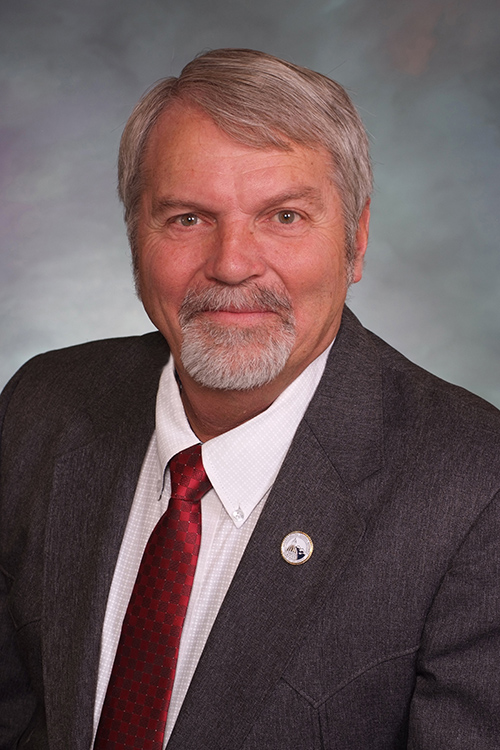
Sen. Rod Pelton
Sponsored bills
Species conservation trust fund projects - appropriation - transfers. The act appropriates $3.9 million from the species conservation trust fund for programs submitted by the executive director of the department of natural resources that are designed to conserve native species that state or federal law list as threatened or endangered or that are candidate species or are likely to become candidate species as determined by the United States fish and wildlife service, allocated as follows: Native terrestrial wildlife conservation, $615,500; Native aquatic wildlife conservation, $839,000; Platte river recovery implementation program, $1,940,000; Colorado river basin native fish recovery programs, $205,500; and Federal endangered species act litigation program, $300,000. On July 1, 2019, the act transfers $600,000 from the Colorado water conservation board construction fund to the species conservation trust fund. For the 2019-20 state fiscal year and each of the 4 subsequent state fiscal years, the act transfers $5,000,000 from the severance tax operational fund to the species conservation trust fund. (Note: This summary applies to this bill as enacted.) Read More
Colorado food - school grant program - nonprofit grant program - appropriation. The act establishes a grant program in the department of education (CDE) to encourage providers that are entitled to federal money for lunches for students (participating providers) to purchase food products from Colorado growers, producers, and processors (Colorado food). The grant program reimburses participating providers for the amount of Colorado food that the provider purchased in the previous school year. The act caps the reimbursements at $500,000 per year. The act establishes a separate program in CDE to make a grant to a nonprofit organization to make grants to entities that promote the sale of Colorado food to schools and to eligible providers to encourage the purchase of Colorado food. The nonprofit organization is required to conduct an annual evaluation and report to CDE. For the 2019-20 state fiscal year, the act appropriates $168,942 from the general fund to CDE for the school purchasing programs. (Note: This summary applies to this bill as enacted.) Read More
Read More
The bill states that food is misbranded as "meat" or a cut of meat if it does not come from animals and that lab-grown meat is misbranded as "meat" or a cut of meat unless these terms are not modified by "lab-grown" or "artificially cultured".(Note: This summary applies to this bill as introduced.) Read More
Beginning with the third quarter of the 2020-21 state fiscal year, the concurrent resolution allows the transfer of available net proceeds minus any money required to pay bonds issued by law by the Great Outdoors Colorado (GOCO) trust fund board of every state-supervised lottery game operated under the authority of section 2 of article XVIII of the state constitution to the state education fund.(Note: This summary applies to this concurrent resolution as introduced.) Read More
For property tax years commencing on or after January 1, 2020, but before January 1, 2030, the bill exempts from property tax business personal property used to manufacture wind turbines or components of wind turbines at the site where the wind turbines will be placed into service.(Note: This summary applies to this bill as introduced.) Read More
Under current law, certain freestanding and office-based facilities performing outpatient procedures such as liposuction and radiation treatments are not regulated to the same extent as facilities within a hospital and, in some cases, not at all. The bill extends the jurisdiction of the department of public health and environment to license these facilities and to adopt rules governing their operation. (Note: This summary applies to this bill as introduced.) Read More
Read More
Current law requires each county to publish a report about its expenses and contracts (expense report), the salaries of public employees and officials in the county (salary report), and the financial statements for each fund kept by the county treasurer (financial statement). The expense report is published monthly and the salary report is published twice per year. The bill changes the salary report to an annual report. Commencing January 1, 2020, the bill allows a county to publish the expense report, the salary report, and the financial statement on a county website with a link to the report published in at least one legal newspaper.(Note: This summary applies to this bill as introduced.) Read More