

The act repeals the health-care delivery system reform incentive payments program in the Colorado healthcare affordability and sustainability enterprise (enterprise) and creates the hospital quality incentive program (incentive program) to use enterprise hospital provider fee revenue to make additional payments to hospitals that meet performance metrics in delivering safer and more effective care that improves patient outcomes and reduces preventable utilization to reduce health-care costs. Prior to implementing the program, the enterprise board shall approve the percentage of hospitals' reimbursement in the incentive program and the incentive program structure, performance measures, and scoring methodology. Once the incentive program is implemented, the total amount of payments made under the incentive program must not exceed 9% of the total reimbursements made to hospitals in the previous state fiscal year.(Note: This summary applies to this bill as enacted.)
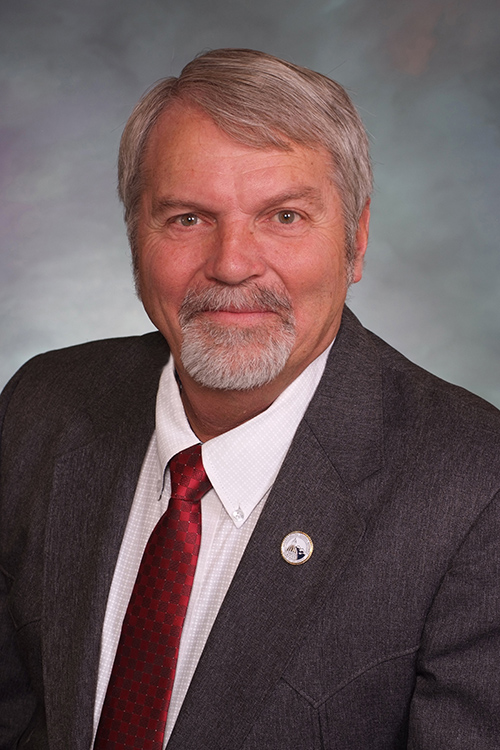
Sen. Rod Pelton
Sponsored bills
Under current law, the state treasurer is required to transfer $10.5 million from the general fund to the multimodal transportation and mitigation options fund every July 1 beginning on July 1, 2024, and ending on July 1, 2031. The act eliminates this annual transfer only for 2026, 2027, and 2028. The act decreases the cash funds appropriation from the multimodal transportation and mitigation options fund created in the annual general appropriation act for the 2026-27 state fiscal year made to the department of transportation for multimodal transportation projects by $10.5 million.(Note: This summary applies to this bill as enacted.)
In 2022, the general assembly enacted Senate Bill 22-110, concerning a requirement that a wind-powered energy generation facility be equipped with light mitigating technology (technology), to require an owner or operator of a new wind-powered energy generation facility (facility) to install technology at the facility and to obtain federal aviation administration (FAA) approval before installing the technology. An owner or operator of a facility can request from the governing body of the local government in which the facility is located an extension of up to 24 months to install the technology. The act requires the owner or operator of a facility to also obtain federal communications commission (FCC) approval for installation of the technology and requires that a governing body of a local government grant an owner or operator of a facility an extension of time to install the technology if FAA, FCC, or other federal agency approval is delayed. The act also requires that an extension of time granted by the governing body of a local government is at least 24 months in duration.(Note: This summary applies to this bill as enacted.)
The act requires the nonemergency medical transportation broker (broker) to establish the transportation community advisory board (TCAB) and requires the state department of health care policy and financing (state department) to collaborate with the TCAB prior to establishing rules and processes for the safety and oversight of nonmedical transportation services and nonemergency medical transportation (NEMT) services. The act requires, in collaboration with the TCAB, certain rules for NEMT the state department must adopt. The state department may impose trip caps or market-share restrictions on a transportation provider (provider) as part of corrective action plan. The act requires providers to use vehicles equipped with 2-way video cameras and a video recording system when transporting members. The act establishes how the broker must roll out their implementation and requires the broker to provide all providers with software, a communication toolkit, training, and technical assistance to facilitate NEMT services. The broker may encourage medicaid members (members) to book transportation services at least 2 days before their requested transportation date, and the broker shall accept and make reasonable efforts to fulfill same-day and next-day transportation requests. The act requires providers, only after all service regions have been implemented, to accommodate member requests for preferred or alternate drivers when operationally feasible. The act requires the broker, and, if there is no broker, the providers to verify that individuals using the transportation services are eligible members during the scheduling of transportation services. The act prohibits the broker from operating, owning, or controlling a provider in Colorado. The act requires the broker to provide their trip assignment rules and procedures to the state department for approval and for publication on the state department's website. The act allows a transportation network company to provide NEMT services when a provider is unavailable. The state department shall ensure all transportation providers, drivers, and vehicles are credentialed, and services provided by noncredentialed drivers or in noncredentialed vehicles are not eligible for reimbursement. The act prohibits the state department from denying payment of services to providers if the provider provides scheduled transportation services in good faith based on the information provided by the broker or if the provider had no knowledge of an inaccuracy and the provider followed all applicable rules and procedures. Subject to available appropriations, the act requires the state department to audit providers and audit the broker annually. The act requires the state department to categorize all NEMT expenditures as medical services and make changes to the NEMT program as necessary to obtain medical services federal match rates for NEMT services. The act also eliminates the requirement that the state department provide transportation services as an administrative cost. The act reduces appropriations to the state department from the general fund by $76,639 and from the healthcare affordability and sustainability hospital provider fee cash fund by $20,941,853.(Note: This summary applies to this bill as enacted.)
The act establishes the ibogaine research pilot program (pilot program) in the behavioral health administration (BHA) to research the safety and effectiveness of using ibogaine to treat mental health conditions and substance use disorders. The act requires the BHA to establish a committee to review pilot program site applications and make recommendations to the BHA on which applicants to accept. The BHA may select up to 5 ibogaine pilot sites. The act allows the BHA to seek, accept, and expend gifts, grants, and donations and establishes the ibogaine research pilot program cash fund. The pilot program is contingent on the BHA receiving sufficient gifts, grants, and donations to administer the pilot program and award grants to the selected ibogaine pilot sites to help with financing needs. Under current law, the division of natural medicine advisory board consists of 15 voting members, 8 of whom must have general expertise and experience related to natural medicine and 7 of whom must have specialized expertise and experience in various areas of natural medicine. The act amends the expertise and experience requirements to apply equally to all 15 voting members. The act adds that a facilitator of natural medicine services is not liable for a physical or psychological injury that a participant may experience as a result of the facilitator's performance or supervision of the natural medicine services that a participant receives, unless the injury is the result of the facilitator's intentional misconduct, gross negligence, or a deviation from the recognized standard of care. The act authorizes the state licensing authority for natural medicine or natural medicine product (state licensing authority) to adopt rules related to the administration, manufacturing, and use of ibogaine. The act sets requirements for how the state licensing authority must prioritize reviewing applications for licensure to facilitate natural medicine services and allows the state licensing authority to set different licensing fees depending on the type of natural medicine the applicant is seeking licensure for. The act allows the state licensing authority to accept gifts, grants, and donations from public or private sources and requires gifts, grants, or donations received to be deposited in the regulated natural medicine division cash fund. The act requires the BHA to work to secure federal research and development funding available through the advanced research projects agency for health within the federal department of health and human services, or other available funding, in order to advance research on the use of ibogaine for the treatment of serious mental illness. The act updates the powers and duties of the director of the division of professions and occupations to include adopting rules that guide the use and administration of ibogaine. A licensee seeking to cultivate, manufacture, dispense, or administer ibogaine shall, in consultation with Indigenous communities, establish a benefit-sharing plan that directly benefits those Indigenous communities. The act:Updates definition of 'administration session' to include the use of regulated natural medicine and regulated natural medicine product that the participant purchases to consume during the administration session;Prohibits a person from advertising bona fide harm reduction services or bona fide support services offered for remuneration, advertising natural medicine or natural medicine products, or using harm reduction services or support services to conduct sales of natural medicine;Clarifies that the state licensing authority is not required to conduct routine, periodic, or pre-operational inspections as a condition of licensure unless expressly required;Requires state licensing authority to adopt rules regarding licensing privileges and restrictions of a limited regulated natural medicine sales license and eligibility requirements for an applicant to obtain a limited regulated natural medicine sales license;Allows the state licensing authority to adopt rules regarding the application procedures and license requirement for a healing center to operate a temporary premises; and requirements for cultivation, manufacture, testing, or dispensing of ibogaine;Allows the department of public health and environment to issue a temporary premises permit to a licensed natural medicine healing center if certain conditions are met and allows a healing center to apply for a temporary premises permit;Prohibits a healing center licensee from selling regulated natural medicine or regulated natural medicine product unless a co-located limited regulated natural medicine sales licensee conducts the transaction in accordance with certain requirements; andAllows the director of the natural medicine division to issue an order to cease and desist if the director determines that a person is acting or has acted without a license to operate a natural medicine business or to own, grow, harvest, transfer, manufacture, supervise, provide, or administer natural medicine.(Note: This summary applies to this bill as enacted.)
The state private activity bond program funds privately developed projects by allowing the state and its political subdivisions to issue tax-exempt private activity bonds. The federal internal revenue code limits the total amount of tax-exempt private activity bonds that a state and its political subdivisions may issue each year by imposing a private activity bond ceiling (state ceiling). Existing law specifies a formula to allocate the ability to issue tax-exempt private activity bonds up to the state ceiling and initially allocates 50% of these bonds among several state issuing authorities through direct allocations as determined by the department of local affairs (department). On September 15 each year, with a few exceptions, each state issuing authority is required to relinquish unused portions of its direct allocation which is then further allocated pursuant to law. The Colorado agricultural development authority is one of the state issuing authorities to which the department may allocate a portion of the state ceiling. The act changes the date on which the Colorado agricultural development authority is required to relinquish the unused portion of its direct allocation from September 15 to November 15 each year.(Note: This summary applies to this bill as enacted.)
Maddy summarySB 132, known as the "Magnus Law," requires Colorado law enforcement officers to offer drivers involved in collisions resulting in death or suspected serious injury the opportunity to voluntarily take a breath test for alcohol. The bill mandates officers provide clear, plain-language advisement that the test is voluntary, refusal carries no penalty, and results cannot be used in court. It applies when officers reasonably suspect the driver was at fault and the driver isn't critically injured, creating a standardized protocol to ensure consistent investigation of potential impairment at serious crash scenes. This change aims to preserve evidence that might otherwise be lost, without altering existing legal standards for driving under the influence.
The act expands the 'Colorado Cottage Foods Act' (CCFA) by allowing for the sale of homemade foods that require refrigeration and foods that include meat and meat products. A producer of a food (producer) that requires time and temperature control must take a food safety course that includes food handling training concerning time and temperature control and acquire and maintain proof of course completion. A producer selling products that require time and temperature control for safety may sell one type of such food product, with the ability to offer up to 5 variations of that one type of food product. The producer must specify the individual food products that require time and temperature control for safety and provide a list of such food products to the department of public health and environment (department) or a county, district, or regional health agency (public health agency) upon request. A producer selling products under the CCFA is required to register with the department before selling. The department must issue a registration number to each producer and maintain an electronic registry of producers. A producer may earn up to $150,000 of net revenues under the CCFA each calendar year, increased from $10,000 . The department is required to adjust this cap annually for inflation. The act authorizes a public health agency that inspects or investigates homemade food products produced pursuant to the CCFA to impose a fine for a violation of the requirements of the CCFA and to recover the cost of the inspection or investigation. If a public health agency determines that, on 3 separate occasions within 12 months, a producer has misbranded food that requires time and temperature control for safety or failed to comply with requirements related to food that requires time and temperature control for safety, the producer shall not sell foods that require time and temperature control. The act creates the cottage foods cash fund (cash fund) and transfers $300,000 into the cash fund ($200,000 from the medication administration cash fund and $100,000 from the assisted living residence cash fund). The act also appropriates $119,354 to the department to implement the act.(Note: This summary applies to this bill as enacted.)
Maddy summaryThis bill designates a two-mile stretch of Colorado Highway 14 in Weld County as 'Mono & Matt Road' to honor Edwardo 'Mono' Hernandez and Matthew Garcia, two high school basketball players who died in a 2014 traffic accident. The legislation authorizes the Colorado Department of Transportation to install signs for the new name and allows the department to accept donations for this purpose while exploring a cooperative agreement with Weld County for future maintenance. By placing the names on a specific roadway, the bill creates a permanent physical tribute to the students in the location where the accident occurred.
The act requires the state treasurer to transfer $1.2 million from the universal high school scholarship cash fund (fund) to the Colorado economic development fund and $2.3 million from the fund to the general fund on June 30, 2026.(Note: This summary applies to this bill as enacted.)