

The high cost support mechanism provides high cost support funding to telecommunications and broadband service providers that provide service in high-cost areas of the state. The high cost support mechanism was scheduled to conclude on December 1, 2023. The act continues support funding from the high cost support mechanism to 12 rural telecommunications providers in Colorado until September 1, 2024. The date aligns with the department of regulatory agencies' 2023 sunset review of the high cost support mechanism and the final determination of the high cost support mechanism by the general assembly in 2024. APPROVED by Governor March 23, 2023 EFFECTIVE August 7, 2023 NOTE: This act was passed without a safety clause and takes effect 90 days after sine die. (Note: This summary applies to this bill as enacted.)
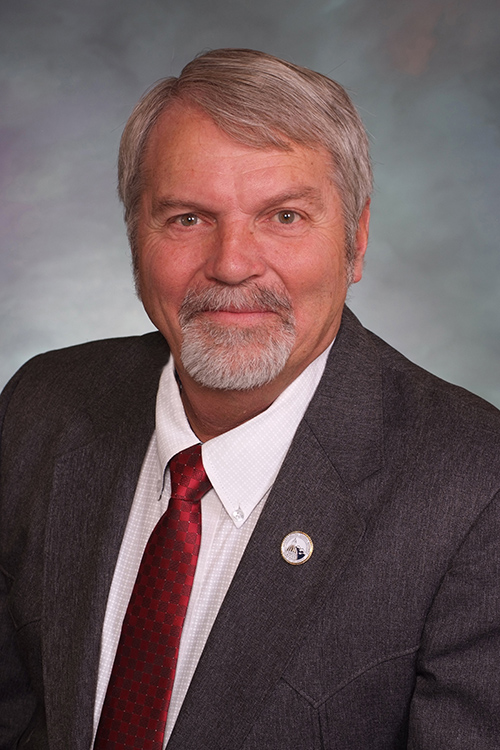
Sen. Rod Pelton
Sponsored bills
The bill requires the state treasurer to transfer 60% of the severance taxes paid by an entity that are attributable to the developing, processing, or energy conversion of minerals and mineral fuels subject to taxation in a county in a given tax year to that same county. A county that receives a transfer in accordance with the bill shall use the transferred funds for building or improving roads, schools, or local infrastructure.(Note: This summary applies to this bill as introduced.)
The bill prohibits financial institutions that do business in the state from discriminating against any person based on environmental criteria. A financial institution's violation of this prohibition is an unfair or deceptive trade practice. (Note: This summary applies to this bill as introduced.)
The act instructs the commissioner of agriculture to hire an employee or engage a contractor to provide grant and loan application assistance to small meat processors or people attempting to start a small meat processor business. The grant or loan must be used to start, expand, or support a small meat processor business. The employee or contractor may also assist agricultural producers and agricultural businesses in applying for and obtaining grants. The grant and loan application assistance program repeals on July 1, 2024. To implement the act, $62,885 is appropriated to the department of agriculture for use by the agricultural markets division. (Note: This summary applies to this bill as enacted.)
The act requires that an owner or operator of a new wind-powered energy generation facility (facility) install light mitigating technology (technology) at the facility if vertical construction of the first wind turbine included in the facility begins on or after April 1, 2022, and the owner or operator is required to obtain a land-use permit from a local government or is an independent power producer. The act defines technology as a sensor-based system that is designed to detect approaching aircraft, that keeps the lights off when it is safe to do so, and that meets federal aviation administration (FAA) requirements. An owner or operator of a facility is responsible for obtaining FAA approval for the installation of approved technology and may request from the governing body of the local government an extension of time up to 24 months if the owner or operator can demonstrate that, despite its commercially reasonable efforts, the technology was not available within the time frame afforded. The board of county commissioners in the county in which a facility is located may adopt and enforce an ordinance or resolution to authorize the board to impose civil penalties of $1,000 per day against a facility owner or operator if the board determines that the owner or operator has failed to comply with the act. (Note: This summary applies to this bill as enacted.)
Beginning July 1, 2022, the act requires the department of human services to work in partnership with counties towards implementation of a high-quality county work management system across all counties to interface with the Colorado benefits management system used to process and approve applications for essential state public assistance programs, such as the supplemental nutrition assistance program (SNAP), medicaid, and Colorado works. Eligibility and enrollment for SNAP and LEAP are integrated to increase access and efficiency. A community food access program (food program) is created in the department of agriculture (department). The purpose of the food program is to improve access to and lower prices for healthy foods in low-income and underserved areas of the state by supporting small food retailers. As part of the food program, the department shall create a community food consortium (consortium) for small food retailers and Colorado-owned and Colorado-operated farms. The small food business recovery and resilience grant program (grant program) is established, to be overseen by the food program. An advisory committee is established to assist the department with the grant program. One-time grants not to exceed $25,000 will be provided to small food retailers to help support infrastructure and other necessary items to make fresh, healthy food more accessible to low-income and underserved communities. The department is granted authority to promulgate rules as necessary to implement the food program. The department shall develop a strategy for outreach to Colorado-owned and Colorado-operated farms, food retailers, and small farms that are interested in participating in the consortium or grant program. The food program is repealed, effective September 1, 2027. For the 2022-23 state fiscal year, the following appropriations are made from the economic recovery and relief cash fund: $3 million to the department of human services for use by administration and finance for IT systems interoperability; $2 million to the department of human services for use by the office of economic security for fuel assistance payments related to food and energy assistance; $1 million to the department of human services for use by the office of economic security for electronic benefits transfer programming related to food and energy assistance; $1 million to the department of agriculture to implement the community food access program; and $7 million to the department of agriculture to implement the small food business recovery and resilience grant program and outreach.(Note: This summary applies to this bill as enacted.)
The act directs the department of early childhood to contract with a Colorado-based nonprofit entity to provide children's mental health programs. $2,000,000 is appropriated to the department of early childhood from the economic recovery and relief cash fund for use by the community and family support division to implement the provisions of the act. (Note: This summary applies to this bill as enacted.)
The act creates the microgrids for community resilience grant program (grant program) to be administered by the division of local government (division) in the department of local affairs (department), in collaboration with the Colorado resiliency office in the division and the Colorado energy office. A cooperative electric association or a municipally owned utility (utility) may apply to the division for a grant award to finance the purchase of microgrid resources in eligible rural communities within the utility's service territory that are at significant risk of experiencing severe weather or natural disaster events and in which one or more community anchor institutions, which institutions are important community, educational, health care, or other institutions, are located. The microgrids, which can be connected to or be disconnected from, and work independent of, the utility's electric grid, can increase an eligible rural community's ability to avoid or remediate interruptions to the electric grid, such as those caused by severe weather or natural disaster events. On an annual basis commencing in 2023, the division is required to: Report on the progress of the grant program, including information on the number of grants awarded and the amount of money awarded for each grant; Submit copies of the report to the house of representatives energy and environment committee and the senate transportation and energy committee, or their successor committees; and Publish the report on the department's website. For state fiscal year 2022-23, the bill appropriates from the general fund: $3,500,000 to the department for use by the division for implementation of the grant program; and $20,713 to the office of the governor for use by the Colorado energy office for grant program administration. (Note: This summary applies to this bill as enacted.)