Maddy summaryThis Senate Resolution officially recognizes the 125th anniversary of Western Colorado University and honors its contributions to higher education and workforce development in Colorado. The document commends the university's students, faculty, staff, and alumni for their dedication over the past century and a quarter. It serves as a symbolic acknowledgment rather than a law that changes policy or allocates funding.
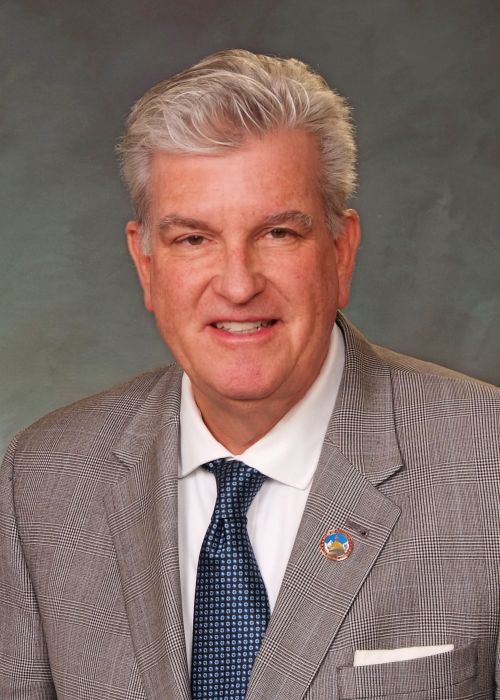
Sen. John Carson
Sponsored bills
Based on the findings and recommendations of the committee on legal services, the act extends all state agency rules that were adopted or amended on or after November 1, 2024, and before November 1, 2025.(Note: This summary applies to this bill as enacted.)
Under current law, the maximum amount of liability of the petroleum storage tank fund for an individual occurrence of a leak, spill, or release of a petroleum product from an underground storage tank (occurrence) is $2,000,000. The act allows an owner or operator of an underground or aboveground storage tank (owner or operator) to exceed this amount of liability with the permission of the director of the division of oil and public safety (director) and the petroleum storage tank committee (committee). If the director and the committee grant such permission, the director and committee shall establish a new maximum amount of liability per occurrence for the owner or operator. Under current law, all class I, II, and III liquid fuel products must comply with the most current applicable standards of ASTM International. The act allows the director to adopt a rule or issue policy guidance that provides exceptions to specific requirements established in an ASTM standard.(Note: This summary applies to this bill as enacted.)
The act declares emergency medical services as an essential service in the state and an integral part of the state's health-care infrastructure. The act also declares that emergency medical service providers, whether responding on duty or as a volunteer and regardless of location, provide essential services when providing emergency ambulance services and nonemergency ambulance services. The act also updates certain definitions related to emergency medical services, including the addition of a definition of 'out-of-hospital services', which term is defined to mean the furnishing of necessary health-care goods and services outside of a hospital setting but does not include prehospital setting transports. The act clarifies that an off-duty emergency medical service provider is not obligated to respond to the scene of a medical emergency or provide emergency medical services.(Note: This summary applies to this bill as enacted.)
The act requires coaches of youth athletic activities to complete a biennial mental health education course. The required mental health education course must address a coach's impact on the mental health of a youth athlete, a wellness framework for youth athletes, mental health disorders, trauma, substance abuse, and suicide prevention. The act requires a coach of a youth athlete, or other designated personnel, to advise the parent or guardian of the youth athlete to seek a medical evaluation from a licensed health-care provider for appropriate medical and behavioral health guidance if the youth athlete is removed from play for a suspected concussion.(Note: This summary applies to this bill as enacted.)
The bill establishes regulations for the sale, transfer, or distribution of compounded weight-loss medication, which custom-made medications that, is defined in the bill as a drug that is: Created by combining, mixing, or altering other drugs or drug substances; Intended to be used by humans for obesity or weight management and contains an active ingredient that is named in a drug approved by the federal food and drug administration (FDA); and A glucagon-like peptide-1 receptor agonist drug, known as a 'GLP-1' drug. Unlike mass-produced medications, a compound weight-loss medication is not subject to approval by the federal food and drug administration (FDA). A person may not sell, transfer, or distribute a compounded weight-loss medication unless the person confirms that the medication: FDA. Is made from bulk drug substances and drugs that are approved by the FDA when such approval is required; Was manufactured in compliance with FDA processes; Contains bulk drug substances that are pharmaceutical grade and are accompanied by a certificate of analysis containing information that is material to the safety and efficacy of the bulk drug substances; Was manufactured at a facility that is registered with the FDA and passed an FDA inspection within the previous 2 years; and Is verified for purity and accurate dosage. Labels for compounded weight-loss medications must list all active and inactive ingredients, the quantity of those ingredients, and the ingredients' country of origin. There must also be a warning on the label stating that the compounded weight-loss medication has not been FDA-approved, has inadequate evidence of safety or efficacy, and has known and unknown side effects. A person must also provide certain disclosures to a patient when prescribing compounded weight-loss medications. The bill prohibits the use of false or misleading claims, including unsubstantiated claims, when advertising or promoting compounded weight-loss medications. A person that sells, transfers, or distributes compounded weight-lost medication must keep records related to the compounded weight-loss medication for at least 2 years after the date of expiration of the compounded weight-loss medication and make those records available for inspection by the state board of pharmacy. The state board of pharmacy may issue fines of up to $1,000 per dose of compounded weight-loss medications that are sold or distributed in violation of the bill and may revoke a pharmacy or business license for violations. The attorney general has authority to enforce this bill as a deceptive trade practice under the 'Colorado Consumer Protection Act'. The bill establishes that a person engages in a deceptive trade practice when the person : Makes a false or misleading claim about a compounded weight-loss medication when advertising or promoting the medication; Distributes a compounded weight-loss medication when not legally authorized to distribute or transfer the drug used in the compounded weight-loss medication; Makes a materially false or misleading representation that the compounded weight-loss medication is approved by the FDA when the medication is not approved by the FDA; or Makes a materially false, misleading, or unverified claim regarding the efficacy, safety, performance, outcomes, or benefits of the compounded weight-loss medication. The attorney general has exclusive authority to enforce the bill as a deceptive trade practice under the 'Colorado Consumer Protection Act'. There is no private right of action for a violation of the bill, and the provisions of the bill may only be enforced by the attorney general. The bill does not apply to certain facilities or in certain circumstances, including: The administration of a compounded weight-loss medication by a practitioner at certain hospitals, clinics, and other health facilities licensed by the department of public health and environment; Long term care facilities; Assisted living residences; Home care agencies; The program of all-inclusive care for the elderly or PACE program; Adult day care facilities; or The compounding of drugs for animal use.(Note: Italicized words indicate new material added to the original summary; dashes through words indicate deletions from the original summary.)(Note: This summary applies to the reengrossed version of this bill as introduced in the second house.)

The act requires each school district or, for an institute charter school or nonpublic school, the school, (local education provider) to install an exterior key box that contains keys and other access control devices necessary for law enforcement agencies to access each building and room located on the school grounds. A local education provider is not required to install an exterior key box at a school if:The school has a key box that does not satisfy the requirements in the act and has an alternative plan and procedures to provide emergency access for local law enforcement; orThe local education provider applied for but does not receive a disbursement from the school security disbursement program that may be used to install an exterior key box at the school. The contents of an exterior key box and the information contained therein are not a public record for the purposes of the 'Colorado Open Records Act'.(Note: This summary applies to this bill as enacted.)
The act expands the ways in which individuals may become eligible for certification as a certified public accountant (CPA) in Colorado by creating 3 new education and experience pathways that may satisfy the requirements for CPA certification. The pathways become available for applicants beginning on January 1, 2027. The 3 pathways are:Obtaining a baccalaureate degree, completing 2 years of accounting-related work experience, completing a professional ethics course, and passing the written CPA exam;Obtaining a baccalaureate degree, completing 30 additional semester hours, completing one year of accounting-related work experience, completing a professional ethics course, and passing the written CPA exam; andObtaining a post-baccalaureate degree, completing one year of accounting-related work experience, completing a professional ethics course, and passing the written CPA exam. For each pathway, an applicant's work experience must:Meet the requirements set by the Colorado state board of accountancy (board) by rule;Include any type of service or advice representing certain accounting-related skills needed to serve the public at the time of initial certification; andBe verified by an actively licensed CPA who meets board requirements. Section 2 of the act conforms statutory provisions relating to an applicant's eligibility to sit for a CPA examination with the pathways to certification created by the act. Section 2 also reinforces that, regardless of an applicant's eligibility to sit for an exam, the applicant must complete one of the specified pathways in order to obtain a CPA certificate. Section 4 establishes that an individual CPA who is licensed or certified in good standing in another state or jurisdiction of the United States and whose principle place of business is located in another state or jurisdiction of the United States (out-of-state CPA) has all the same practice privileges as Colorado certificate holders, without the need to obtain a Colorado certificate, if the individual was required at their initial licensure or certification in the other state or jurisdiction of the United States to pass the uniform CPA examination and obtain a baccalaureate degree conferred by an accredited college or university. Additionally, the act continues the practice privileges of out-of-state CPAs who held practice privileges in Colorado as of December 31, 2024. Finally, the conferral of practice privileges upon out-of-state CPAs must be conducted in conformity with rules adopted by the board; except that the board shall not require an out-of-state CPA to provide a notice, fee, or other submission as a condition of exercising such practice privileges in Colorado.(Note: This summary applies to this bill as enacted.)
Maddy summaryThis bill proposes that Colorado lawmakers consider adding guaranteed lifetime income options to the state public employees' retirement defined contribution plan and voluntary savings plans. The measure aims to ensure public employees have access to a reliable income stream in retirement, similar to what is already available in the state's traditional defined benefit plan. By allowing workers to choose options that provide lifetime payouts, the bill seeks to improve retirement security and financial confidence for over 226,000 active public employees. The resolution encourages the General Assembly to study how these new options could help workers retire with dignity while maintaining the portability of their savings.
Under current law, consumers in Colorado have a right to repair all digital electronic equipment, which could include equipment that is considered critical infrastructure. The bill exempts information technology equipment that is intended for use to be used in critical infrastructure from Colorado's consumer right to repair laws. Critical infrastructure is defined as a system or asset, whether physical or virtual, so vital to the United States that the incapacity or destruction of the system or asset would have a debilitating impact on security, national economic security, national public health or safety, or any combination of those matters. The bill authorizes the attorney general to review an exemption from Colorado's consumer right to repair laws for certain information technology equipment (equipment) that is intended to be used in critical infrastructure. In reviewing whether the equipment is exempt, the attorney general shall consider whether the equipment is actually intended to be used in a manner that qualifies as critical infrastructure and whether the equipment is sold under a business-to-business or business-to-government contract and not customarily sold in a retail setting. Any determination made by the attorney general regarding an exemption may be appealed by the manufacturer of the equipment.(Note: Italicized words indicate new material added to the original summary; dashes through words indicate deletions from the original summary.)(Note: This summary applies to the reengrossed version of this bill as introduced in the second house.)