

Under current law, the state income tax rate imposed on the taxable income of individuals, estates, trusts, and corporations is 4.4%; except that, for the income tax year commencing on January 1, 2024, the income tax rate is 4.25% and for any income tax year commencing on or after January 1, 2025, but before January 1, 2035, the income tax rate is temporarily reduced if state revenue exceeded the limitation on state fiscal year spending imposed by section 20 (7)(a) of article X of the state constitution for the state fiscal year that ended during the income tax year. The extent to which the rate is temporarily reduced depends on the total amount of excess state revenues remaining after homestead exemption reimbursements and qualified-senior primary residence reimbursements are paid. The bill makes the 4.25% tax rate permanent beginning with the income tax year commencing on January 1, 2025, makes any additional temporarily reduced income tax rate permanent for subsequent income tax years, and eliminates the state income tax on individuals, estates, and trusts for income tax years commencing on or after January 1, 2035. (Note: This summary applies to this bill as introduced.)
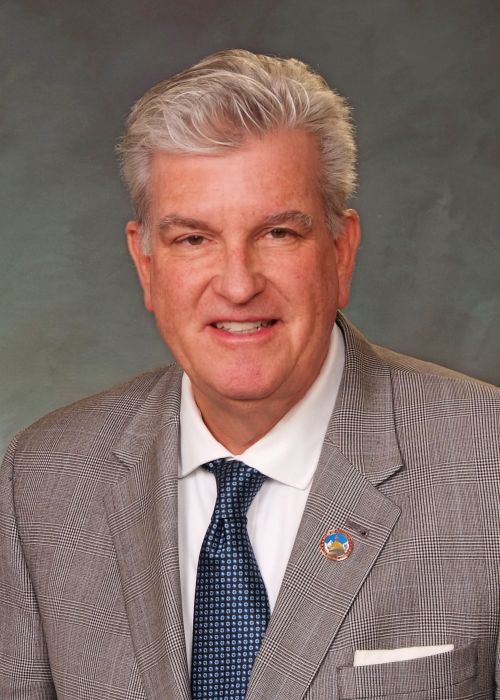
Sen. John Carson
Sponsored bills
Current law requires mandatory sentencing to at least the minimum of the prescribed range for a person who, within the immediately preceding 4 years, was twice convicted of felony theft from a store and who is once again convicted of felony theft from a store. The bill requires a state court to sentence a person convicted of burglary, robbery, theft, or a related property crime from or of a store, who was convicted of any 2 of the specified property crimes or comparable municipal offenses from or of a store within the preceding 4 years, to at least the midpoint term for the current offense. The bill adds language to the existing theft statute clarifying how a gift card's value is determined for purposes of determining the offense level and associated penalty. If the stolen item of value is a gift card, then the value is the full monetary face value or, in the case of a variable load gift card, the maximum potential value, regardless of whether funds have been transferred to the gift card at the time of the theft. The bill adds gift cards to the list of written instruments subject to forgery. (Note: This summary applies to this bill as introduced.)
The bill creates the Colorado government efficiency authority (authority). The authority is governed by a board consisting of the following appointees: One representative of the private sector with business experience with state contracts, appointed by the governor; One representative of the private sector with experience as a chief financial officer or legal advisor, appointed by the speaker of the house of representatives; One representative of the private sector with experience in energy and environmental work, appointed by the president of the senate; One representative of the private sector with experience in transportation, appointed by the minority leader of the house of representatives; One representative of the private sector with experience in health care or real estate, appointed by the minority leader of the senate; The staff director of the joint budget committee, or the staff director's designee, as a nonvoting advisory member; The director of the office of state planning and budgeting, or the director's designee, as a nonvoting advisory member; and The state auditor, or the state auditor's designee, as a nonvoting advisory member. Members of the board serve without compensation for any service provided to the authority and do not receive any reimbursement from the board for expenses incurred in furtherance of the board's responsibilities. The board is charged with: Examining every state-funded state agency and state department's operations, personnel, and mission to determine whether the state agency or state department is maximizing the efficient use of state money and resources; Identifying efficiencies in state government that would result in cost savings and improved provision of government services; Working with the federal government to implement federal directives designed to increase government efficiency and reduce government costs; Providing recommendations to the governor and general assembly about implementing efficiencies in state government, leveraging money from the federal government, and implementing federal directives; Holding public hearings that solicit input from the public about increasing efficiencies in state government; and Developing a process for members of the public to make ongoing recommendations related to state government efficiency, which recommendations will be reviewed by the authority. The authority may accept gifts, grants, donations, and federal money to pay for the authority's operations. The authority is not funded by a state agency or state department. (Note: This summary applies to this bill as introduced.)
Maddy summaryThis Senate Resolution (SR 25-006) commemorates the three-year anniversary of Russia's invasion of Ukraine. It formally commends Colorado-based nonprofit Ukraine Power for delivering nearly $400,000 in aid to Ukrainians over the past three years, and expresses the Colorado Senate's support for Ukraine's sovereignty and efforts to achieve a just peace. The resolution has no binding policy impact - it is a symbolic gesture, not a legislative action, and directly affects Ukraine, Ukraine Power, and Colorado's Ukrainian community by acknowledging their efforts and shared values.
Maddy summaryThis is a ceremonial resolution (not a policy bill) designating September 14-20, 2025, as "Co-Responder Units and Behavioral Health Crisis Professionals Week" in Colorado. It honors professionals who work alongside law enforcement in crisis situations involving mental health or substance use, recognizing their role in de-escalating emergencies and connecting individuals to resources like counseling and housing. The resolution expresses legislative appreciation for their service but does not create new laws, funding, or policy changes.
Maddy summarySJR 25-007 is a ceremonial resolution proclaiming February 14 as "Colorado Read to Your Child Day." It does not create new laws or allocate funding but aims to raise public awareness about the importance of reading aloud to children for early literacy development. The resolution cites research linking early reading exposure to future academic success and reduced educational disparities. This resolution directly affects Colorado residents by designating an annual observance to encourage family reading habits, without implementing any concrete policy changes.
For the purpose of reducing transportation costs, the bill repeals the following fees, effective July 1, 2025: The road usage fee imposed by the state and the bridge and tunnel impact fee imposed by the statewide bridge and tunnel enterprise that are imposed on the purchase of each gallon of taxed gasoline and special fuel; The fee imposed by the state on short-term motor vehicle rentals; The passenger per-ride fees imposed on car share rides by the state, the clean fleet enterprise, and the nonattainment area air pollution mitigation enterprise; and The waste tire enterprise fee imposed on the purchase of new motor vehicle and trailer tires by the waste tire management enterprise. Because this fee is the only source of revenue for the waste tire management enterprise, the bill also repeal the enterprise. The bill also requires the nonattainment area air pollution mitigation enterprise, no later than January 1, 2026, to establish a reformulated gasoline cost stabilization program to offer reformulated gasoline cost stabilization rebates to individuals who own motor vehicles that are registered in counties in which the federal government requires all gasoline sold to be reformulated gasoline. (Note: This summary applies to this bill as introduced.)
Maddy summaryThis bill is a formal resolution recognizing February 2025 as Black History Month in Colorado. It does not create new laws or policies but serves as an official acknowledgment of the significance of Black history and contributions to Colorado and the nation. The resolution references historical milestones, including Black laborers, community builders, and civil rights efforts in Colorado, to underscore the importance of this observance. It affects all Coloradans by formally designating the month for recognition and education.
Maddy summaryThis procedural resolution designates February 4 of each year as "Missing Persons Day" in Colorado. It formally recognizes the issue of missing persons through state-wide awareness, encouraging public support for families and law enforcement efforts without creating new legal requirements or funding. The resolution aligns with Colorado's existing AMBER Alert and Missing Indigenous Person Alert programs.
Maddy summarySenate Resolution 25-004 recognizes February 1, 2025, as World Hijab Day in Colorado. The resolution highlights the hijab's significance in Islamic tradition as a symbol of dignity and modesty, and acknowledges World Hijab Day's purpose of promoting religious tolerance and cultural understanding through public education. It does not create new laws or requirements but serves as a formal state acknowledgment of this annual observance. The resolution was unanimously passed by the Colorado Senate on January 31, 2025, without amendments.