

Maddy summarySJR 25-018 recognizes April 2025 as Sexual Assault Awareness Month and designates April 30, 2025, as Colorado Denim Day. The resolution symbolically supports the annual Denim Day observance, which began in Colorado in 2013, to raise awareness about sexual violence and honor the work of organizations like the Colorado Coalition Against Sexual Assault (CCASA). It highlights ongoing challenges such as evidence kit backlogs and the need for survivor support services, without creating new laws or funding. This is a ceremonial resolution, not a policy change, aligning Colorado with the global Denim Day movement that uses wearing jeans to protest attitudes condoning sexual assault.
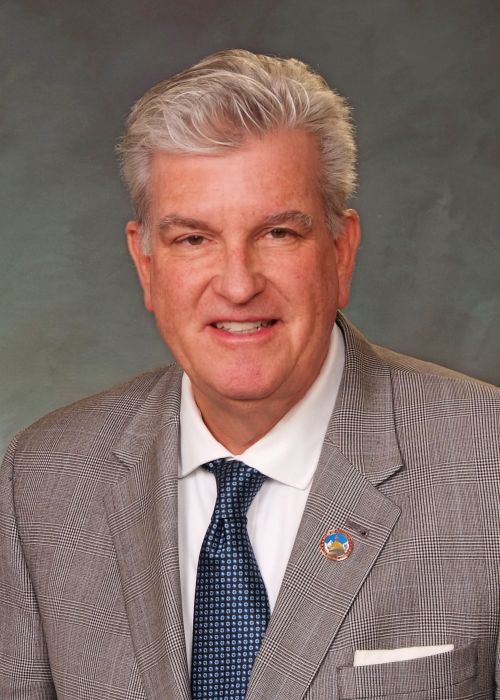
Sen. John Carson
Sponsored bills
Maddy summaryThis symbolic resolution designates March 21 as "Single Parent Day in Colorado" to recognize single parents' efforts in raising children. It directly honors single parents across the state, referencing U.S. Census data showing over 10 million single-parent households nationwide. The resolution continues Colorado's recognition of the day, aligning with President Reagan's 1984 national declaration. It has no policy or funding provisions - it is purely a commemorative gesture without legal or financial impact.
The act eliminates the statutory cap on the number of veterinary students permitted to attend Colorado state university at one time. The act eliminates additional financial limitations related to the professional veterinary medicine program at Colorado state university, including eliminating the university's bonding authority with respect to the veterinary medicine program. (Note: This summary applies to this bill as enacted.)
The statutory definition of "clean energy" determines which energy projects are eligible for clean energy project financing at the county and city and county level. The statutory definition of "clean energy resource" determines which energy resources may be used by a qualifying retail utility to meet the 2050 clean energy target. The act updates the 2 statutory definitions to include nuclear energy; except that, for property valuations made for tax purposes, the act exempts from the definition of "clean energy resource" nuclear energy. (Note: This summary applies to this bill as enacted.)
Backflow is the reverse flow of water, fluid, or gas caused by back pressure or back siphonage. Under current law, individuals who are engaged in the business of installing, removing, inspecting, testing, or repairing backflow prevention devices are subject to the licensure requirements for plumbers, except when the individuals are installing or testing a stand-alone fire suppression sprinkler system. The act exempts individuals engaged in the business of inspecting, testing, or repairing backflow prevention devices from licensure requirements but retains the licensure requirements for individuals engaged in the installation or removal of the devices; except that individuals who install or replace a backflow prevention device on a stand-alone fire suppression system remain exempted from the licensure requirements. The act requires that, on and after July 1, 2025, a licensed plumber who installs, tests, inspects, repairs, or reinstalls a backflow prevention device and a certified cross-connection control technician or a licensed plumber with a cross-connection control technician certification who tests or repairs a backflow prevention device must affix a tag on the backflow prevention device that contains certain information about the licensed plumber, the certified cross-connection control technician, or the licensed plumber with a cross-connection control technician certification, as applicable, and the service that was provided. (Note: This summary applies to this bill as enacted.)
Under current law, owners of certain large buildings (covered buildings) are required to annually collect and report each covered building's energy use to the Colorado energy office. The act clarifies that agricultural buildings are not covered buildings, and therefore, owners of agricultural buildings are exempt from the energy use collecting and reporting requirements. The act defines an agricultural building as a building or structure used to house agricultural implements, hay, unprocessed grain, poultry, livestock, or other agricultural products or inputs primarily for the purpose of maintaining or operating an agricultural process. Agricultural implements include certain agricultural equipment and do not include implements that are primarily for rent or sale. The act permits an owner of an agricultural building to submit for an affirmative exemption from any requirement to report benchmarking data and for an exemption to remain valid until there is a change in ownership or a change that renders the building no longer an agricultural building. For the duration of an exemption, the owner of an agricultural building is required to certify, upon request, the exemption status of an exempt building. (Note: This summary applies to this bill as enacted.)
The act modifies the types of funds that are available for immediate withdrawal as a matter of right in real estate transactions by: Limiting wire transfer funds to only those funds that are wired through a funds-transfer system operated by the federal reserve or the Clearing House Payments Company; and Adding a real-time or an instant payment made through a funds-transfer service operated by the federal reserve or the Clearing House Payments Company's real-time payments system.(Note: This summary applies to this bill as enacted.)
Under current law, every governing body of a municipality that has adopted and enforced a building code after July 1, 2023, is required to adopt and begin enforcing an energy code for residential buildings. The bill creates an exemption for municipalities with a population of less than 2,500 residents from having to adopt and enforce an energy code for residential buildings.(Note: This summary applies to the reengrossed version of this bill as introduced in the second house.)
Maddy summarySJR 25-013 is a symbolic resolution recognizing Thursday, March 20, 2025, as Nowruz Day in Colorado. It honors the ancient Persian New Year celebration observed by Iranian, Kurdish, Afghan, and Central Asian communities, acknowledging its cultural significance and the contributions of Colorado's Iranian-American residents. The resolution has no legal effect but formally extends recognition to the traditions of Nowruz, including its themes of renewal and community. It directly affects Colorado's Iranian-American community by affirming their cultural heritage through state acknowledgment.
Maddy summaryThis resolution (SJR 25-009) expresses Colorado's support for federal management of national public lands, including parks, forests, and monuments. It formally opposes efforts to sell, transfer, or dispose of these lands and urges Colorado's governor, attorney general, and congressional delegation to take action against such proposals. The resolution is non-binding but directs state officials to advocate for continued public stewardship by federal agencies like the National Park Service and Bureau of Land Management. It was passed by the Colorado Senate and referred to the House for consideration.