

Maddy summaryThis Senate Resolution recognizes October 2026 as Conflict Resolution Month in Colorado to promote peaceful dispute resolution methods. The bill directly affects Coloradans by encouraging community events, workplace discussions, and educational programs focused on mediation, arbitration, and restorative justice practices. Key provisions invite residents to reflect on and resolve conflicts responsibly while asking leaders and officials to participate in celebrating this month. The resolution also calls for increased awareness of conflict resolution benefits among judges, government staff, and local communities.
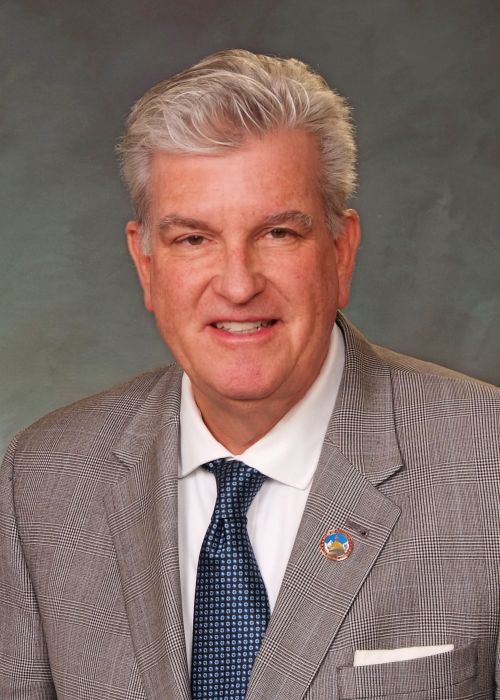
Sen. John Carson
Sponsored bills
Previously, money in the diseased livestock indemnity fund could be used only to pay indemnity to a livestock owner whose herd had been sold for slaughter or destroyed because the herd was exposed to or diagnosed with an infectious or contagious disease. The act expands the permissible uses of the money in the diseased livestock indemnity fund by allowing the commissioner of agriculture to authorize using the money to prepare for and respond to certain emerging threats to livestock health. The act renames the fund the 'livestock health preparedness, response, and diseased livestock indemnity fund' to reflect the expanded scope of the permissible uses of money in the fund.(Note: This summary applies to this bill as enacted.)
Maddy summaryThis bill reappoints Kerri L. Hunter as Colorado's State Auditor for a five-year term from July 1, 2026, to June 30, 2031. The reappointment follows a unanimous recommendation from the Legislative Audit Committee, which reviews candidates for the position based on qualifications and experience. Under Colorado law, the General Assembly appoints the State Auditor, and this resolution formally approves Hunter's continued service after her initial term ended in 2026. The measure directly affects the State Auditor's office by extending its leadership while maintaining the existing appointment process.
Maddy summaryThis Senate Resolution designates March 21 as "Single Parent Day in Colorado" to honor single parents who raise children alone due to divorce, death, or other circumstances. The measure directly affects single-parent households in the state, which include over 10 million households nationally and represent nearly a quarter of families with children under 18. The resolution contains no new laws or funding, serving instead as a symbolic gesture to recognize the dedication and challenges faced by single parents. It was signed by the Senate President and sent to Janice S. Moglen, a longtime Colorado advocate for Single Parent Day.
Maddy summaryThis bill approves specific updates to eligibility lists for two Colorado water funding programs. It adds new drinking water projects (like Delta County's distribution system) and modifies existing entries (such as adding "green infrastructure" to Loveland's project), while deleting completed projects (like Kiowa's). These changes determine which local water districts, municipalities, and property associations can access financial assistance from the Drinking Water Revolving Fund and Water Pollution Control Revolving Fund. The bill does not create new funding rules but formally adopts the Commission's proposed list adjustments.
Maddy summarySJR 11 is a commemorative resolution designating a specific segment of U.S. Highway 34 (between Wilson Ave. and North County Rd. 23H) as the "Sgt. John 'Jack' Thurman Memorial Highway" in honor of a World War II Marine Corps veteran. The bill, which has no policy or funding provisions, simply names the highway section to recognize Sergeant Thurman's service at Iwo Jima, his military awards, and his post-war contributions as an architect and community leader in Colorado. It authorizes the Colorado Department of Transportation to accept donations for signage and explore maintenance agreements with local governments. This is a ceremonial designation with no direct impact on residents or new laws.
The act broadens the definition of 'ranch' for purposes of property taxation to mean a parcel of land that is predominantly used for grazing livestock for the primary purpose of obtaining a monetary profit. A ranch must operate through a pasture-based operation, which is newly defined as a method of livestock management where pasture-grazed livestock have regular access to open pasture and derive a majority of their diet through grazing. The act also broadens the definition of 'farm' for purposes of property taxation to mirror the predominant use language in the definition of 'ranch'. With this change, a farm means a parcel of land that is predominantly used to produce agricultural products that originate from the land's productivity for the primary purpose of obtaining a monetary profit.(Note: This summary applies to this bill as enacted.)
The bill creates penalties to be assessed against a parent or guardian who permits their minor child or ward to operate an electrical assisted bicycle, electric motorcycle, electric scooter, or electric skateboard (electric vehicle) if the minor child or ward operates the electric vehicle in a manner that violates certain laws concerning the usage of such electric vehicles, including laws regarding age requirements for different classes of such electric vehicles, how to safely and properly operate such electric vehicles on roadways or pathways, and required safety gear.(Note: This summary applies to this bill as introduced.)
Maddy summarySJR 4 designates September 20-26, 2026, as "Frontotemporal Degeneration (FTD) Awareness Week" in Colorado. This symbolic resolution recognizes FTD - a terminal, incurable neurodegenerative disease affecting speech, behavior, and motor skills - and aims to increase public awareness of the condition. It directly supports Coloradans living with FTD, their families, and advocacy groups like the Association for Frontotemporal Degeneration, which focuses on research and care. The bill has no funding or regulatory provisions, as it is purely a recognition measure.
Maddy summaryThis Senate Resolution (SR 3) designates March as "Arts Education Month" in Colorado. It does not create new laws or funding but symbolically recognizes the importance of arts education (including dance, music, theater, and visual arts) for students' development and academic success. The resolution aligns Colorado with national observances in March and acknowledges the state's lack of data on arts education access and the need to expand equitable opportunities. It is a non-binding recognition, sent to the Governor and State Board of Education, with no direct policy changes or requirements for schools.