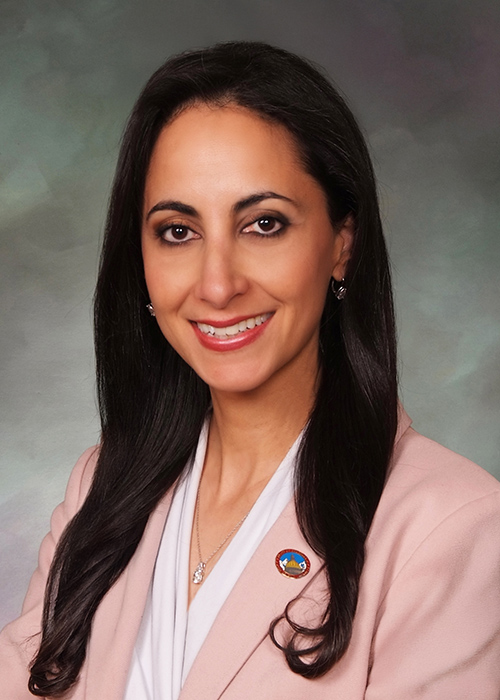
Photo of Iman Jodeh
D Colorado Senate · District 29 On the 2026 ballot

Sen. Iman Jodeh

Compare
Total votes
5,352
all sessions
Attendance
92%
370 missed
With party
99%
of cast votes
Higher than 86% of chamber peers
Bipartisan score
1%
crosses aisle rarely
Lower than 92% of chamber peers
Sponsored
631
bills & resolutions
Higher than 83% of chamber peers
Committees
2
assignments
631 bills and resolutions

Sponsored bills

Total
631
Primary
101
Co-sponsor
530
This page
631
matching current filters
Co-sponsor SB 25-301
Signed into law · Colorado Senate · Co-sponsor
Remove Authorization Requirement Adjust Chronic Prescription

The act allows a health-care provider to, under certain circumstances, adjust the dose or frequency of a chronic maintenance drug without needing prior authorization from an insurance carrier. (Note: This summary applies to this bill as enacted.)

Signed into law May 29, 2025 1 co-sponsor
Co-sponsor SB 25-296
Signed into law · Colorado Senate · Co-sponsor
Insurance Coverage for Breast Cancer Examinations

The act makes changes to requirements for preventive care coverage by health insurers for breast cancer screening, including: Relocating in statute the high-risk breast cancer screening requirements; Defining and specifying criteria for the use of diagnostic breast examinations and supplemental breast examinations; and Clarifying that, in addition to regular breast cancer screening, diagnostic and supplemental breast examinations that are medically necessary and conducted within nationally recognized screening guidelines do not require cost sharing by the patient.(Note: This summary applies to this bill as enacted.)

Signed into law May 29, 2025 1 co-sponsor
Co-sponsor SB 25-061
Signed into law · Colorado Senate · Co-sponsor
Federally Recognized Tribes & Construction of Laws

Current Colorado laws do not always expressly provide whether the laws apply to the Southern Ute Indian Tribe or the Ute Mountain Ute Tribe (Tribes). The act creates a rule of construction that a law does not apply to the Tribes unless the law clearly and expressly states that the law applies to the Tribes. The act further clarifies that if the general assembly enacts a new law or materially amends an existing law that is silent as to its application to the Tribes or to tribally controlled entities; purports to apply statewide; or grants a governmental agency or entity civil, criminal, or regulatory authority, it is presumed that the law does not apply within the exterior boundaries of the reservations to the Tribes, including the Tribes' officials and employees acting in their official capacities, to a tribally controlled entity, or to Tribal lands. The act reinforces that these rules of construction do not: Preclude or limit the authority of the Tribes' governing bodies from requesting inclusion in legislation pending before the general assembly; Abrogate the sovereign immunity of the state or the Tribes; or Affect the rights of the state, the Tribes, or other persons to pursue legal remedies that may be available to contest the application of laws passed by the general assembly.(Note: This summary applies to this bill as enacted.)

Signed into law May 28, 2025 1 co-sponsor
Co-sponsor SB 25-290
Signed into law · Colorado Senate · Co-sponsor
Stabilization Payments for Safety Net Providers

The act creates the provider stabilization fund for use by Colorado department of health care policy and financing (department) to distribute provider stabilization payments to safety net providers who provide services to low-income, uninsured individuals on a sliding-fee schedule or at no cost. Provider stabilization payments will be distributed to eligible safety net providers based on the proportion of low-income, uninsured individuals that an individual provider serves in comparison to the total number of low-income, uninsured individuals served by all eligible safety net providers. The state treasurer is directed to make an interest-free loan of interest earnings on the principal in the unclaimed property trust fund (UPTF) and, if the interest earnings are insufficient, from the principal of the UPTF as well, to the provider stabilization fund as follows: $25 million for the 2025-26 state fiscal year; $20 million for the 2026-27 state fiscal year; and $15 million for each of the 2027-28, 2028-29, and 2029-30 state fiscal years. The act specifies that the loan from the UPTF to the provider stabilization fund is an interfund loan that is not classified as revenue, is booked as an interfund receivable or payable, is not state fiscal year spending or state revenues, and does not count against the state fiscal year spending limit or the excess state revenues cap. The department is directed to repay the loan by January 1, 2045, but in any year in which state revenues do not exceed the limit on state fiscal year spending, the department must present to the joint budget committee a proposal to repay all or a portion of the loan at an earlier time, and to the extent possible, the general assembly must prioritize repaying the loan starting in the 2030-31 state fiscal year or sooner if funds are available. The provider stabilization fund also consists of any money the general assembly appropriates, transfers, or credits to the fund and any gifts, grants, or donations the department may receive for the fund. The act directs the department to leverage money in the provider stabilization fund to obtain federal matching money. The act establishes a provider stabilization fund advisory board (advisory board) to assist the department in implementing and administering the provider stabilization fund. The department, with assistance from the advisory board, is required to submit an annual report on the provider stabilization fund to specified committees, the governor, and the medical services board in the department. The advisory board is scheduled for repeal on September 1, 2031, and is subject to a sunset review by the department of regulatory agencies before the repeal. The act appropriates $25,000,000 from the provider stabilization fund to the department to implement the act, allocated as follows: $138,505 for personal services to administer the act, including 2.0 FTE; $15,900 for operating expenses; and $24,845,595 for provider stabilization payments to eligible safety net providers.(Note: This summary applies to this bill as enacted.)


Signed into law May 28, 2025 1 co-sponsor
Co-sponsor HB 25-1057
Signed into law · Colorado House · Co-sponsor
American Indian Affairs Interim Committee

The act creates the American Indian affairs interim committee (committee). The purpose of the committee is to examine issues and challenges that impact American Indian Tribal Nations. The committee consists of 6 voting members of the general assembly who serve for the duration of the committee unless they resign, are removed, or are no longer in office and 2 nonvoting members, one from the Southern Ute Indian Tribe and one from the Ute Mountain Ute Tribe. The act allows the committee to meet up to 6 times and recommend up to 5 bills during each interim, but the committee does not meet or recommend legislation during the 2025 interim. On or before January 15, 2031, the act requires the committee to submit a report to the executive committee of the legislative council summarizing the work of the committee during the preceding 5 years. The committee is repealed, effective June 30, 2031. (Note: This summary applies to this bill as enacted.)
Signed into law May 28, 2025 1 co-sponsor
Co-sponsor HB 25-1097
Signed into law · Colorado House · Co-sponsor
Placement Transition Plans for Children

Beginning July 1, 2026, absent an emergency placement change, the act requires a county or district department of human or social services (county department) child welfare caseworker (caseworker) to create an individualized placement transition plan (plan) for a child any time the child is moved from one placement in a foster care home, kinship foster care home, or non-certified kinship care home (placement) to another or back to the child's home. The plan must prioritize the mental, emotional, and physical needs of the child while considering the needs of the parents, current providers, and future providers as the needs of the parents, current providers, and future providers relate to the care of the child. If a sibling group is moved from a placement together, the caseworker may develop a single plan for the sibling group, as long as the plan takes into account the individualized needs of each child. The plan, at a minimum, must include: A determination of pre-transition logistics to adequately prepare for the child's new placement; A plan for pre- and post-transition communications between individuals who have relevant information for the transition; A timeline to transition the child to a new placement; A plan to physically move the child to the new placement; and A framework for a caseworker's post-transition communications. The department of human services (state department), within existing resources, shall create a training on the importance of plans that is recorded and made available on a training system that can be accessed statewide. The training must focus on plans and individuals who have lived experience with placement transitions, including an emphasis on individuals who experienced placement transitions. Newly employed caseworkers must complete the training within the first year of employment as a caseworker. All caseworkers may complete this training every 3 years. A foster care, kinship foster care, or non-certified kinship care provider (provider) may complete the training and may receive support from the state department or the county department to improve the provider's skills in transitioning a child in the provider's care from one placement to another. The state department may adopt rules for purposes of the plans. (Note: This summary applies to this bill as enacted.)

Signed into law May 28, 2025 1 co-sponsor
Primary HB 25-1279
Signed into law · Colorado House · Lead sponsor
State-Level Data for Colorado Works Program

No later than October 1, 2025, the act requires the department of human services (state department), in consultation with the works allocation committee, to: Develop a standardized process for each county to collect and report to the state department on a monthly basis certain information about the Colorado works program; Develop recommendations that include a menu of standardized outcome measures and required levels of evidence for third-party contracted services funded with Colorado's temporary assistance for needy families (TANF) allocation; and Submit a report to the joint budget committee (JBC) that includes a description of the standardized process and recommendations. Beginning January 1, 2026, and each January thereafter, the act requires the state department to submit a report to the JBC that includes the information collected and reported through the standardized process and the total dollar amount of Colorado's TANF allocation that is redistributed through the state budget or other programs and services and publish the information on a monthly basis on the state department's website in a publicly accessible format. No later than July 1, 2026, the act requires the state department to submit a report to the JBC that includes certain information related to the standard of need for eligibility for basic cash assistance. For the 2025-26 state fiscal year, the act appropriates $154,000 to the department of human services for use by the office of economic security to conduct the works program evaluation. (Note: This summary applies to this bill as enacted.)

Signed into law May 28, 2025 0 co-sponsors
Co-sponsor HB 25-1271
Signed into law · Colorado House · Co-sponsor
Federal Benefits for Youth in Foster Care

Beginning on or before July 1, 2027, the act requires a county department of human or social services (county department) to determine whether a child or youth who is in foster care and who has a deceased parent (child or youth) may be eligible to receive survivor benefits administered by the United States railroad retirement board, social security administration, or veterans benefits administration (federal survivor benefits). The county department must make an initial eligibility determination within 90 days after assuming legal custody of or authority over the child or youth. Under current law, certain federal agencies appoint a representative payee or fiduciary (representative payee) to receive and manage federal benefits on behalf of a child or youth in foster care. If a child or youth may be eligible for federal survivor benefits and the county department is the most appropriate representative payee, the act requires the county department to apply for federal survivor benefits on behalf of the child or youth. If the county department determines that the child or youth may be eligible for federal survivor benefits but that the county department is not the most appropriate representative payee, the county department shall provide information to the prospective representative payee that the county department has identified about how to apply for federal survivor benefits on behalf of the child or youth and how to become the child's or youth's representative payee. Under current law, a county department serving as a representative payee may use federal benefits to offset the cost of providing basic care and services to a child or youth in foster care. The act prohibits this offset practice with respect to federal survivor benefits. Instead, the act directs a county department serving as a representative payee to establish an account for the federal survivor benefits (account). A county department serving as a representative payee must save money in the account for the needs of the individual child or youth. Once the child or youth leaves foster care, the county department is required to release funds in the account to the child or youth. The act sets forth various accounting and notice requirements related to federal survivor benefits and requires the department of human services (department), in consultation with interested stakeholders, to adopt rules providing guidance for county departments. The guidance extends to procedures for identifying a representative payee, county department responsibilities when federal survivor benefits are denied or when a child or youth leaves foster care, and policies governing the establishment and maintenance of an account for federal survivor benefit funds. The department must provide technical assistance to a county department about how to conserve federal survivor benefit funds in the best interests of an individual child or youth. (Note: This summary applies to this bill as enacted.)

Signed into law May 28, 2025 1 co-sponsor
Co-sponsor HB 25-1197
Signed into law · Colorado House · Co-sponsor
Sale of Electrical Assisted Bicycles Requirements

The act: Requires that a seller of an electrical assisted bicycle must make certain disclosures to the purchaser regarding the characteristics of the electrical assisted bicycle; Requires that, on or after January 1, 2027, a manufacturer or distributor of a new electrical assisted bicycle must label each electrical assisted bicycle with the highest class or each of the classes in which the electrical assisted bicycle is capable of operation; Prohibits a person from selling or offering to sell a vehicle that is not an electrical assisted bicycle if the vehicle is falsely labeled as an electrical assisted bicycle. A violation is a deceptive trade practice under the "Colorado Consumer Protection Act". Prohibits a person from advertising, offering for sale, or selling a vehicle that is not an electrical assisted bicycle by using certain words associated with electrical assisted bicycles without providing a disclosure that the vehicle is not in fact an electrical assisted bicycle. A violation is a deceptive trade practice under the "Colorado Consumer Protection Act". Requires that a lithium-ion battery or a second-use lithium-ion battery (battery) that is part of or intended for use in an electrical assisted bicycle must be certified by an accredited testing laboratory for compliance with certain battery standards and that the certification or name of the accredited testing laboratory must be included on the packaging or documentation for the battery or on the battery itself; and Clarifies that a multiple mode electrical assisted bicycle must meet all the requirements applicable to each respective class of electrical assisted bicycle for which the multiple mode electrical assisted bicycle provides for operation. Currently, "electrical assisted bicycle" is defined as having to conform to one of 3 classes based on the highest achievable speed and type of motor of the electrical assisted bicycle. The act amends the existing definition of "electrical assisted bicycle" to clarify that the following vehicles are not an electrical assisted bicycle: A vehicle that is modified so that it no longer meets the requirements for any electrical assisted bicycle class; or A vehicle that is designed, manufactured, or intended by the manufacturer or seller to be easily configured so as not to meet all the requirements of an electrical assisted bicycle class. The act also defines "multiple mode electrical assisted bicycle" to account for electrical assisted bicycles that are capable of switching between different classes. (Note: This summary applies to this bill as enacted.)

Signed into law May 28, 2025 1 co-sponsor
Co-sponsor HB 25-1328
Signed into law · Colorado House · Co-sponsor
Implement Recommendations Direct Care Worker Stabilization Board

The act implements recommendations made by the direct care workforce stabilization board (board) by: Requiring the board to investigate health-care benefits for the direct care workforce; Requiring the department of labor and employment (department) to collaborate with the board and other entities to establish a comprehensive "know your rights" training for direct care workers; Requiring the department to ensure that the "know your rights" training is available to direct care workers, to allow worker organizations to participate in the training free of charge, and to report direct care worker training completion information to the board; and Requiring direct care employers to document each direct care worker's completion of the "know your rights" training. The act also requires the director of the division of labor standards and statistics (director) in the department to provide compliance assistance to direct care employers and investigate possible violations by the direct care employers. The director is also required to enforce compliance with the requirements in the act. To implement the board's recommendations, the act also requires the department of health care policy and financing to: In collaboration with the board, establish a website and communication platform for direct care workers and develop a direct care worker-specific notice of rights for direct care employers; Collaborate with direct care employers to inform direct care workers about the website and communication platform; and Allow specified entities access to the contact information of each direct care worker enrolled in the communication platform. For the 2025-26 state fiscal year, the act appropriates $120,105 to the department of health care policy and financing based on an assumption that the department of health care policy and financing will receive certain federal funding. Also for the 2025-26 state fiscal year, the act appropriates $168,459 to the department of labor and employment for use by the division of labor standards and statistics. (Note: This summary applies to this bill as enacted.)

Signed into law May 28, 2025 1 co-sponsor
Showing 381 to 390 of 631 bills
Previous 1 … 38 39 40 … 64 Next