The act eliminates the statutory cap on the number of veterinary students permitted to attend Colorado state university at one time. The act eliminates additional financial limitations related to the professional veterinary medicine program at Colorado state university, including eliminating the university's bonding authority with respect to the veterinary medicine program. (Note: This summary applies to this bill as enacted.)
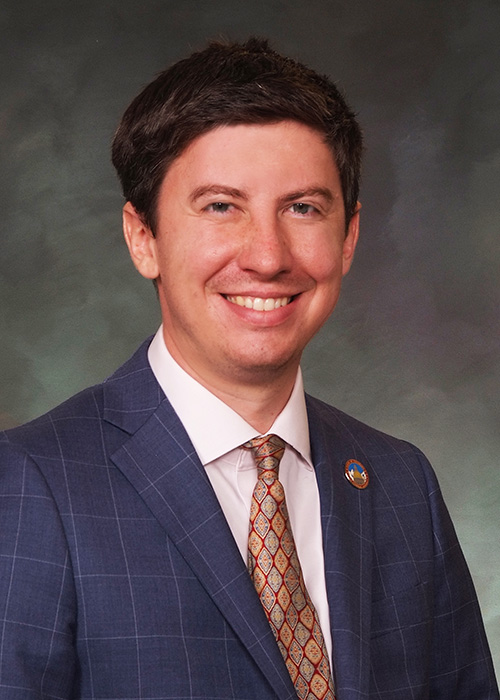
Sen. William Lindstedt
Sponsored bills
The act designates the Agaricus julius mushroom, commonly known as the Emperor mushroom, as the state mushroom of the state of Colorado. (Note: This summary applies to this bill as enacted.)
The act authorizes an occupational therapist to directly recommend or prescribe durable medical equipment to a patient without requesting the prescription from a licensed physician and requires that the occupational therapist consult with the patient concerning payment options. (Note: This summary applies to this bill as enacted.)
The statutory definition of "clean energy" determines which energy projects are eligible for clean energy project financing at the county and city and county level. The statutory definition of "clean energy resource" determines which energy resources may be used by a qualifying retail utility to meet the 2050 clean energy target. The act updates the 2 statutory definitions to include nuclear energy; except that, for property valuations made for tax purposes, the act exempts from the definition of "clean energy resource" nuclear energy. (Note: This summary applies to this bill as enacted.)
Backflow is the reverse flow of water, fluid, or gas caused by back pressure or back siphonage. Under current law, individuals who are engaged in the business of installing, removing, inspecting, testing, or repairing backflow prevention devices are subject to the licensure requirements for plumbers, except when the individuals are installing or testing a stand-alone fire suppression sprinkler system. The act exempts individuals engaged in the business of inspecting, testing, or repairing backflow prevention devices from licensure requirements but retains the licensure requirements for individuals engaged in the installation or removal of the devices; except that individuals who install or replace a backflow prevention device on a stand-alone fire suppression system remain exempted from the licensure requirements. The act requires that, on and after July 1, 2025, a licensed plumber who installs, tests, inspects, repairs, or reinstalls a backflow prevention device and a certified cross-connection control technician or a licensed plumber with a cross-connection control technician certification who tests or repairs a backflow prevention device must affix a tag on the backflow prevention device that contains certain information about the licensed plumber, the certified cross-connection control technician, or the licensed plumber with a cross-connection control technician certification, as applicable, and the service that was provided. (Note: This summary applies to this bill as enacted.)

The Colorado rangers law enforcement shared reserve, commonly known as the Colorado rangers (CLER), is a statewide law enforcement agency that has been established as a political subdivision of the state through the execution of an intergovernmental agreement for the public purpose of promoting the safety, security, and general welfare of all Coloradans by establishing a peace officers standards and training board (P.O.S.T. board) certified statewide shared peace officer reserve force. Sections 1 through 4 of the act update laws relating to civil defense workers and peace officers to clarify the status of the CLER as a governmental entity created by intergovernmental agreement rather than as a volunteer organization, as it was prior to 2018, the requirement that a Colorado ranger be a P.O.S.T. board certified peace officer, and the scope of a Colorado ranger's authority. Section 5: Authorizes the board of the CLER to establish policies to allow compensation to be paid to a Colorado ranger if the Colorado ranger: Is deployed as a peace officer to a jurisdiction for an extended period, as defined or described in the policies; or Is deployed as a peace officer outside the state as authorized by a specified interstate compact for any length of time; and Authorizes the CLER to accept gifts, grants, and donations.(Note: This summary applies to this bill as enacted.)

The act requires the Colorado bureau of investigation (CBI) to spend $3,000,000 in specifically appropriated money from House Bill 24-1430, concerning the provision for payment of the expenses of the executive, legislative, and judicial departments of the state of Colorado, and of its agencies and institutions, for and during the fiscal year beginning July 1, 2024, except as otherwise noted, on backlogged DNA evidence and sexual assault kit tests, as well as DNA retesting related to CBI's laboratory misconduct that was discovered in 2023. Additionally, the act allows CBI to contract with external labs to perform the testing. The act requires CBI to create a dashboard on the department of public safety's website to update the public on the backlog at least every 30 days. CBI shall provide the general assembly with updates on the sexual assault kit backlog, including the number of cases pending, the number of tests CBI's lab conducted, the number of tests CBI contracted out, an update on CBI's laboratory staffing levels, the average turnaround time for a sexual assault kit test, and other relevant data points every 30 days from March 10, 2025, through June 30, 2026. (Note: This summary applies to this bill as enacted.)
Maddy summarySJR 25-013 is a symbolic resolution recognizing Thursday, March 20, 2025, as Nowruz Day in Colorado. It honors the ancient Persian New Year celebration observed by Iranian, Kurdish, Afghan, and Central Asian communities, acknowledging its cultural significance and the contributions of Colorado's Iranian-American residents. The resolution has no legal effect but formally extends recognition to the traditions of Nowruz, including its themes of renewal and community. It directly affects Colorado's Iranian-American community by affirming their cultural heritage through state acknowledgment.
Maddy summaryThis resolution (SJR 25-009) expresses Colorado's support for federal management of national public lands, including parks, forests, and monuments. It formally opposes efforts to sell, transfer, or dispose of these lands and urges Colorado's governor, attorney general, and congressional delegation to take action against such proposals. The resolution is non-binding but directs state officials to advocate for continued public stewardship by federal agencies like the National Park Service and Bureau of Land Management. It was passed by the Colorado Senate and referred to the House for consideration.
The act establishes uniform confidentiality standards for the protection of taxpayer information used or obtained in connection with a sales or use tax investigation performed by a third-party auditor on behalf of a local taxing jurisdiction. Except for certain limited circumstances, the act prohibits third-party auditors from divulging or making known in any way to any person information that is obtained from a sales or use tax investigation on behalf of a local taxing jurisdiction or disclosed in any document, report, or return filed in connection with local sales or use taxes. Third-party auditors may disclose taxpayer information in certain limited circumstances, including disclosure to: An official, employee, hearing officer, attorney, or other public agent of the local taxing jurisdiction who is authorized to receive such information in connection with the local taxing jurisdiction's sales or use tax investigation performed by the third-party auditor; A requesting taxpayer, or the taxpayer's authorized agent, of the taxpayer's own tax filings; The department of revenue (department) for purposes of statistical analysis and publication as authorized by current law; and The department and the federal internal revenue service as necessary and pertinent to a taxpayer's compliance or failure to comply with state or federal tax law. A taxpayer may waive the confidentiality requirements for the taxpayer's own filings. A violation of the confidentiality provisions is a misdemeanor punishable by a fine of not more than $1,000 per violation. The act also clarifies the scope of the authority of the executive director of the department to share taxpayer information with statutory local governments, special districts, and requesting home rule jurisdictions as necessary to facilitate dispute resolution, coordination, intergovernmental agreements, and information sharing between the department and such local governments consistent with law, which prohibits the disclosure of any such shared information to any third party. (Note: This summary applies to this bill as enacted.)