

The healthy school meals for all program (program) reimburses participating school food authorities for meals that those authorities provide to students without charge. Section 2 of the act allows the amount of these reimbursements to be modified in 2 different scenarios. First, if a referred measure that would, in combination with the income tax deduction modification that was approved by the voters in connection with the program, result in the collection of at least $150 million for the income tax year commencing on January 1, 2026, is not approved by the voters voting on the referred measure at the 2025 statewide election, the department of education (department) is required to only provide reimbursements to participating school food authorities for meals served at eligible sites. Eligible sites are those that either: Qualify for the community eligibility provision program, as that program exists on November 15, 2025; or Are identified as eligible sites by the department based on the amount that the general assembly appropriates for the purpose of providing reimbursements to a participating school food authority for offering eligible meals without charge and the percentage of a site's student enrollment who are certified as eligible for free meals based on documentation of benefit receipt or categorical eligibility as described in federal rule, or any successor regulations. Second, if the department, in consultation with the office of state planning and budgeting, determines that the amount that the general assembly appropriated for the purpose of providing reimbursements to a participating school food authority is less than the costs of the department providing those reimbursements, the department may determine a prorated reimbursement amount for the reimbursements that the department provides through the program to each participating school food authority for the remainder of that budget year. Sections 4 and 6 limit the existing authority of the department, if the department determines that there is an insufficient amount of money in the healthy school meals for all program cash fund (fund) for the department to provide reimbursements to a participating school food authority for offering eligible meals without charge, to make an expenditure from the general fund to provide those reimbursements to state fiscal years commencing on or before July 1, 2024. Section 3 allows the general assembly to appropriate money from the state education fund to cover program costs for which there is not sufficient money in the fund, as it was required to do for state fiscal years 2024-25, for state fiscal year 2025-26. Section 4 requires the department, on January 15, 2027, in consultation with the office of state planning and budgeting, to report to the joint budget committee on whether there is a sufficient balance in the fund for: The state treasurer to transfer an amount from the fund to the state education fund equal to the total amount of expenditures from the state education fund for the program for state fiscal years 2022-23, 2023-24, 2024-25, and 2025-26 minus the amount of additional tax revenue deposited in the state education fund as a result of the increase in state income tax generated in connection with voter approval of the program for those same fiscal years; and The department to provide reimbursements to a participating school food authority for offering eligible meals without charge. Section 8 extends the local school food purchasing program indefinitely, so that the program extends beyond the 2024-25 school year. Section 9 similarly extends the required reporting on the local school food purchasing program. Section 11 decreases the appropriation for school meal reimbursements provided through the program from the general fund by $42,240,242 and increases the appropriation from the state education fund by $8,119,271 for the same purpose. (Note: This summary applies to this bill as enacted.)
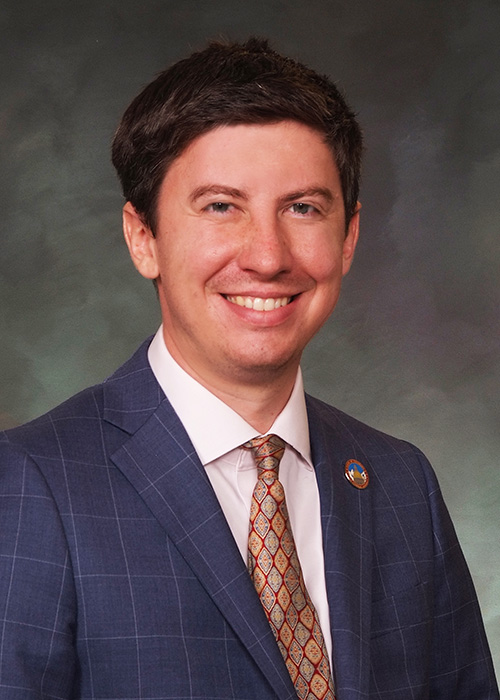
Sen. William Lindstedt
Sponsored bills
The act authorizes an agency of government to incorporate a project labor agreement requirement for a public project in the amount of $1 million or more if the project labor agreement will promote successful project delivery by securing a skilled labor force for the project and if it will promote cost-efficiency, safety, quality, and timely completion of the project. (Note: This summary applies to this bill as enacted.)
The act refers 2 ballot issues to the voters at the November 2025 statewide election concerning funding for the healthy school meals for all program. Section 2 refers a ballot issue to the voters at the November 2025 statewide election to allow the state to retain and spend state revenue that would otherwise need to be refunded for exceeding the estimate in the ballot information booklet analysis for Proposition FF and to allow the state to maintain the increases in state taxable income established in Proposition FF that would otherwise need to be decreased. If voters reject the ballot issue, the state will both: Refund $12,430,388 to individuals who have a federal taxable income of $300,000 or more and claimed itemized or standard state income tax deductions greater than $12,000 for single tax return filers and $16,000 for joint tax return filers; and Adjust the limit on itemized deductions established in Proposition FF to a level that would have reduced the amount of income tax revenue attributable to these itemized deductions by $12,430,388. If voters approve the ballot measure: The state will not refund $12,430,388 to individuals who have a federal taxable income of $300,000 or more and claimed itemized or standard state income tax deductions greater than $12,000 for single tax return filers and $16,000 for joint tax return filers; and The increases in federal taxable income as a result of Proposition FF will stay at the levels established by Proposition FF. Section 3 refers a ballot issue to the voters at the November 2025 statewide election to allow the state to increase taxes by $95 million annually by increasing state taxable income to support the healthy school meals for all program. If voters approve the ballot issue: Income tax deductions for individuals who have a federal taxable income of $300,000 or more will be reduced from current levels to $1,000 for single filers and $2,000 for joint filers; and The state will allocate the additional revenue generated by the reduction in income tax deductions to the healthy school meals for all program. If voters reject the ballot issue, income tax deductions will not be reduced, and there will not be any additional revenue to be allocated to the healthy school meals for all program. In addition to the income tax changes and potential refunds that may result from voters approving or rejecting the ballot issues described in sections 2 and 3, the act also changes the healthy school meals for all program cash fund (fund) and healthy school meals for all programs. If voters approve the ballot issue submitted pursuant to section 2 and reject the ballot issue submitted pursuant to section 3, $1 million is transferred annually from the fund to local school food purchasing programs. If voters approve the ballot issue submitted pursuant to section 3, regardless of whether the voters approve the ballot issue submitted pursuant to section 2: The permissible distribution of local food purchasing grants is modified; Certain school food authorities are allowed to collaborate to implement advisory committees; The duties of an advisory committee are clarified; and The distribution of funds from the fund is changed so that the amounts distributed through local food purchasing grants for increasing wages or providing stipends for individuals whom the participating school food authority employs to directly prepare and serve food for school meals and through the local school food purchasing technical assistance and education grant program are modified based on the amount of money in the fund. NOTE: Certain provisions of the act are contingent on the results a measure concerning Proposition FF refunds or Proposition FF revenue increases being either approved or not approved by a majority of voters at the November 2025 statewide election.(Note: This summary applies to this bill as enacted.)
The act allows the department of health care policy and financing (department) to, on behalf of the department, contract with a recovery audit contractor (RAC) vendor to conduct RAC audits of medicaid providers (providers). RAC audits may only review claims that are no more than 3 years past the expiration date of the timely filing period. The department may only review claims that fall outside of this 3-year time frame if required by a federal audit. The act limits the number of audits a provider may undergo each year and the number of medical records that can be requested for a given audit. If the RAC vendor identifies preliminary findings during the RAC audit, the RAC vendor must send the provider a report detailing the preliminary findings, the rationale for the preliminary findings, and the methodology for how any overpayments were calculated and determined. The act allows a provider that received preliminary findings following a complex audit to request an exit conference to discuss the preliminary findings with the RAC vendor and the department to resolve the concerns detailed in the preliminary findings prior to undergoing an informal reconsideration of the preliminary findings. A provider is required to participate in an informal reconsideration before filing a formal appeal regarding the department's findings during an RAC audit. The department is required to submit an annual report to the joint budget committee containing information about the RAC audits conducted and the department's involvement in those RAC audits. The act, in the department's budget for medical and long-term care services for medical-eligible individuals, decreases the cash funds appropriation from recoveries and recoupments by $20,900,588 and increases the cash funds appropriation from the recovery audit contractor recoveries cash fund by $20,900,588. (Note: This summary applies to this bill as enacted.)
For vinous liquor alcohol shipper licenses, once those licenses are issued by the state, the act removes the requirement that a driver delivering vinous liquors on behalf of an alcohol beverage shipper licensee ensure that the individual accepting delivery is the individual intended to receive the product and instead requires only that the driver delivering the vinous liquor ensure that the individual accepting delivery is not under twenty-one years of age or visibly intoxicated. (Note: This summary applies to this bill as enacted.)
In current law, the sentencing structure for theft, except for auto theft, is based on the value of the item stolen. The act exempts theft of firearms from that sentencing structure and makes theft of a firearm a class 6 felony, regardless of the firearm's value. The act appropriates $324,225 from the general fund to the judicial department to implement the act. (Note: This summary applies to this bill as enacted.)
Under current law, there exists a working group formed by the department of human services and the state court administrator in the judicial department to perform various duties related to the allocation of juvenile detention beds. The act amends these duties. Under current law, 22 emergency detention beds are available statewide. The act expands this to 39 emergency detention beds available statewide. The act requires the department of human services to publish a monthly report concerning the status of all youth who are in detention and are awaiting services that would mitigate the substantial risk of harm to others that are presented by the juvenile or the juvenile's risk of flight from prosecution and the number of emergency beds used by each judicial district or facility. The act requires the division of youth services to: Publish a report by July 1, 2027, concerning available placements for juveniles who are awaiting mitigating services in the state; and Establish a pilot program for certain staff members to wear a body-worn camera while in a facility while interacting with youth. The act requires a court to dismiss a delinquency petition or charges against a juvenile if the court determines that the juvenile is incompetent to proceed and the highest charged act constitutes a class 2 misdemeanor, petty offense, drug misdemeanor, or traffic offense. The act amends and expands considerations for a juvenile's case management plan, if the court determines that a juvenile is incompetent to proceed. The act creates the deflection and community investment grant program in the division of criminal justice to provide grants to eligible applicants to implement a mixed-delivery system of trauma-informed health and development deflection programs for youth, including Native American youth. The grant program repeals on January 1, 2031. For the 2025-26 state fiscal year, the act: Appropriates $6,854,420 from the general fund to the department of human services to implement the act; Reappropriates $122,279 of general funds to the department of education to the department of human services for use by the division of youth services to implement the act; Appropriates $437,264 from the general fund to the department of public safety for use by the division of criminal justice to implement the act; and Appropriates $2,708,316 from the general fund to the department of public safety for use by the division of criminal justice for the deflection and community investment grant program.(Note: This summary applies to this bill as enacted.)
The act creates a specific criminal offense related to wrongfully interfering with a transit worker and adds it to the criminal harassment statute, as well as making the offense subject to the victim rights act. The act eliminates similar criminal conduct from the regional transportation district (district) statutory scheme. Further, a law enforcement agency may grant money received from the peace officer training and support fund to the district for training, equipment, and other purposes deemed necessary to ensure the safety of employees and patrons of the district. (Note: This summary applies to this bill as enacted.)
The act defines "knowing misconduct" as a voluntary act or omission or series of acts or omissions consciously performed by a crime laboratory employee (employee) as a result of effort or determination in which the employee is aware that the employee's conduct is improper or deceptive and involves mishandling physical evidence or data or results, incorrectly performing forensic testing, presenting misleading or false results, concealing material information, or presenting false sworn testimony about evidence. The act defines a "significant event" as an act or omission by an employee that is a gross deviation from the standard operation procedures or accreditation requirements of the crime laboratory, or requirements in law that were applicable at the time of the act or omission of the employee, that could substantially negatively affect the integrity of the crime laboratory activities. The act requires an employee to report witnessed or discovered knowing misconduct or a significant event (collectively, "wrongful action") within 7 days of witnessing or discovering the wrongful action to the director of the crime laboratory (director) or to the employee's immediate supervisor, who shall report it to the director. A director who receives a report shall investigate the alleged wrongful action. As part of the investigation, the director must compile a list of all cases that the employee worked on. At the conclusion of the investigation, the director shall prepare a written final report. When an investigation is of alleged wrongful action in a pending case, the director shall notify each district attorney who has jurisdiction over the pending case about the investigation. At the conclusion of the investigation, if the investigation determines that the employee did not engage in wrongful action, the director shall deliver the final report to each district attorney who received notice of the investigation and to each district attorney who has jurisdiction over any case that was subject to investigation. If the investigation determines that the employee engaged in wrongful action, the director shall deliver the final report and all discoverable materials to each district attorney who has jurisdiction over any case that the employee worked on in an official capacity. If an investigation concerning wrongful action by a crime laboratory occurred after July 1, 2014, and before July 1, 2025, and the investigation resulted in criminal allegations filed against the employee or a sustained internal affairs action by the department supervising the employee, the director shall, as soon as practicable but no later than September 1, 2025, prepare a final report and provide the final report to all district attorneys with jurisdiction over any criminal case that is identified in the final report that is pending or has resulted in a conviction in that jurisdiction. Upon receipt of a notice from a director about an investigation into alleged wrongful action in a pending case, a district attorney shall notify the defendant in the case of the investigation. If the case involved a crime listed in the "Victim Rights Act", the district attorney shall also notify the victim about the alleged wrongful action, if the charges have been filed but the trial has not begun. A district attorney who receives a final report of an investigation that determines that a crime laboratory employee engaged in wrongful action in any case shall notify the defendant in that case, and each defendant whose case was reviewed as part of the investigation, of the determination of wrongful action. The act establishes a defendant's right to counsel in matters involving an employee's wrongful action and a right to investigate the wrongful action, to request discovery related to the wrongful action, and to seek post-conviction relief based on the wrongful action. The act permits a court to enter a protective order related to discovery requests. The act establishes a process for a defendant convicted in a case involving an employee's wrongful action to petition for post-conviction relief based on the wrongful action. If the defendant's petition for post-conviction relief asserts facts that, if true, demonstrate that a wrongful action was material to the case, the court shall decide the claim upon the merits after an evidentiary hearing. At the evidentiary hearing, the defendant has the burden to show that the employee committed the wrongful action and that the wrongful action is material to the case. If the defendant meets their burden, the court shall vacate the defendant's conviction and grant a new trial. The act makes all records related to an investigation criminal justice records and makes release of the records governed by the existing law governing criminal justice records; except that the custodian of a final report that concludes that a crime laboratory employee engaged in wrongful action may deny inspection of the report if there is an ongoing criminal investigation or criminal case. The act appropriates $140,433 from the general fund to the judicial department for use by the state courts. (Note: This summary applies to this bill as enacted.)
The act adds species that appear in Appendix I to the Convention on International Trade in Endangered Species of Wild Fauna and Flora (CITES Appendix I) to the wildlife covered under Colorado's wildlife trafficking and wildlife possession laws. The act clarifies that species listed on Colorado's endangered and threatened species list or the endangered and threatened species list pursuant to the federal "Endangered Species Act of 1973", 16 U.S.C. sec. 1531 et seq. (federal act) are also covered under Colorado's wildlife possession and wildlife trafficking laws. The act establishes penalties for violating wildlife trafficking laws. A person who violates wildlife trafficking laws commits a class 1 misdemeanor; except that: If a person violates wildlife trafficking laws and the aggregate value of the wildlife involved is more than $1,000 but less than $10,000, the person commits a class 5 felony; If a person is convicted of trafficking wildlife and the wildlife involved is an endangered species or threatened species under Colorado law or the federal act or is a species that appears in CITES Appendix I, the person commits a class 4 felony; or If a person violates wildlife trafficking laws and the aggregate value of the wildlife involved is more than $10,000, the person commits a class 4 felony. The act grants the parks and wildlife commission (commission) in the department of natural resources (department) authority to suspend wildlife licenses held by a person convicted of a violation of wildlife trafficking laws. The act clarifies that the division of parks and wildlife (division) in the department has the authority to pursue a civil action against an individual to recover the possession or value of wildlife that was unlawfully taken and the minimum value that the division may recover for certain animals that are on the federal endangered and threatened species lists. The act requires the division to conduct investigations and surveys to collect information and data related to wildlife trafficking and determine appropriate conservation, management, and law enforcement measures based on those investigations and surveys. The general assembly is required to appropriate sufficient money to implement the act from the wildlife cash fund; except that money from the sale of hunting and fishing licenses in the wildlife cash fund must not be used for these purposes. (Note: This summary applies to this bill as enacted.)