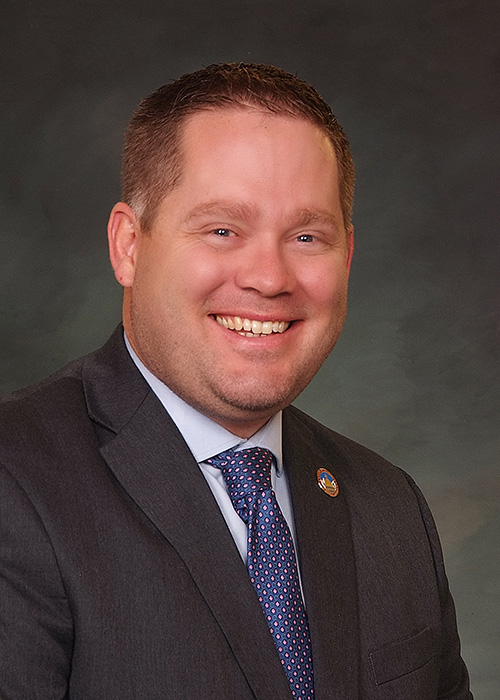
Photo of Kyle Mullica
D Colorado Senate · District 24 On the 2026 ballot

Sen. Kyle Mullica

Compare
Total votes
4,821
all sessions
Attendance
93%
316 missed
Near the chamber average
With party
96%
of cast votes
Lower than 89% of chamber peers
Bipartisan score
2%
crosses aisle rarely
Higher than 80% of chamber peers
Sponsored
475
bills & resolutions
Near the chamber average
Committees
7
assignments
475 bills and resolutions

Sponsored bills

Total
475
Primary
199
Co-sponsor
276
This page
475
matching current filters
Primary HB 20-1078
Signed into law · Colorado House · Lead sponsor
Pharmacy Benefit Management Firm Claims Payments

Beginning January 1, 2021, the act: Prohibits a pharmacy benefit management firm (PBM) from reimbursing a pharmacy in an amount less than the amount that the PBM reimburses any affiliate for the same pharmacy services; Prohibits PBMs from retroactively reducing payment on a clean claim submitted by a pharmacy unless as the result of an audit conducted in accordance with state law; and Requires health insurers that contract with PBMs to ensure that the PBMs are complying with this prohibition. The division of insurance is authorized to promulgate rules to establish the manner in which carriers and pharmacy benefit management firms are required to show compliance with the act. (Note: This summary applies to this bill as enacted.)

Signed into law Apr 1, 2020 0 co-sponsors
Primary HB 20-1031
Signed into law · Colorado House · Lead sponsor
Replace Columbus Day With New State Holiday

The act establishes Frances Xavier Cabrini day as a state legal holiday on the first Monday in October and repeals Columbus day. (Note: This summary applies to this bill as enacted.)

Signed into law Mar 20, 2020 0 co-sponsors
Primary HB 20-1121
In committee · Colorado House · Lead sponsor
Retaliation Against An Elected Official

Under current law, there is a crime of retaliation against a judge if an individual makes a credible threat or commits an act of harassment or an act of harm or injury upon a person or property as retaliation or retribution against a judge. The crime is a class 4 felony. The bill adds elected officials and their families to the crime. (Note: This summary applies to this bill as introduced.)

In committee Jan 30, 2020 0 co-sponsors
Primary SB 19-229
Signed into law · Colorado Senate · Lead sponsor
Campaign Contributions Dependent Care Expenses

Use of campaign contributions received for reasonable and necessary expenses - care of children or other dependents. The act permits a candidate committee established in the name of a candidate to expend contributions received and accepted during any particular election cycle to reimburse the candidate for reasonable and necessary expenses for the care of children or other dependents the candidate incurs directly in connection with his or her campaign activities during the election cycle. The candidate committee is required to disclose these expenditures in the same manner as any other expenditures the committee is required to disclose.(Note: This summary applies to this bill as enacted.) Read More

Signed into law May 30, 2019 0 co-sponsors
Primary SB 19-164
Signed into law · Colorado Senate · Lead sponsor
Sunset In-home Support Services Program

Medicaid - home- and community-based services - extend in-home support services waiver program. The act implements the recommendations of the department of regulatory agencies' sunset review by extending the repeal date of in-home support services for certain home- and community-based services (HCBS) waivers under the Colorado medical assistance program by 9 years, from 2019 to 2028. Prior to the repeal, the department of regulatory agencies shall conduct a sunset review of the program. The act amends the eligibility definition for in-home support services, removing the reference to specific HCBS waivers and including those waivers for which there is state and federal authority for in-home support services. The act also removes language relating to an obsolete reporting requirement. (Note: This summary applies to this bill as enacted.) Read More

Signed into law May 30, 2019 0 co-sponsors
Primary HB 19-1010
Signed into law · Colorado House · Lead sponsor
Freestanding Emergency Departments Licensure

Freestanding emergency departments - mandatory licensure - exceptions - appropriation. Effective July 1, 2022, the act creates a new license, referred to as a "freestanding emergency department license". The department of public health and environment (department) may issue the license to a health facility that offers emergency care, that may offer primary and urgent care services, and that is either: Owned or operated by, or affiliated with, a hospital or hospital system and located more than 250 yards from the main campus of the hospital; or Independent from and not operated by or affiliated with a hospital or hospital system and not attached to or situated within 250 yards of, or contained within, a hospital. A facility licensed as a community clinic before July 1, 2010, and that serves a rural community or ski area is excluded from the definition of "freestanding emergency department". The act allows the department to waive the licensure requirements for a facility that is licensed as a community clinic or that is seeking community clinic licensure and serves an underserved population in the state. The state board of health must adopt rules regarding the new license, including rules to set licensure requirements and fees and safety and care standards. $43,248 is appropriated to the department from the health facilities general licensure cash fund to implement the act. (Note: This summary applies to this bill as enacted.) Read More

Signed into law May 29, 2019 0 co-sponsors
Primary HB 19-1203
Signed into law · Colorado House · Lead sponsor
School Nurse Grant Program

School nurse grant program - appropriation. The act creates the school nurse grant program (grant program) in the department of public health and environment (department). The grant program awards grants to local education providers, as defined in the act, to hire school nurses to serve in public schools. Grants are awarded on a 5-year grant cycle, with an initial one-year grant, renewable for an additional 4 years, as long as there is a school nurse in the grant-funded position and the grant money is being used for authorized purposes. Subject to annual appropriations from the general assembly, the department shall recommend grant recipients, and the state board of health shall annually award up to $3 million during the 5-year grant cycle. Once the 5-year grant cycle is complete, the department shall administer a new grant cycle. The department may expend a portion of the grant money for reasonable and necessary administrative expenses. In each year in which school nurse grants are awarded, the department shall report to certain committees of the general assembly concerning the grant program. For the 2019-20 state fiscal year, the act appropriates $2,944,809 from the marijuana tax cash fund to the department of public health and environment for use by the prevention services division for the school nurse grant program. The act also appropriates $55,121 and 0.8 FTE from the marijuana tax cash fund to the department of public health and environment for the prevention services division for the primary care office. (Note: This summary applies to this bill as enacted.) Read More

Signed into law May 29, 2019 0 co-sponsors
Primary SB 19-235
Signed into law · Colorado Senate · Lead sponsor
Automatic Voter Registration

Voter registration - transfer of records from department of revenue - transfer of records from department of health care policy and financing - voter registration agency reports - verification of signatures - appropriation. Beginning July 1, 2020, the department of revenue is required to transfer to the secretary of state (secretary) the electronic record of each unregistered elector or person eligible to preregister who applies for the issuance, renewal, or correction of a Colorado driver's license or identification card and who provides documentation of citizenship. The elector's county clerk reviews the record for completeness and sends the elector a notice advising that the elector has been registered to vote. The elector can return the notice to either decline to be registered or affiliate with a party. If the elector does not decline to be registered within 20 days after the notice is mailed and the form is not returned as undeliverable, the elector is registered to vote. The department of health care policy and financing is also required to begin transferring to the secretary the electronic records of electors who apply for medicaid, subject to compliance with all federal laws and regulations. The elector's county clerk reviews the record for completeness and sends the elector a notice advising that the elector has been registered to vote. The elector can return the notice to decline to be registered, affiliate with a party, or provide a signature if necessary for their record. If the elector does not decline to be registered within 20 days after the notice is mailed and the form is not returned as undeliverable, the elector is registered to vote. Agencies that oversee offices designated as voter registration agencies are required to begin reporting information to the secretary related to the number of people who apply for benefits or programs, the number of voter registration choice forms the offices collect, and the number of people who receive voter registration forms. The office of information technology is required to assess and report to the secretary which voter registration agencies collect sufficient information for voter registration purposes. When the office of information technology and the secretary determine that an agency collects sufficient information, the agency is required to begin transferring records to the secretary for voter registration purposes. Unless a person who knows they are ineligible to vote intentionally takes voluntary action to become registered, the transfer of the person's record by a voter registration agency does not constitute completion of a voter registration form by that person. Beginning July 1, 2020, the act creates a process for electors who are registered through a voter registration agency to provide a signature for verification if they return a ballot in an election but a copy of their signature is not found in the statewide voter registration system. For the implementation of the act, $67,840 is appropriated to the department of state, $136,240 is appropriated to the office of the governor for use by the office of information technology, $18,000 is appropriated to the department of revenue for use by the division of motor vehicles, and $90,287 is appropriated to the department of human services. It is anticipated that the department of human services will receive an additional $45,413 in federal funds for the office of information technology services to implement the act. (Note: This summary applies to this bill as enacted.) Read More


Signed into law May 29, 2019 0 co-sponsors
Showing 461 to 470 of 475 bills