

The bill requires that firearms be responsibly and securely stored when they are not in use to prevent access by unsupervised juveniles and other unauthorized users. The bill creates the offense of unlawful storage of a firearm if a person stores a firearm in a manner that the person knows, or should know: That a juvenile can gain access to the firearm without the permission of the juvenile's parent or guardian; or A resident of the premises is ineligible to possess a firearm under state or federal law. Unlawful storage of a firearm is a class 2 misdemeanor. The bill requires licensed gun dealers to provide with each firearm, at the time of a firearm sale or transfer, a locking device capable of securing the firearm. Transferring a firearm without a locking device is an unclassified misdemeanor punishable by a maximum $500 fine. The bill requires the state court administrator to annually report to the general assembly about the number of charges related to unsafe firearms storage and the disposition of those charges. The bill requires the office of suicide prevention within the department of public health and environment (department) to include on its website, and in materials provided to firearms-related businesses and health care providers, information about the offense of unlawful storage of a firearm, penalties for providing a handgun to a juvenile or allowing a juvenile to possess a firearm, and the requirement that gun dealers provide a locking device with each firearm transferred. Subject to available money, the department is required to develop and implement a firearms safe storage education campaign to educate the public about the safe storage of firearms, and state requirements related to firearms safety and storage, and information about voluntary temporary firearms storage programs . (Note: Italicized words indicate new material added to the original summary; dashes through words indicate deletions from the original summary.) (Note: This summary applies to the reengrossed version of this bill as introduced in the second house.)
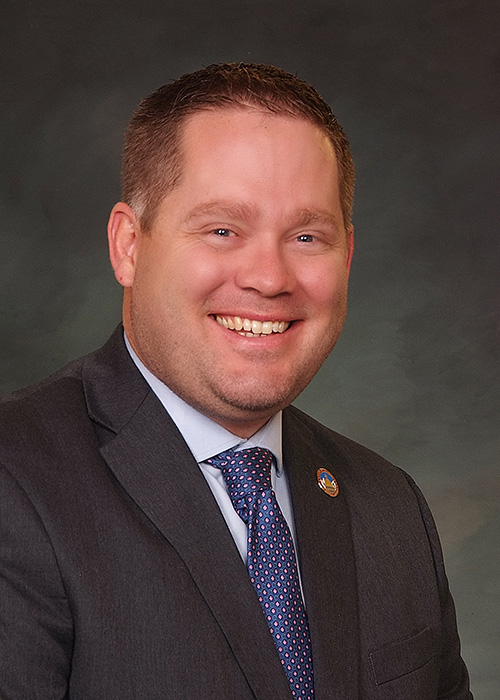
Sen. Kyle Mullica
Sponsored bills
The act allows the executive director of the department of revenue to disclose information relevant to an assessment of a gasoline distributor for the failure to make the required sworn statement and pay the tax for any calendar month or for a gasoline distributor filing an incorrect or fraudulent statement or return for any calendar month. The executive director may only disclose this information to taxpayers with cases involving common or related issues of fact or law. Taxpayers are limited in the use and disclosure of this information.The act also requires, upon written request by a local government official, a gasoline distributor to disclose certain records to local government officials related to an alleged violation of the administration of the gasoline and special fuels tax.(Note: This summary applies to this bill as enacted.)
The bill authorizes the director of the division of professions and occupations or the applicable regulatory board in the department of regulatory agencies (regulator) to suspend or waive statutes or rules governing a health care profession or occupation over which a regulator has authority during a disaster emergency declared by the governor. The suspension or waiver of a statute or rule is limited to those in which strict compliance would prevent, hinder, or delay necessary action in coping with or responding to the disaster emergency and may not suspend, waive, or modify any supervisory requirements. The bill allows a regulator to promulgate emergency rules commensurate with the nature of the disaster emergency and within the limits of the declaration and the applicable practice act for a health care profession or occupation. The emergency rules automatically expire 60 days after the termination of the declared disaster emergency. (Note: This summary applies to this bill as introduced.)
Sections 1 through 8 of the act raise the minimum age of a person to whom cigarettes, tobacco products, and nicotine products (products) may be sold from 18 years of age to 21 years of age. A products retailer must card anyone seeking to purchase products who appears to be under 50 years of age at the time of purchase. Section 1 repeals criminal penalties against a minor for purchasing or attempting to purchase a product. Section 7 prohibits a retailer from permitting a person under 18 years of age to sell or participate in the sale of products. Section 8 also: Increases the minimum number of compliance checks required of each retail location at which the products are sold to 2 per year or at least the minimum number annually required by federal regulation, whichever number is greater; and Requires the executive director of the department of revenue (executive director) to adopt rules concerning enforcement of the laws governing the regulation of products, including rules: Regarding enforcement coordination between the division of liquor enforcement (division) in the department of revenue and local licensing authorities and regarding enforcement against products smuggling; Regarding fees, which must not exceed $400 per year, unless the executive director determines that statewide compliance with products regulation has dropped below 90%, at which time the executive director may, by rule, raise the maximum fee to $600; and Authorizing a single, large-operator license fee for retailers with more than 10 retail locations, which fee is not subject to the general maximum fee amount. Section 9 requires every retailer of the products in the state, on and after July 1, 2021, to obtain a license for each retail location owned. The division is charged with licensing retailers and coordinating with local authorities on retail location compliance checks and investigations of complaints about retailers. Section 10 prohibits: New retail locations at which products are sold from being located within 500 feet of a school unless a local licensing authority has approved a license application for the new retail location; Retail locations that sell electronic smoking device products from advertising those products in a manner that is visible from outside the retail location; and Delivery of products, other than cigars and pipe tobacco, directly to consumers unless the delivery is made by an owner or employee of a licensed retailer who is at least 21 years of age and, at the time of delivery, checks the identification of the individual receiving the delivery to determine that the individual is 21 years of age or older. Section 11 authorizes the division to seek injunctive relief against a person who violates the act and impose fines on or suspend or revoke the state license of a retailer found to have violated the act. Section 12 adjusts the fine amounts for violating the prohibition against selling products to minors from a maximum fine of $1,000 to $15,000 for a fifth or subsequent violation within 24 months to a maximum fine of $1,000 to $15,000 for a fourth or subsequent violation within 24 months. Additionally, the division must prohibit a retailer who commits a second or subsequent violation within 24 months from selling products at the retail location where the violation occurred for a specified period of time, starting with at least 7 days for a second violation within 24 months, to at least 30 days for a third violation within 24 months, and finally for up to 3 years for a fourth or subsequent violation within 24 months. Additionally, section 12 establishes fines ranging from $1,000 for a first violation to $3,000 for a third or subsequent violation within 24 months for the following violations: Advertising electronic smoking device products at a retail location where they are sold in a manner that is visible from outside the retail location; Delivering products without complying with the delivery requirements; and Selling or offering to sell products without a valid state license. If a person sells or offers to sell products without a valid state license at least 3 times within 24 months, the person is not eligible to apply for a state license for 3 years thereafter. Further, section 12 also applies the same fine structure that applies to selling products from a vending machine or failing to display the requisite warning to a violation of the prohibition against allowing a person under 18 years of age to sell or participate in the sale of products. For the 2019-20 state fiscal year, the act appropriates $45,414 to the department of revenue from the liquor enforcement division and state licensing authority cash fund (cash fund) for implementation of the act. For the 2020-21 state fiscal year, the act appropriates: $2,391,262 to the department of revenue from the cash fund for implementation of the act; $98,605 to the department of law from reappropriated funds received from the department of revenue for legal services for the department of revenue; and $69,450 to the department of personnel from reappropriated funds received from the department of revenue for vehicle replacement lease or purchase.(Note: This summary applies to this bill as enacted.)
The act continues the nurse-physician advisory task force for Colorado health care (NPATCH) for 7 years, until September 1, 2027. Additionally, the act specifies that 3 of the NPATCH members must be licensed physicians recommended by and representing a statewide physicians' organization that represents multi-specialty physicians and whose membership includes at least one-third of the doctors of medicine and osteopathy licensed in the state. $15,554 is appropriated from the division of professions and occupations cash fund to the department of regulatory agencies for use by the division of professions and occupations for personal services needed to implement the act. (Note: This summary applies to this bill as enacted.)
The act implements the recommendations of the department of regulatory agencies in its sunset review and report on the "Nurse Practice Act", under which nurses are regulated by the state board of nursing (board), as follows: Continues the regulation of nurses by the board for 7 years, until September 1, 2027; Authorizes the board to enter into a confidential agreement to limit practice with a nurse who has a health condition that affects the ability of the nurse to practice safely and modifies grounds for disciplining a nurse to specify that a nurse may be disciplined for failing to notify the board of a health condition that limits the nurse's ability to practice safely, failing to act within the limits imposed by the health condition, or failing to comply with the terms of a confidential agreement entered into with the board; Adds, as a ground for disciplining a nurse, engaging in a sexual act with a patient during the course of care or within 6 months after care is concluded; Requires licensees and insurance carriers to report malpractice settlements and judgments; Modifies the grounds for discipline relating to alcohol or drug use or abuse to clarify that the use or abuse need not be ongoing to trigger discipline; Requires a nurse to report an adverse action or the surrender of a license within 30 days after the action; Requires a nurse to report a criminal conviction within 30, rather than 45, days after the conviction; Repeals the standards of "willful" and "negligent" with regard to certain grounds for disciplining a nurse; Changes the title "advanced practice nurse" and the acronym "A.P.N." to "advanced practice registered nurse" and "A.P.R.N."; Eliminates the age limit and the requirement to be retired for a nurse to obtain a volunteer license; Repeals the requirement for the director of the division of professions and occupations to consult with the board before appointing an executive administrator and other personnel for the board; and Repeals the requirement for at least one board member to sit on the panel to interview candidates for the board executive administrator position. In addition to implementing the sunset recommendations, the act: Reduces the number of experience hours required for an A.P.R.N. to obtain prescriptive authority from 1,000 hours to 750 hours and includes a legislative declaration stating that the experience hours should not be adjusted downward before the next sunset review of the "Nurse Practice Act"; Eliminates the requirement that an A.P.R.N. seeking or who has obtained prescriptive authority develop, maintain, or update an articulated plan and that the board audit those plans; Adds definitions of "collaboration", "delegation of patient care", and "licensed health care provider" to the "Nurse Practice Act" for purposes of clarifying the ability of nurses to delegate nursing tasks to other providers and assistive personnel; and Modifies the definitions of "practice of practical nursing" and "practice of professional nursing".(Note: This summary applies to this bill as enacted.)
The act implements the recommendations of the department of regulatory agencies in its sunset review and report on the certification of nurse aides by the state board of nursing (board) as follows: Continues the regulation of certified nurse aides by the board for 7 years, until 2027; Combines the laws regulating the practice of certified nurse aides with the "Nurse Practice Act"; Modifies the grounds for disciplining a certified nurse aide regarding the excessive use or abuse of alcohol or drugs; Eliminates an inconsistency regarding the waiting period to apply for a new certification following the revocation or surrender of a nurse aide certification; Repeals the requirement that the board send communications regarding disciplinary actions by certified mail; and Modifies the exception to uncertified nurse aide practice in a medical facility to allow an uncertified individual to practice for up to 4 months if the practice is within the scope of employment and is part of an approved training program prior to certification and the certification is not by endorsement. Additionally, the act permits a certified nurse aide, if deemed competent by a registered nurse to do so, to: Place into a minor client's mouth medication that has been sorted by the minor's parent or guardian; and Administer oxygen and change ostomy bags.(Note: This summary applies to this bill as enacted.)
A Colorado state credit union may open new branches in Colorado or in other states 30 days after providing written notice to the state commissioner of financial services. The state commissioner may enter into agreements with other state credit union regulators for the purposes of examination and supervision of out-of-state offices. (Note: This summary applies to this bill as enacted.)