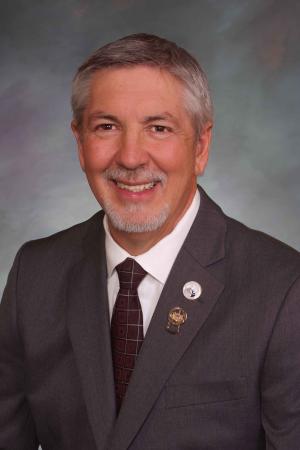
Photo of Dennis Hisey
R Colorado Senate · District 2

Sen. Dennis Hisey

Contact Email
Compare
Total votes
1,839
all sessions
Attendance
100%
2 missed
Higher than 80% of chamber peers
With party
93%
of cast votes
Near the chamber average
Bipartisan score
5%
crosses aisle rarely
Near the chamber average
Sponsored
103
bills & resolutions
Near the chamber average
Committees
0
assignments
103 bills and resolutions

Sponsored bills

Total
103
Primary
103
Co-sponsor
0
This page
103
matching current filters
Primary SB 21-155
Signed into law · Colorado Senate · Lead sponsor
Limited Gaming Commission Member From Gaming Area

The limited gaming control commission consists of 5 members, 4 of whom are from specified professions and industries and one of whom is a registered elector of the state who is not employed in one of the specified professions or industries. The act requires the governor to prioritize appointing members who are registered electors of Gilpin county or Teller county and allows the registered elector members of the commission from Gilpin and Teller County to be employed in one of the specified professions or industries.(Note: This summary applies to this bill as enacted.)

Signed into law May 21, 2021 0 co-sponsors
Primary HB 21-1112
Signed into law · Colorado House · Lead sponsor
School District Scholarship Programs

The act authorizes a school district board of education to establish a scholarship program for graduates of the school district. The scholarships must be paid from additional mill levy revenue that the school district is authorized to collect; gifts, grants, and donations; or both. A school district board of education that establishes a scholarship program is encouraged to prioritize low-income and first-generation students and limit the allowable uses of scholarship money.(Note: This summary applies to this bill as enacted.)

Signed into law May 18, 2021 0 co-sponsors
Primary HB 21-1138
Signed into law · Colorado House · Lead sponsor
Restrict Off-highway Vehicles On Public Roads

The act clarifies that it is unlawful to operate an off-highway vehicle on the public streets, roads, or highways of the state, regardless of the state or other jurisdiction in which the off-highway vehicle is registered or titled, except under certain existing exceptions.(Note: This summary applies to this bill as enacted.)

Signed into law May 7, 2021 0 co-sponsors
Primary SB 21-020
Signed into law · Colorado Senate · Lead sponsor
Energy Equipment And Facility Property Tax Valuation

The act ensures that clean energy resources and energy storage systems used to store electricity are assessed for valuation for the purpose of property taxation in a similar manner to renewable energy facility property used to generate and deliver electricity. The act also modifies the income approach for certain renewable energy facilities by extending the"tax factor" from a 20-year period to a 30-year period. It also specifies that after the 20- or 30-year period, as applicable, a tax factor is not applied and the taxable value shall not exceed the depreciated value floor calculated using the cost basis method. The administrator is also required to utilize the income approach for solar energy facilities that generate 2 megawatts or less, so that similar facilities will be valued in the same manner.(Note: This summary applies to this bill as enacted.)

Signed into law Apr 22, 2021 0 co-sponsors
Primary HB 21-1076
Signed into law · Colorado House · Lead sponsor
Carpooling Service Internet Application Register Colorado Department Of Transportation

The act requires the owner or operator of a carpooling service internet application (internet application) to register annually with the department of transportation. Owners or operators are also required to disclose to users of the internet application that carpooling service companies are not regulated by the state; that the state does not conduct medical examinations, vehicle inspections, or insurance verification in relation to the provision of carpooling service; and that background checks on drivers might not be conducted. The act also requires that the amount that can be charged to a user through the internet application be reasonably calculated to cover the direct and indirect costs of providing carpooling service and limits the number of passengers that a driver providing carpooling service through the internet application may transport at any one time.The act also limits each driver providing carpooling service to one trip per day and defines "carpooling service" as a trip that is at least 23 miles between pick-up and drop-off points or a trip to or from a ski area, regardless of distance.(Note: This summary applies to this bill as enacted.)

Signed into law Apr 19, 2021 0 co-sponsors
Primary SB 21-170
In committee · Colorado Senate · Lead sponsor
Wildland Fire Mitigation Cooperative Electric Association

The bill requires a cooperative electric association (association) to adopt a wildland fire protection plan. The plan must include information on: Areas where the association has powerline facilities that may have an increased risk of wildland fires; The procedures and standards that the association will use to inspect and operate its powerline facilities and perform vegetation management around those facilities; The modifications or upgrades that the association will implement to reduce risks of wildland fires; The procedures for de-energizing powerline facilities to mitigate potential wildland fires; Community outreach efforts during the wildland fire season; and The potential for coordination with other wildland fire protection plans. An association must file its wildland fire protection plan with the public utilities commission every 3 years and must submit an annual report to the commission detailing its compliance with the plan. The bill allows, but does not require, an association to remove or partially remove vegetation outside of a powerline facility easement as necessary following a major weather event or other emergency situation. In addition, an association may designate vegetation as "hazard vegetation" if the association finds that the vegetation is dead, likely to fail, or likely to fall, sway, or grow into a powerline facility and finds that the vegetation is likely to cause substantial damage, disrupt service, or come within a minimum clearance distance of the powerline facility. An association may, but is not required to, remove or partially remove hazard vegetation outside of an easement after providing notice to the landowner. The association is not required to provide notice if removal of the hazard vegetation is necessary to continue safe operation of its facilities or if the removal is done as part of trimming or removing vegetation after a storm or other emergency event. If vegetation outside of a powerline facility easement dies as the result of being trimmed or partially removed by an association, the landowner may request that the association remove the vegetation at the association's expense. The association is required to remove the vegetation within ninety days; except that the association may offer and the landowner may accept payment for the reasonable cost of removal instead of the association removing the vegetation. An association is not liable for personal injury, property damage, or fire suppression costs resulting from a wildland fire if any of the following apply: The association filed a wildland fire protection plan and completed the activities described in it; A landowner failed to control vegetation outside of a powerline facility easement on the landowner's land; The association requested and was denied access to perform vegetation management in a right-of-way on land owned by a local government, the state, a federal agency, or a tribal agency; or A landowner prevented the association from maintaining its powerline facility easement or from removing hazard vegetation outside the easement. If none of those circumstances apply and an association is found liable for a wildland fire, the prevailing plaintiff is limited to actual damages and cannot recover noneconomic, punitive, or exemplary damages. (Note: This summary applies to this bill as introduced.)


In committee Apr 6, 2021 0 co-sponsors
Primary HB 20B-1003
Signed into law · Colorado House · Lead sponsor
Food Pantry Assistance Grant Program

The bill expands and extends the provisions of the food pantry assistance grant program (grant program) that is currently in law. Current law states that all grants from the grant program must be made on or before December 30, 2020, and allows for grants to food banks and food pantries, including faith-based organizations (eligible entities) . The bill extends this date to February 28, 2021. and also allows food delivery organizations to apply for a grant . The bill states that it is the intent of the general assembly that food purchased through an award from the grant program be purchased and distributed all money awarded by the grant program is expended on or before June 30, 2021. Currently, grant awards through the grant program range from $2,500 to $35,000. The bill no longer caps the grant awards at $35,000. The amount a grant recipient may use for direct and indirect costs expenses is increased from 10% to 50% 20%. Allowable expenses are expanded to include food delivery. In awarding grants to eligible entities, the department of human services shall in no case determine the amount of a grant award on the risk level of the county in which the eligible entity is located, based upon the risk level dial framework established by the department of public health and environment. The repeal date is extended one year, to June 30, 2023. The bill makes an appropriation. (Note: Italicized words indicate new material added to the original summary; dashes through words indicate deletions from the original summary.) (Note: This summary applies to the reengrossed version of this bill as introduced in the second house.)

Signed into law Dec 7, 2020 0 co-sponsors
Primary HB 20-1336
Signed into law · Colorado House · Lead sponsor
Holocaust And Genocide Studies In Public Schools

The act requires the state board to adopt standards related to Holocaust and genocide studies on or before July 1, 2021. The adoption of standards is conditional on the receipt of gifts, grants, or donations. The act requires each school district board of education and charter school to incorporate the standards on Holocaust and genocide studies adopted by the state board into an existing course that is currently a condition of high school graduation for school years beginning on or after July 1, 2023, if the standards are adopted by the state board on or before July 1, 2023. The act requires the department of education to create and maintain a publicly available resource bank of materials pertaining to Holocaust and genocide courses and programs, which must be available for access by public schools no later than July 1, 2021. (Note: This summary applies to this bill as enacted.)

Signed into law Jul 8, 2020 0 co-sponsors
Primary HB 20-1312
Signed into law · Colorado House · Lead sponsor
Behavioral Health Training Requirements Educator License

The act creates a requirement that of the 90 hours of professional development training currently required for renewal of a teacher's license during the term of the teacher's license, at least 10 of those hours must include some form of behavioral health training that is culturally responsive and trauma- and evidence-informed and increases awareness of laws and practices relating to educating students with disabilities in the classroom, including child find and inclusive learning environments. The 10 clock hours may be obtained by any combination of related courses, so long as at least 1 of the 10 clock hours is related to behavioral health training and at least 1 of the 10 clock hours is related to educating students with disabilities in the classroom. The act requires teacher preparation programs to include in program graduation requirements that each teacher candidate in an initial educator licensure program complete at least 1 semester- or quarter-length course in behavioral health training that is culturally responsive and trauma- and evidence-informed. (Note: This summary applies to this bill as enacted.)

Signed into law Jul 8, 2020 0 co-sponsors
Primary HB 20-1029
Signed into law · Colorado House · Lead sponsor
Allow County Officers To Accept Lower Salary

The annual salary of an elected county officer (officer) is currently specified in statute. The act allows an officer in certain counties classified under specific salary categories to make an election to receive 50% of the amount specified in law. The officer may subsequently elect to increase or decrease his or her salary annually as long as it does not exceed the amount allowed in statute. (Note: This summary applies to this bill as enacted.)

Signed into law Jul 7, 2020 0 co-sponsors
Showing 51 to 60 of 103 bills
Previous 1 … 5 6 7 … 11 Next