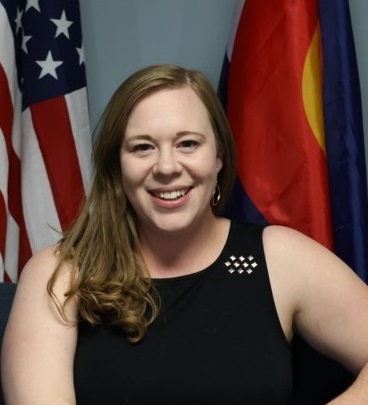
Photo of Katie Wallace
D Colorado Senate · District 17 On the 2026 ballot

Sen. Katie Wallace

Compare
Total votes
1,346
all sessions
Attendance
100%
1 missed
Higher than 80% of chamber peers
With party
98%
of cast votes
Near the chamber average
Bipartisan score
1%
crosses aisle rarely
Lower than 84% of chamber peers
Sponsored
490
bills & resolutions
Higher than 86% of chamber peers
Committees
2
assignments
490 bills and resolutions

Sponsored bills

Total
490
Primary
55
Co-sponsor
435
This page
490
matching current filters
Co-sponsor HB 25-1130
Signed into law · Colorado House · Co-sponsor
Labor Requirements for Government Construction Projects

The act authorizes an agency of government to incorporate a project labor agreement requirement for a public project in the amount of $1 million or more if the project labor agreement will promote successful project delivery by securing a skilled labor force for the project and if it will promote cost-efficiency, safety, quality, and timely completion of the project. (Note: This summary applies to this bill as enacted.)

Signed into law Jun 3, 2025 1 co-sponsor
Co-sponsor SB 25-193
Signed into law · Colorado Senate · Co-sponsor
Sunset Primary Care Payment Reform Collaborative

In 2019, the division of insurance within the department of regulatory agencies (department) established the primary care payment reform collaborative (collaborative) to, among other things, advise in the development of affordability standards and targets for insurance carrier investments in primary care, identify barriers to the adoption of alternative payment models by health-care providers and insurers, and develop recommendations to address barriers. The act implements the recommendations of the department's sunset review and report by: Continuing the collaborative for 7 years, until September 1, 2032; and Scheduling the next sunset review of the collaborative to be conducted pursuant to the sunset review structure for advisory committees. In addition, the act clarifies that the collaborative is required to ensure the development and consideration of alternative payment models that are responsive to the needs of primary care delivery in pediatrics and that the commissioner of insurance is required to invite pediatric primary care providers to participate in the collaborative. (Note: This summary applies to this bill as enacted.)

Signed into law Jun 3, 2025 1 co-sponsor
Primary HB 25-1274
Signed into law · Colorado House · Lead sponsor
Healthy School Meals for All Program

The act refers 2 ballot issues to the voters at the November 2025 statewide election concerning funding for the healthy school meals for all program. Section 2 refers a ballot issue to the voters at the November 2025 statewide election to allow the state to retain and spend state revenue that would otherwise need to be refunded for exceeding the estimate in the ballot information booklet analysis for Proposition FF and to allow the state to maintain the increases in state taxable income established in Proposition FF that would otherwise need to be decreased. If voters reject the ballot issue, the state will both: Refund $12,430,388 to individuals who have a federal taxable income of $300,000 or more and claimed itemized or standard state income tax deductions greater than $12,000 for single tax return filers and $16,000 for joint tax return filers; and Adjust the limit on itemized deductions established in Proposition FF to a level that would have reduced the amount of income tax revenue attributable to these itemized deductions by $12,430,388. If voters approve the ballot measure: The state will not refund $12,430,388 to individuals who have a federal taxable income of $300,000 or more and claimed itemized or standard state income tax deductions greater than $12,000 for single tax return filers and $16,000 for joint tax return filers; and The increases in federal taxable income as a result of Proposition FF will stay at the levels established by Proposition FF. Section 3 refers a ballot issue to the voters at the November 2025 statewide election to allow the state to increase taxes by $95 million annually by increasing state taxable income to support the healthy school meals for all program. If voters approve the ballot issue: Income tax deductions for individuals who have a federal taxable income of $300,000 or more will be reduced from current levels to $1,000 for single filers and $2,000 for joint filers; and The state will allocate the additional revenue generated by the reduction in income tax deductions to the healthy school meals for all program. If voters reject the ballot issue, income tax deductions will not be reduced, and there will not be any additional revenue to be allocated to the healthy school meals for all program. In addition to the income tax changes and potential refunds that may result from voters approving or rejecting the ballot issues described in sections 2 and 3, the act also changes the healthy school meals for all program cash fund (fund) and healthy school meals for all programs. If voters approve the ballot issue submitted pursuant to section 2 and reject the ballot issue submitted pursuant to section 3, $1 million is transferred annually from the fund to local school food purchasing programs. If voters approve the ballot issue submitted pursuant to section 3, regardless of whether the voters approve the ballot issue submitted pursuant to section 2: The permissible distribution of local food purchasing grants is modified; Certain school food authorities are allowed to collaborate to implement advisory committees; The duties of an advisory committee are clarified; and The distribution of funds from the fund is changed so that the amounts distributed through local food purchasing grants for increasing wages or providing stipends for individuals whom the participating school food authority employs to directly prepare and serve food for school meals and through the local school food purchasing technical assistance and education grant program are modified based on the amount of money in the fund. NOTE: Certain provisions of the act are contingent on the results a measure concerning Proposition FF refunds or Proposition FF revenue increases being either approved or not approved by a majority of voters at the November 2025 statewide election.(Note: This summary applies to this bill as enacted.)

Signed into law Jun 3, 2025 0 co-sponsors
Co-sponsor SB 25-321
Signed into law · Colorado Senate · Co-sponsor
Motor Vehicle Emissions Inspection Facilities

The state contracts to conduct emissions testing. The act repeals the limits on how long the contracts may run and authorizes the division of administration in the department of public health and environment (division) to determine the length of each contract. Colorado law also authorizes a vehicle emissions inspection facility to charge a fee that is set by the air quality control commission (commission). The act authorizes the commission to adopt rules adjusting the fees, but the commission is limited to adjusting: The $15 maximum fee to $30 when a licensed inspection and readjustment station inspects vehicles model year 1981 and older; and The $25 maximum fee to $50 for a clean screen inspection performed on vehicles registered in the basic emissions program. The commission may adopt rules requiring the emissions compliance of vehicles that have failed an emissions test and that are registered outside of the enhanced emissions program area but that operate within the program area. The act requires the commission to adopt rules requiring inspections of motor vehicles that are registered in the nonattainment area and identified as having excess emissions under the clean screen program and are either within the 2-year vehicle inspection cycle or exempt from periodic inspection. If a motor vehicle's emissions control system has been disconnected, deactivated, or rendered inoperable, the division may notify the executive director of the department of revenue. Under Colorado law, fines and penalties assessed for violations of air quality laws are deposited in the community impact cash fund. The act creates a motor vehicle emissions assistance fund (fund) and diverts the first $1 million from the community impact cash fund to the new fund, but at the end of each state fiscal year, any unspent money in the fund exceeding $250,000 is returned to the community impact cash fund. The division may expend money from the fund to provide grants for: Paying emissions inspection fees for motor vehicles registered to individuals participating in an established and recognized public assistance program; or Adjustments or emissions-related repairs that are necessary and sufficient to receive a certification of emissions compliance. Qualification standards are set for the grants. The division may accept and expend gifts, grants, and donations. The money in the fund is continuously appropriated. To implement the act, $5,674 is transferred from the AIR account of the highway users tax fund to the Colorado DRIVES vehicle services account of the highway users tax fund. The fine money is declared to be damages and exempt from the expenditure caps of the Taxpayer's Bill of Rights. (Note: This summary applies to this bill as enacted.)

Signed into law Jun 3, 2025 1 co-sponsor
Co-sponsor SB 25-145
Signed into law · Colorado Senate · Co-sponsor
Online Cancellation of Automatic Renewal Contracts

Under current law, if a consumer consents to an automatic renewal contract for a good or service through an online medium, the person that sells the good or service may provide the consumer with an opportunity to cancel the automatic renewal contract either online or in person. The act changes this provision to state that the person that sells the good or service is required to provide the consumer with an opportunity to cancel the automatic renewal contract online if the consumer consented to the automatic renewal contract through an online medium. If the consumer consented to the automatic renewal contract through other means, the person is required to provide the consumer with an online cancellation link or an in-person mechanism for canceling the automatic renewal contract. The person that sells the good or service may display a discounted offer, a retention benefit, or information regarding the effects of cancellation if the person simultaneously displays a direct link to cancel the automatic renewal contract. The attorney general may adopt rules to implement and enforce the act. (Note: This summary applies to this bill as enacted.)

Signed into law Jun 3, 2025 1 co-sponsor
Co-sponsor HB 25-1098
Signed into law · Colorado House · Co-sponsor
Automated Protection Order Victim Notification System

The act requires the division of criminal justice in the department of public safety (division) to establish an automated protection order notification system (notification system) to provide a protected person, a protected person's immediate family, and other interested persons (registered users) with information related to a criminal or civil protection order. The notification system must disseminate specific information to registered users in English and Spanish through a telephone call, email, text message, or mobile phone application. The act authorizes the division to contract with a third-party entity to provide the functionality for the notification system. A public entity is immune from liability in any civil action based on its release of information or failure to release information related to the notification system. The act prohibits the division from establishing or operating the notification system until the division receives sufficient money to establish and operate the notification system for at least one year from gifts, grants, or donations, including federal funds, or money appropriated to the division from the Colorado crime victim services fund. (Note: This summary applies to this bill as enacted.)

Signed into law Jun 2, 2025 1 co-sponsor
Co-sponsor HB 25-1146
Signed into law · Colorado House · Co-sponsor
Juvenile Detention Bed Cap

Under current law, there exists a working group formed by the department of human services and the state court administrator in the judicial department to perform various duties related to the allocation of juvenile detention beds. The act amends these duties. Under current law, 22 emergency detention beds are available statewide. The act expands this to 39 emergency detention beds available statewide. The act requires the department of human services to publish a monthly report concerning the status of all youth who are in detention and are awaiting services that would mitigate the substantial risk of harm to others that are presented by the juvenile or the juvenile's risk of flight from prosecution and the number of emergency beds used by each judicial district or facility. The act requires the division of youth services to: Publish a report by July 1, 2027, concerning available placements for juveniles who are awaiting mitigating services in the state; and Establish a pilot program for certain staff members to wear a body-worn camera while in a facility while interacting with youth. The act requires a court to dismiss a delinquency petition or charges against a juvenile if the court determines that the juvenile is incompetent to proceed and the highest charged act constitutes a class 2 misdemeanor, petty offense, drug misdemeanor, or traffic offense. The act amends and expands considerations for a juvenile's case management plan, if the court determines that a juvenile is incompetent to proceed. The act creates the deflection and community investment grant program in the division of criminal justice to provide grants to eligible applicants to implement a mixed-delivery system of trauma-informed health and development deflection programs for youth, including Native American youth. The grant program repeals on January 1, 2031. For the 2025-26 state fiscal year, the act: Appropriates $6,854,420 from the general fund to the department of human services to implement the act; Reappropriates $122,279 of general funds to the department of education to the department of human services for use by the division of youth services to implement the act; Appropriates $437,264 from the general fund to the department of public safety for use by the division of criminal justice to implement the act; and Appropriates $2,708,316 from the general fund to the department of public safety for use by the division of criminal justice for the deflection and community investment grant program.(Note: This summary applies to this bill as enacted.)

Signed into law Jun 2, 2025 1 co-sponsor
Co-sponsor HB 25-1290
Signed into law · Colorado House · Co-sponsor
Transit Worker Assault & Funding for Training

The act creates a specific criminal offense related to wrongfully interfering with a transit worker and adds it to the criminal harassment statute, as well as making the offense subject to the victim rights act. The act eliminates similar criminal conduct from the regional transportation district (district) statutory scheme. Further, a law enforcement agency may grant money received from the peace officer training and support fund to the district for training, equipment, and other purposes deemed necessary to ensure the safety of employees and patrons of the district. (Note: This summary applies to this bill as enacted.)

Signed into law Jun 2, 2025 1 co-sponsor
Co-sponsor HB 25-1275
Signed into law · Colorado House · Co-sponsor
Forensic Science Integrity

The act defines "knowing misconduct" as a voluntary act or omission or series of acts or omissions consciously performed by a crime laboratory employee (employee) as a result of effort or determination in which the employee is aware that the employee's conduct is improper or deceptive and involves mishandling physical evidence or data or results, incorrectly performing forensic testing, presenting misleading or false results, concealing material information, or presenting false sworn testimony about evidence. The act defines a "significant event" as an act or omission by an employee that is a gross deviation from the standard operation procedures or accreditation requirements of the crime laboratory, or requirements in law that were applicable at the time of the act or omission of the employee, that could substantially negatively affect the integrity of the crime laboratory activities. The act requires an employee to report witnessed or discovered knowing misconduct or a significant event (collectively, "wrongful action") within 7 days of witnessing or discovering the wrongful action to the director of the crime laboratory (director) or to the employee's immediate supervisor, who shall report it to the director. A director who receives a report shall investigate the alleged wrongful action. As part of the investigation, the director must compile a list of all cases that the employee worked on. At the conclusion of the investigation, the director shall prepare a written final report. When an investigation is of alleged wrongful action in a pending case, the director shall notify each district attorney who has jurisdiction over the pending case about the investigation. At the conclusion of the investigation, if the investigation determines that the employee did not engage in wrongful action, the director shall deliver the final report to each district attorney who received notice of the investigation and to each district attorney who has jurisdiction over any case that was subject to investigation. If the investigation determines that the employee engaged in wrongful action, the director shall deliver the final report and all discoverable materials to each district attorney who has jurisdiction over any case that the employee worked on in an official capacity. If an investigation concerning wrongful action by a crime laboratory occurred after July 1, 2014, and before July 1, 2025, and the investigation resulted in criminal allegations filed against the employee or a sustained internal affairs action by the department supervising the employee, the director shall, as soon as practicable but no later than September 1, 2025, prepare a final report and provide the final report to all district attorneys with jurisdiction over any criminal case that is identified in the final report that is pending or has resulted in a conviction in that jurisdiction. Upon receipt of a notice from a director about an investigation into alleged wrongful action in a pending case, a district attorney shall notify the defendant in the case of the investigation. If the case involved a crime listed in the "Victim Rights Act", the district attorney shall also notify the victim about the alleged wrongful action, if the charges have been filed but the trial has not begun. A district attorney who receives a final report of an investigation that determines that a crime laboratory employee engaged in wrongful action in any case shall notify the defendant in that case, and each defendant whose case was reviewed as part of the investigation, of the determination of wrongful action. The act establishes a defendant's right to counsel in matters involving an employee's wrongful action and a right to investigate the wrongful action, to request discovery related to the wrongful action, and to seek post-conviction relief based on the wrongful action. The act permits a court to enter a protective order related to discovery requests. The act establishes a process for a defendant convicted in a case involving an employee's wrongful action to petition for post-conviction relief based on the wrongful action. If the defendant's petition for post-conviction relief asserts facts that, if true, demonstrate that a wrongful action was material to the case, the court shall decide the claim upon the merits after an evidentiary hearing. At the evidentiary hearing, the defendant has the burden to show that the employee committed the wrongful action and that the wrongful action is material to the case. If the defendant meets their burden, the court shall vacate the defendant's conviction and grant a new trial. The act makes all records related to an investigation criminal justice records and makes release of the records governed by the existing law governing criminal justice records; except that the custodian of a final report that concludes that a crime laboratory employee engaged in wrongful action may deny inspection of the report if there is an ongoing criminal investigation or criminal case. The act appropriates $140,433 from the general fund to the judicial department for use by the state courts. (Note: This summary applies to this bill as enacted.)


Signed into law Jun 2, 2025 1 co-sponsor
Co-sponsor SB 25-168
Signed into law · Colorado Senate · Co-sponsor
Prevention of Wildlife Trafficking

The act adds species that appear in Appendix I to the Convention on International Trade in Endangered Species of Wild Fauna and Flora (CITES Appendix I) to the wildlife covered under Colorado's wildlife trafficking and wildlife possession laws. The act clarifies that species listed on Colorado's endangered and threatened species list or the endangered and threatened species list pursuant to the federal "Endangered Species Act of 1973", 16 U.S.C. sec. 1531 et seq. (federal act) are also covered under Colorado's wildlife possession and wildlife trafficking laws. The act establishes penalties for violating wildlife trafficking laws. A person who violates wildlife trafficking laws commits a class 1 misdemeanor; except that: If a person violates wildlife trafficking laws and the aggregate value of the wildlife involved is more than $1,000 but less than $10,000, the person commits a class 5 felony; If a person is convicted of trafficking wildlife and the wildlife involved is an endangered species or threatened species under Colorado law or the federal act or is a species that appears in CITES Appendix I, the person commits a class 4 felony; or If a person violates wildlife trafficking laws and the aggregate value of the wildlife involved is more than $10,000, the person commits a class 4 felony. The act grants the parks and wildlife commission (commission) in the department of natural resources (department) authority to suspend wildlife licenses held by a person convicted of a violation of wildlife trafficking laws. The act clarifies that the division of parks and wildlife (division) in the department has the authority to pursue a civil action against an individual to recover the possession or value of wildlife that was unlawfully taken and the minimum value that the division may recover for certain animals that are on the federal endangered and threatened species lists. The act requires the division to conduct investigations and surveys to collect information and data related to wildlife trafficking and determine appropriate conservation, management, and law enforcement measures based on those investigations and surveys. The general assembly is required to appropriate sufficient money to implement the act from the wildlife cash fund; except that money from the sale of hunting and fishing licenses in the wildlife cash fund must not be used for these purposes. (Note: This summary applies to this bill as enacted.)
Signed into law Jun 2, 2025 1 co-sponsor
Showing 321 to 330 of 490 bills
Previous 1 … 32 33 34 … 49 Next