

In 2022, the general assembly enacted, and the governor subsequently signed into law, House Bill 22-1358 ('Concerning measures to eliminate the presence of lead in the drinking water of certain facilities where children are present, and, in connection therewith, making an appropriation'), which required child care centers, family child care homes, and each public school that serves any of grades preschool through eighth grade to:Test its drinking water sources by having a state-certified laboratory measure the lead content of water drawn from each drinking water source; andSatisfy other requirements concerning the provision of safe drinking water. House Bill 22-1358 also created the school and child care clean drinking water fund (fund) to help schools, child care centers, and family child care homes comply with House Bill 22-1358. House Bill 22-1358 included a repeal date of June 30, 2026, for its provisions. The act extends the provisions, with amendments, until June 30, 2029. The act also adds high schools (i.e., schools that serve grades 9 to 12) to the scope of House Bill 22-1358, which means that high schools may receive grants from the fund and must satisfy certain requirements on or before dates specified in the act. The act requires the department to adopt rules establishing how a child care center shall demonstrate compliance with the requirements concerning the testing for the presence of lead in drinking water.(Note: This summary applies to this bill as enacted.)
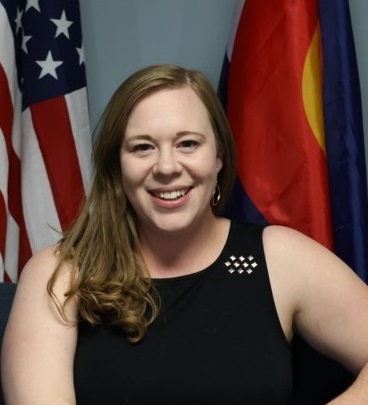
Sen. Katie Wallace
Sponsored bills
Under current law, 28.9% of the revenue the state collects from the retail delivery fee is credited to the multimodal transportation and mitigation options fund (fund). Of the money from the retail delivery fee that is credited to the fund, currently 85% is allocated to the commission for local multimodal projects and 15% is allocated to the commission for state multimodal projects. Beginning on July 1, 2026, the act changes how the fund allocates and expends retail delivery fee revenue between state and local multimodal projects so that 70% of the fund is allocated to the commission for local multimodal projects and 30% of the fund is allocated to the commission for state multimodal projects.(Note: This summary applies to this bill as enacted.)
The act requires each covered social media platform (covered platform) to impose a fee on each add-on transaction that occurs on the covered platform. The act creates the youth mental health services access enterprise in the behavioral health administration (BHA) to use the fee revenue to operate and fund programs that provide youth mental health services. The youth mental health services access enterprise constitutes an enterprise for purposes of section 20 of article X of the state constitution. The act defines a 'covered platform' as a sole proprietorship, a partnership, a limited liability company, a corporation, an association, or another legal entity, or an affiliate thereof, that:Conducts business in this state;Generates revenue directly from add-on transactions conducted in an online gaming service, product, or feature;Generates a majority of its annual revenue from online gaming services, products, or features;Publishes one or more online gaming services, products, or features that are reasonably likely to be accessed by a youth;Collects users' personal data or has users' personal data collected on its behalf; andDetermines the purposes and means of the processing of users' personal data. The act defines an 'add-on transaction' as a transaction through which a player or participant in a video game accessed via an online gaming service, product, or feature acquires:An item or ability that provides the player or participant an advantage over other players or participants of the video game; orA feature that alters or enhances the video game as accessed by the online gaming service, product, or feature. The act creates the youth mental health services access enterprise fund, consisting of money credited to the fund as fee revenue, any money received from the issuance of revenue bonds, and any other money that the general assembly may appropriate or transfer to the youth mental health services access enterprise fund. Money in the youth mental health services access enterprise fund is continuously appropriated to the youth mental health services access enterprise. After deducting its administrative expenses, the youth mental health services access enterprise is required to allocate the remaining fee revenue credited to the fund as follows:40% to operate and fund the youth mental health peer navigator grant program, which program is created in the act;35% to operate and fund the crisis resolution team program, which program is created in the act; and25%, beginning January 1, 2028, to operate the existing youth mental health services program. The initial amount of the fee is 5% of the amount of the add-on transaction. On and after October 1, 2027, the youth mental health services access enterprise may adjust the amount of the fee. The act creates the youth mental health peer navigator grant program to award grants to entities that recruit and train young adults to provide prevention services, peer support, and system navigation to youth in schools or community-based settings. The act creates the crisis resolution team program to provide community-based de-escalation and stabilization services to youth who are experiencing high-acuity behavioral health crises and to their caregivers. Under current law, the BHA operates the youth mental health services program to facilitate access to mental health services, including substance use disorder services, for youth in response to mental health needs identified in an initial mental health screening through the program's web-based portal. The youth mental health services program reimburses providers for up to 3 mental health sessions with a youth. The act directs the youth mental health services access enterprise, rather than the BHA, to operate and fund the youth mental health services program beginning January 1, 2028. The act also allows the youth mental health services access enterprise to reimburse a provider for up to 6 mental health sessions with a youth. The act creates the youth programming and protections enterprise to:Award grants through the existing out-of-school time program grant program; andSupport the department of education's enforcement of educational rights on behalf of children. The youth programming and protections enterprise constitutes an enterprise for purposes of section 20 of article X of the state constitution. The act creates the youth programming and protections enterprise fund. In each state fiscal year, after the state treasurer has credited $8 million to the youth mental health services access enterprise fund, the state treasurer must credit any other money received as fees to the youth programming and protections enterprise fund. Under current law, the department of education administers the out-of-school time program grant program and the state board of education awards grants from the program, subject to available appropriations. The act directs the department of education to consult with the youth programming and protections enterprise in administering the out-of-school time program grant program, and the act directs the youth programming and protections enterprise to award grants from the program in consultation with the state board of education. The act also requires the out-of-school time program grant program to provide programming and services that support the mental health and well-being of children and youth. The act requires a covered platform to ensure that the purchase price for an online gaming service, product, or feature that is reasonably likely to be accessed by a minor to be listed in United States dollars at the point of sale. For the 2026-27 state fiscal year, the act appropriates:$294,984 to the department of revenue from the general fund;$26,500 to the department of law from reappropriated funds;$145,750 to the department of law from the youth mental services access enterprise fund created in the act; and$79,500 to the department of law from the youth programming and protections enterprise fund created in the act.(Note: This summary applies to this bill as enacted.)
The act creates a process for an owner of a single-family residence to petition a district court for limited access to an adjoining property to complete repairs or maintenance to the single-family residence if the owner of the adjoining property has denied such access. The owner of a single-family residence is encouraged to engage the adjoining property owner in alternative dispute resolution, such as mediation, prior to petitioning the court. In petitioning the court, the owner of a single-family residence must demonstrate that they have made reasonable efforts to obtain permission from the adjoining property owner to access the adjoining property. A petitioner must also specify the nature of the repairs or maintenance they seek to complete and describe why they cannot complete the repairs or maintenance without access to the adjoining property. If the court determines that access to the adjoining property is necessary to repair or maintain the petitioner's property and will not negatively affect an easement on the adjoining property, the court shall grant access to the adjoining property as necessary to allow completion of the repair or maintenance and shall prescribe the conditions and duration of the petitioner's access. The act does not apply to an adjoining property that is owned or controlled by the federal government, the state, or a political subdivision of the state.(Note: This summary applies to this bill as enacted.)
The act implements the recommendations of the department of regulatory agencies in its 2025 sunset review of the 'Pet Animal Care and Facilities Act' (PACFA) as follows:Sections 1 and 2 of the act continue the commissioner of agriculture's (commissioner) function of licensing pet animal facilities in accordance with the PACFA for 8 years, until 2034;Section 3 amends the PACFA's pet animal advisory committee (committee) membership structure by requiring the commissioner, on or before December 1, 2026, to appoint 15 members with certain specifications. Section 3 also specifies that members appointed to the committee on or before December 1, 2026, may serve no more than 2 consecutive terms of 4 years.Section 4 prohibits the importation of certain pet animals into the state without a valid certificate of veterinary inspection by an accredited veterinarian in the state of origin issued within 10 days prior to the pet animal's arrival in Colorado;Section 5 increases the current maximum fee amount of $700 for a pet animal facility license application to $1,500;Section 6 raises the maximum civil penalty amount for a violation of the PACFA or of a rule adopted pursuant to the PACFA from $1,000 per violation to $2,500 per violation;Section 7 states that a person that chooses to request a hearing in response to a cease-and-desist order issued by the commissioner for a violation of the PACFA or of a rule adopted pursuant to the PACFA must do so within 30 days after the issuance of the cease-and-desist order;Section 8 requires the commissioner to develop an administrative process for an interested person to petition for the issuance, amendment, or repeal of a rule by the commissioner;Section 9 amends House Bill 26-1011 concerning the transfer of certain pet animals in Colorado, by clarifying that the prohibition on a broker selling, leasing, offering to sell or lease, bartering, auctioning, or otherwise transferring ownership of a dog or cat does not apply to the sale, transfer, or adoption of a dog or cat to or by a pet store prior to January 1, 2028; andSection 10 relocates the statute that establishes the pet overpopulation authority (authority) so the authority is no longer subject to sunset review as part of the PACFA.(Note: This summary applies to this bill as enacted.)
The act requires an operator of a social media platform (operator) to ensure that its social media platform provides a streamlined process to allow law enforcement agencies to contact the social media platform. The process must be available to law enforcement agencies at all times and make available a staffed hotline for the purposes of:Receiving and responding to questions about search warrants;Acknowledging the receipt of a search warrant within 8 hours after receipt; andProviding status updates on search warrant compliance to a requesting law enforcement agency. With certain exceptions, an operator must comply with a search warrant within 24 hours if certain conditions apply. A court may reasonably extend this time if the court makes a written finding that the operator or social media platform has shown good cause for the extension and that an extension would not cause an adverse result. The act sets forth enforcement options for the attorney general and district attorneys regarding operators' compliance with search warrants. The act requires an operator to report to a social media platform user's (user's) local law enforcement agency within 24 hours if the operator's social media platform takes any one of certain described adverse actions against a user. A violation of the reporting requirement is a violation of the 'Colorado Consumer Protection Act'. In current law, 'social media platform' is defined as an internet-based service, website, or application that satisfies certain criteria, including having more than 100,000 active users in Colorado. The act removes this criterion. The act makes conforming amendments as necessary to Senate Bill 26-011, as enacted in the 2026 regular legislative session, to have Senate Bill 26-011 conform with the provisions of the act.(Note: This summary applies to this bill as enacted.)
The act creates a jury selection working group (working group) in the judicial department to identify best practices and make recommendations for statutory or rule changes to improve jury selection. The act details the working group's membership and duties, and requires the working group to submit a final report of the working group's recommendations to the judiciary committees of the house of representatives and the senate and to each supreme court justice. If recommendations for rule changes are made, the Colorado supreme court shall respond to the recommendations and post the response on its website for public access.(Note: This summary applies to this bill as enacted.)
Maddy summaryHB 1306 creates a special Colorado license plate for vehicles, requiring owners to pay a $50 initial donation to the Wild Horse Fund and a $25 one-time fee to obtain the plate. To renew the plate annually, owners must make an additional $25 donation to the fund. All collected funds support the state’s wild horse population management program, as specified in the bill. This option is available to any Colorado resident who qualifies for standard vehicle registration.
The act extends for an additional 10 years the availability of the state income tax credit allowed to a taxpayer who makes a qualifying monetary contribution to promote child care in the state equal to 50% of the total value of the contribution, not to exceed $100,000, through income tax years commencing prior to January 1, 2038.(Note: This summary applies to this bill as enacted.)
The act makes the following changes to the 'Labor Peace Act':Specifies that employees' right to bargain collectively includes the right to bargain collectively concerning any mandatory subject of bargaining;Eliminates the requirement for a second election to negotiate a union security agreement clause in the collective bargaining process;Declares that it is not an unfair labor practice for an employer to refuse to agree to a lawful proposal made by the exclusive representative of the employees, or for the exclusive representative of the employees to refuse to agree to a lawful proposal made by the employer, concerning a mandatory subject of bargaining if the refusing party has bargained in good faith with the other party; andRequires employers and employees, through their exclusive representative, to bargain in good faith.(Note: This summary applies to this bill as enacted.)