

Current law authorizes the inspection, testing, quarantine, condemnation, and destruction of livestock when there is an outbreak of an infectious or contagious disease. The act: Removes the requirement that the inspection, testing, and quarantine of livestock occur pursuant to rules promulgated by the commissioner of agriculture (commissioner); and Changes the appraisal process that is required before livestock may be condemned and destroyed. The act gives the commissioner the authority to investigate all buildings, yards, pens, pastures, and other areas in which any animals are kept, handled, or transported to ensure compliance with the "Livestock Health Act". The commissioner may: Administer oaths and take statements; Issue administrative subpoenas requiring the attendance of witnesses and the production of all books, memoranda, papers, and other documents, articles, or instruments; and Compel the disclosure by witnesses of all facts known to them that are relevant to the matters under investigation. Under current law, it is an unlawful act to alter or falsify a health certificate issued for the import of livestock into the state. The act makes it an unlawful act to alter or falsify a health certificate issued for the export of livestock out of the state. APPROVED by Governor May 18, 2023 EFFECTIVE May 18, 2023(Note: This summary applies to this bill as enacted.)
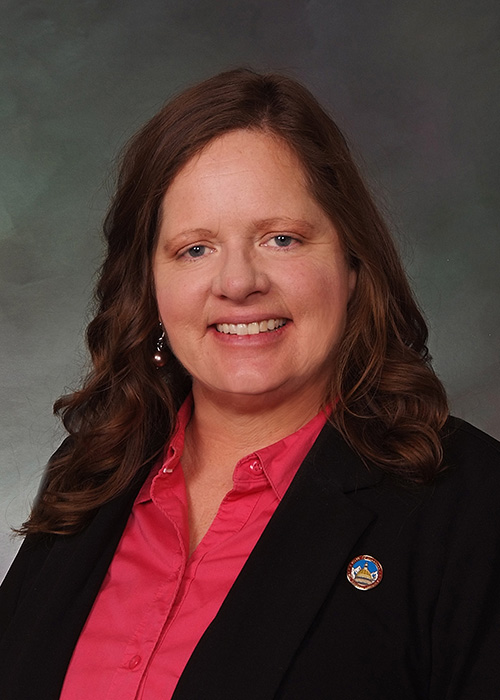
Sen. Janice Marchman
Sponsored bills
The act requires the office of future of work (office) to contract with a third party to study workforce transitions in Colorado's economy. The office will request proposals from private or public entities to bid on performing the study. The workforce transitions study (study) must: Evaluate the skill transferability of workers in the oil and gas industry and in occupations in Colorado that are facing the most disruption due to automation; Explore training availability, skills needed, and transition strategies; and Provide recommendations for programs and policies to prepare the workforce for these transitions. On or before December 1, 2024, the office is required to submit a report of the study's research and findings to the governor and to specified legislative committees of reference. The office is also required to issue an update on the key findings of the study to the governor and specified legislative committees of reference by August 1, 2024. For the 2023-24 state fiscal year, the act requires the general assembly to appropriate $317,318 from the general fund to the department of labor and employment for use by the executive director's office. APPROVED by Governor May 16, 2023 EFFECTIVE August 7, 2023 NOTE: This act was passed without a safety clause and takes effect 90 days after sine die. (Note: This summary applies to this bill as enacted.)
The act requires the department of education (department), by January 2024, to offer free optional trainings in evidence-informed practices in mathematics, including a training specifically designed for elementary school educators and a training specifically designed for secondary school mathematics educators. Each training must include instruction on interventions for students who are below grade level or struggling in mathematics, children with disabilities, and students who are English language learners. Trainings must be available to relevant staff of school districts, related administrative units, district charter schools, institute charter schools, boards of cooperative services, and community-based organizations. School district boards of education and institute charter schools are strongly encouraged to adopt procedures for schools to provide support to students in pre-kindergarten through twelfth grade and their families to improve mathematics outcomes. Procedures may include: Identifying students who are below grade level or struggling in mathematics based on academic assessments; Notifying the parents, guardians, or legal custodians if a student is below grade level or struggling in mathematics; Providing parents, guardians, or legal custodians with a list of interventions and acceleration strategies to assist with mathematics at home, including a state-advisory list of curricula, referrals for tutoring, or other intervention opportunities, if applicable; Publishing mathematics curricula annually, including supplemental curricula or interventions; and Implementing train-the-trainer or train-the-parent framework plans to improve mathematics achievements for students. The act creates the Colorado academic accelerator grant program (grant program). The purpose of the grant program is to create community learning centers that: Provide opportunities for free academic enrichment and support, which must include tutorial services to help students meet rigorous academic standards and to increase proficiency in mathematics outcomes; and Offer families opportunities for engagement in students' education. Eligible entities that apply to the grant program are selected for a grant that runs for a period of 3 years. The department shall prioritize eligible entities that: Adopt intervention strategies; Use evidence-informed programs that build student skills in STEM and mathematics; Use digital math accelerator programs; Serve high-needs students, as determined by the department; Have an established presence and relationship in the community; and Demonstrate in the application how they will meet the needs of diverse student populations. The act requires school districts, public schools, the state charter school institute, and institute charter schools that are on an improvement plan, priority improvement plan, or a turnaround plan to identify strategies to address the needs of students who are below grade level or struggling in mathematics and set or revise, as appropriate, ambitious but attainable targets that the public school shall attain in reducing the number of students who are below grade level or struggling in mathematics to increase the number of students who achieve grade-level expectations in mathematics. The act adjusts the ninth-grade success grant program to prioritize applicants that propose programming focused on evidence-informed mathematics skills, acceleration strategies, and intervention strategies, including a focus on students who are below grade level or struggling in mathematics and have academic achievement levels in mathematics that are consistently ranked the lowest for public high schools in the state, as determined by the department. The act includes a requirement that candidates for an elementary education endorsement, a middle school mathematics endorsement, or a secondary mathematics endorsement be trained in evidence-informed practices in mathematics, including interventions to help students who are below grade level or struggling in mathematics, children with disabilities, and students who are English language learners. The act adds developmentally appropriate early numeracy to continuing professional development requirements for teachers employed by a preschool, and requires the department of early childhood to include developmentally appropriate early numeracy as a subject matter area in the resource bank of preschool curricula for use by preschool providers. The act appropriates $26,694,530 from the general fund to the department as follows: $594,530 for math educator training and improvement planning; $24,500,000 for the grant program; and $1,600,000 for the ninth-grade success grant program. APPROVED by Governor May 15, 2023 EFFECTIVE May 15, 2023 (Note: This summary applies to this bill as enacted.)
As an alternative route to teacher licensure, the act creates a teacher degree apprenticeship program (apprenticeship program). The apprenticeship program builds on elements of current alternative teacher licensure programs, including a bachelor's degree requirement, training programs approved by the state department of education (CDE), and structured on-the-job training. The apprenticeship program is run collaboratively with the United States department of labor office of apprenticeship (DOL office) and the state apprenticeship office (state office) and utilizes apprentice mentor teachers and teacher apprenticeship program sponsors (sponsor). The act allows CDE to issue a teacher apprenticeship authorization (authorization) to a person (apprentice) who is employed by a school district, board of cooperative services, charter school, or institute charter school (school) who is actively registered in an apprenticeship program, and who is actively enrolled in an affiliated bachelor's degree program from an accredited institution. The authorization is valid for 4 years while the apprentice completes the bachelor's degree requirement of the program. CDE may renew the authorization for up to 2 successive terms, in increments of 2 years, as necessary for the apprentice to fulfill the apprenticeship requirements. An authorization is invalid if the apprentice withdraws from any part of the apprenticeship program or fails to make satisfactory progress. Upon application from an entity with expertise in apprenticeship or teacher preparation, CDE shall authorize the entity to serve as a sponsor. Applications to serve as a sponsor must include a proposed work process schedule and related instruction plan required by the DOL office and state office. CDE shall review each application and approve or disapprove the sponsor. If approved, the sponsor may apply to CDE for approval of an apprenticeship program. An apprenticeship program must meet the following criteria: Be registered with the DOL office or state office; Incorporate a bachelor's degree program from an accredited institution in a related field of study relative to the licensure type; and Incorporate on-the-job training in meaningful and time-saving ways. Every 5 years after apprenticeship program approval, CDE shall consult with the DOL office or state office concerning the federally required audit of the apprenticeship program to ensure the apprenticeship program continues to meet requirements. The state board of education is authorized to promulgate rules for the implementation of the apprenticeship program. For the 2023-24 state fiscal year, $116,134 is appropriated from the general fund to the department of education. For the 2023-24 state fiscal year, $26,435 is appropriated to the department of law from reappropriated funds received from the department of education. The department of law may use this appropriation to provide legal services for the department of education. APPROVED by Governor May 15, 2023 EFFECTIVE August 7, 2023 NOTE: This act was passed without a safety clause and takes effect 90 days after sine die. (Note: This summary applies to this bill as enacted.)
The bill eliminates the requirement that the department of education administer a state assessment in social studies to elementary and secondary students. (Note: This summary applies to the reengrossed version of this bill as introduced in the second house.)
Under current law, the independent ethics commission created in article XXIX of the state constitution does not have jurisdiction over officials or employees of special districts or school districts. The bill gives the independent ethics commission jurisdiction to hear complaints, issue findings, assess penalties, and issue advisory opinions on ethics issues concerning a local government official or local government employee special district official, special district employee, school district official, or school district employee . "Local government" is defined to include a county, municipality, special district, or school district. Existing ethical standards apply to a local government official and a local government employee. The bill applies those standards to a local government official or local government employee through the independent ethics commission . (Note: Italicized words indicate new material added to the original summary; dashes through words indicate deletions from the original summary.) (Note: This summary applies to the reengrossed version of this bill as introduced in the second house.)
Under current law, a mental health professional must be licensed by the department of education (department) in order to work in a school. The act authorizes a school or school district, the state charter school institute, a board of cooperative services that operates a school, or the division of youth services to employ school-based therapists who are not licensed by the department but hold a Colorado license for their profession to work in coordination with licensed special service providers to coordinate mental health supports for students. Before being employed, the school-based therapists must satisfy certain requirements for nonlicensed school employees, including a fingerprint-based criminal background check. Any school-based therapists may be supervised by a mentor special services provider or a licensed administrator. If an eligible school-based therapist provides services to a student related to the student's individualized education program, the eligible school-based therapist must have qualifications consistent with the student's individualized education program. APPROVED by Governor May 4, 2023 EFFECTIVE May 4, 2023 (Note: This summary applies to this bill as enacted.)
The act implements the recommendation of the department of regulatory agencies in its sunset review and report on the state noxious weed advisory committee. The act continues the noxious weed advisory committee until September 1, 2034. APPROVED by Governor May 1, 2023 EFFECTIVE August 7, 2023 NOTE: This act was passed without a safety clause and takes effect 90 days after sine die.(Note: This summary applies to this bill as enacted.)
Usually, an owner of agricultural equipment must seek diagnostic, maintenance, or repair services of the equipment from the agricultural equipment manufacturer (manufacturer). Starting January 1, 2024, the act requires a manufacturer to provide parts, embedded software, firmware, tools, or documentation, such as diagnostic, maintenance, or repair manuals, diagrams, or similar information (resources), to independent repair providers and owners of the manufacturer's agricultural equipment to allow an independent repair provider or owner to conduct diagnostic, maintenance, or repair services on the owner's agricultural equipment. A manufacturer's failure to comply with the requirement to provide resources is a deceptive trade practice. The act folds agricultural equipment into the existing consumer right-to-repair statutes and adds data to the list of resources that a manufacturer must provide to independent repair providers or owners. An independent repair provider or owner is not authorized to make any modifications to agricultural equipment that deactivates a safety notification system or brings the equipment out of compliance with safety or emissions laws or to engage in any conduct that would evade emissions, copyright, trademark, or patent laws. If an agricultural equipment manufacturer enters into a nationwide memorandum of understanding regarding right-to-repair agricultural equipment, the manufacturer is still obligated to meet the requirements of this act. If Congress enacts federal legislation regarding the right to repair agricultural equipment, this act will be repealed. APPROVED by Governor April 25, 2023 EFFECTIVE January 1, 2024 NOTE: This act was passed without a safety clause. (Note: This summary applies to this bill as enacted.)
The act makes it a deceptive trade practice for a person to make or disseminate to the public any advertisement that indicates that the person provides abortions, emergency contraceptives, or referrals for abortions or emergency contraceptives when the person knows or reasonably should have known that the person does not provide those specific services. A health-care provider engages in unprofessional conduct or is subject to discipline in this state if the health-care provider provides, prescribes, administers, or attempts medication abortion reversal in this state, unless the Colorado medical board, the state board of pharmacy, and the state board of nursing, in consultation with each other, each have in effect rules finding that it is a generally accepted standard of practice to engage in medication abortion reversal. The specified boards shall promulgate applicable rules no later than October 1, 2023, in consultation with each other, concerning whether engaging in medication abortion reversal is a generally accepted standard of practice. APPROVED by Governor April 14, 2023 EFFECTIVE April 14, 2023 (Note: This summary applies to this bill as enacted.)