

Backflow is the reverse flow of water, fluid, or gas caused by back pressure or back siphonage. Under current law, individuals who are engaged in the business of installing, removing, inspecting, testing, or repairing backflow prevention devices are subject to the licensure requirements for plumbers, except when the individuals are installing or testing a stand-alone fire suppression sprinkler system. The act exempts individuals engaged in the business of inspecting, testing, or repairing backflow prevention devices from licensure requirements but retains the licensure requirements for individuals engaged in the installation or removal of the devices; except that individuals who install or replace a backflow prevention device on a stand-alone fire suppression system remain exempted from the licensure requirements. The act requires that, on and after July 1, 2025, a licensed plumber who installs, tests, inspects, repairs, or reinstalls a backflow prevention device and a certified cross-connection control technician or a licensed plumber with a cross-connection control technician certification who tests or repairs a backflow prevention device must affix a tag on the backflow prevention device that contains certain information about the licensed plumber, the certified cross-connection control technician, or the licensed plumber with a cross-connection control technician certification, as applicable, and the service that was provided. (Note: This summary applies to this bill as enacted.)
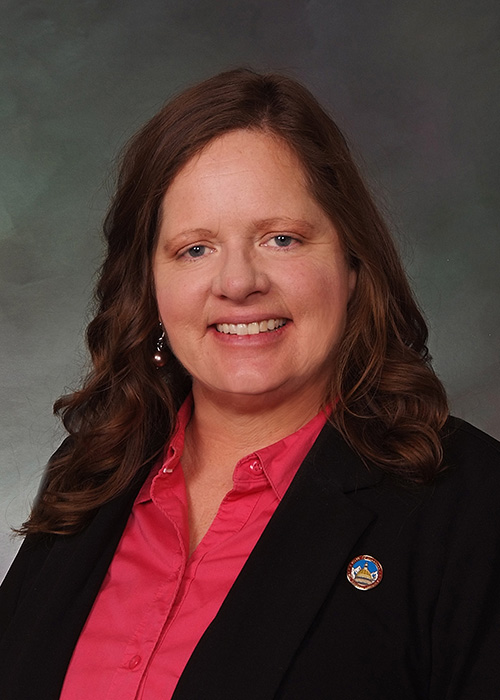
Sen. Janice Marchman
Sponsored bills
Under current law, owners of certain large buildings (covered buildings) are required to annually collect and report each covered building's energy use to the Colorado energy office. The act clarifies that agricultural buildings are not covered buildings, and therefore, owners of agricultural buildings are exempt from the energy use collecting and reporting requirements. The act defines an agricultural building as a building or structure used to house agricultural implements, hay, unprocessed grain, poultry, livestock, or other agricultural products or inputs primarily for the purpose of maintaining or operating an agricultural process. Agricultural implements include certain agricultural equipment and do not include implements that are primarily for rent or sale. The act permits an owner of an agricultural building to submit for an affirmative exemption from any requirement to report benchmarking data and for an exemption to remain valid until there is a change in ownership or a change that renders the building no longer an agricultural building. For the duration of an exemption, the owner of an agricultural building is required to certify, upon request, the exemption status of an exempt building. (Note: This summary applies to this bill as enacted.)
The act modifies the types of funds that are available for immediate withdrawal as a matter of right in real estate transactions by: Limiting wire transfer funds to only those funds that are wired through a funds-transfer system operated by the federal reserve or the Clearing House Payments Company; and Adding a real-time or an instant payment made through a funds-transfer service operated by the federal reserve or the Clearing House Payments Company's real-time payments system.(Note: This summary applies to this bill as enacted.)
The public employees' retirement association (PERA) board (board) conducts or causes to be conducted an actuarial experience study of PERA and a periodic actuarial audit of PERA. Both the actuarial experience study and the periodic actuarial audit, neither of which were referenced in law prior to passage of the act, are conducted approximately once every 5 years, but the timing of the actuarial experience study and the periodic actuarial audit is not aligned. The act requires the board to conduct or cause to be conducted the actuarial experience study every 4 years, beginning with the actuarial experience study that the board conducted in the 2024 calendar year, rather than every 5 years. In addition, the act requires the board to conduct or cause to be conducted the periodic actuarial audit of PERA in the 2026 calendar year and every 4 years thereafter , rather than every 5 years, and to ensure that each periodic actuarial audit takes into consideration the results and findings of the most recent actuarial experience study that was conducted or caused to be conducted by the board. For several years, the pension review commission has been required to commission an independent review of the economic and investment assumptions used to model PERA's financial situation. The act requires the commission to commission the independent review every 4 years, rather than every 3 years, within 3 months of the release of the periodic actuarial audit of PERA conducted or caused to be conducted by the board. (Note: This summary applies to this bill as enacted.)
The act substitutes gender-neutral language for gendered language in title 35, a title concerning agriculture, of the Colorado Revised Statutes. The act also updates archaic language in title 35. (Note: This summary applies to this bill as enacted.)
The act requires the Colorado bureau of investigation (CBI) to spend $3,000,000 in specifically appropriated money from House Bill 24-1430, concerning the provision for payment of the expenses of the executive, legislative, and judicial departments of the state of Colorado, and of its agencies and institutions, for and during the fiscal year beginning July 1, 2024, except as otherwise noted, on backlogged DNA evidence and sexual assault kit tests, as well as DNA retesting related to CBI's laboratory misconduct that was discovered in 2023. Additionally, the act allows CBI to contract with external labs to perform the testing. The act requires CBI to create a dashboard on the department of public safety's website to update the public on the backlog at least every 30 days. CBI shall provide the general assembly with updates on the sexual assault kit backlog, including the number of cases pending, the number of tests CBI's lab conducted, the number of tests CBI contracted out, an update on CBI's laboratory staffing levels, the average turnaround time for a sexual assault kit test, and other relevant data points every 30 days from March 10, 2025, through June 30, 2026. (Note: This summary applies to this bill as enacted.)
If a prospective family pays a child care center, family child care home, or neighborhood youth organization (child care program) an application fee, a deposit fee, or wait list fee and is not enrolled in the child care program after six months of paying the fee, the act makes the fee is refundable. A child care program may retain a reasonable administrative fee determined by the department of early childhood (department) before issuing a refund to the prospective family. The prospective family must submit a written request to the child care program to receive a refund. Upon receiving the written request from the prospective family, the child care program shall refund the fees to the prospective family and may remove the prospective family from the wait list. Prospective families who are offered a child care slot with a child care program and who refuse the child care slot shall not receive a refund. If a family enrolls in a child care program and signs a contract with the child care program provider, the terms of the contract, including fees outlined in the contract, are not subject to the requirements of the act. A child care program shall provide a fee schedule and the process on fee refunds to a prospective family and an enrolled family. A child care program may publish the fee schedule digitally on the child care program's website. During the department's periodic inspections, or if a complaint is filed regarding fees, the act directs the department to review the information in the child care center's policy for establishing fees to confirm the child care center is complying with the law. If the department finds the child care center is not compliant, the child care center has 30 days after the date of inspection to comply. If the child care center does not comply within 30 days after the date of inspection, the department may take further disciplinary action. The department shall not take disciplinary action against a child care program that makes a good faith administrative error or is not in compliance for the first time. (Note: This summary applies to this bill as enacted.)
Maddy summarySJR 25-013 is a symbolic resolution recognizing Thursday, March 20, 2025, as Nowruz Day in Colorado. It honors the ancient Persian New Year celebration observed by Iranian, Kurdish, Afghan, and Central Asian communities, acknowledging its cultural significance and the contributions of Colorado's Iranian-American residents. The resolution has no legal effect but formally extends recognition to the traditions of Nowruz, including its themes of renewal and community. It directly affects Colorado's Iranian-American community by affirming their cultural heritage through state acknowledgment.
Maddy summaryThis resolution (SJR 25-009) expresses Colorado's support for federal management of national public lands, including parks, forests, and monuments. It formally opposes efforts to sell, transfer, or dispose of these lands and urges Colorado's governor, attorney general, and congressional delegation to take action against such proposals. The resolution is non-binding but directs state officials to advocate for continued public stewardship by federal agencies like the National Park Service and Bureau of Land Management. It was passed by the Colorado Senate and referred to the House for consideration.
Under Colorado law, a person may file a claim with the division of parks and wildlife (division) for compensation for damages to property caused by wildlife, and the division must review and investigate that claim. The act requires that the personal information of a person, information related to site assessments received by the division through the claim procedures, and personal information associated with proactive nonlethal measures is kept confidential and not disclosed pursuant to the "Colorado Open Records Act". The act excludes from this prohibition: Information about nonlethal predator-livestock conflict minimization measures that does not reveal the identity of the person or the person's business; Nonidentifying information of county-level data highlighting the number or dollar amount of claims made to the division, the number of claims that were settled and the monetary amounts of those settlements, the number of claims that are pending at the time of a request for disclosure, and the number of claims that were denied and the reasons for denial; and Personal information that becomes public by the actions of the subject of the personal information or the subject's agent. The act prohibits bringing or maintaining a private action challenging the division's determination that a person or the person's agent has taken actions or made statements that led to the person's personal information becoming publicly known. (Note: This summary applies to this bill as enacted.)