

The act expands the veterans mental health services program to provide grants to local nonprofit organizations to establish and expand community behavioral health programs that provide behavioral health services to service members, veterans, and family members of service members and veterans. The act reduces the reappropriated funds appropriation made in the long bill to the department of military and veterans affairs for use by the division of veterans affairs for veterans mental health services by $5,000,000; except that the reduction is not made if: The amount of reappropriated funds made in the long bill to the department of military and veterans affairs for use by the division of veterans affairs for veterans mental health is less than $5,000,000; or The long bill does not include an appropriation to the department of military and veterans affairs for use by the division of veterans affairs for veterans mental health.(Note: This summary applies to this bill as enacted.)
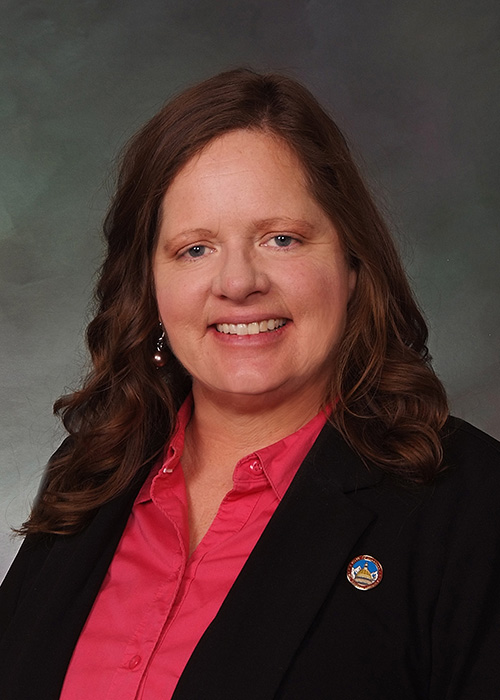
Sen. Janice Marchman
Sponsored bills
The act changes the tuition assistance program for eligible members of the Colorado National Guard (member) to a tuition waiver program (program). The act allows a member, upon being accepted for enrollment at a designated institution of higher education (institution), to pursue studies that lead to a postgraduate degree, a bachelor's degree, an associate degree, or a certificate of completion with all tuition waived. For a member, the tuition waiver must not exceed more than 65 credit hours at a designated 2-year institution of higher education and no more than 130 credit hours at a designated 4-year institution of higher education; except that the total credit hours for a member who attends both a 2-year institution and a 4-year institution must not exceed more than 145 credit hours. The department of military and veterans affairs (department) shall administer the program. In order to qualify for the program, a member must: Be accepted by an institution; Be in good standing with the Colorado National Guard; and Complete a Colorado application for state financial aid or a free application for federal student aid. Each institution shall determine if a member enrolled with the institution remains in satisfactory academic standing in accordance with the academic policies of the institution and is making progress toward the completion of the requirements of the education program in which the member is enrolled. If the institution finds that the member is not in satisfactory academic standing in accordance with the academic policies of the institution or is not making progress toward the completion of a degree, the member must reimburse the department for the amount of the tuition waived for that academic term. The act makes an appropriation of $562,787 to the department. (Note: This summary applies to this bill as enacted.)
Under current law, a licensed manufacturer of spirituous liquor (manufacturer) may conduct tastings of the manufacturer's own spirituous liquors at the manufacturer's licensed premises or at one other approved sales room location. The bill authorizes the manufacturer to also conduct tastings: Of other alcohol beverages acquired from a wholesaler licensed in the state; and At up to 5 2 approved sales room locations. A manufacturer must apply for a permit from the state licensing authority to serve and sell alcohol beverages acquired from a wholesaler licensed in the state at the manufacturer's premises or a sales room location. A copy of the permit application must be posted for 30 days in a conspicuous place at the location that is the subject of the application and must be published in a local newspaper of general circulation. If the permit application is approved, the manufacturer must serve sandwiches and light snacks if selling and serving alcohol beverages acquired from a wholesaler licensed in the state and must not have the proceeds from the sale of alcohol beverages acquired from wholesalers account for more than 50% of the total proceeds for alcohol beverage sales. (Note: Italicized words indicate new material added to the original summary; dashes through words indicate deletions from the original summary.) (Note: This summary applies to the reengrossed version of this bill as introduced in the second house.)
Each school district, board of cooperative services that operates a school, district charter school, and institute charter school (local education provider) is required to establish written policies for the acquisition, retention, display, and use of library resources and for the reconsideration of a library resource (policies). A local education provider is required to comply with specified standards in establishing the policies and is required to establish the policies by September 1, 2025. If a local education provider has already established policies that comply with the requirements of the act, the local education provider is not required to establish new policies. A public school library may remove a library resource from its permanent collection only if the library resource has been reviewed in accordance with an established policy for the reconsideration of library resources that complies with the standards established in the act. These requirements do not apply to routine collection maintenance and deaccession in accordance with a public school library's established collection development and maintenance policy. Before a local education provider reconsiders a library resource, the local education provider is required to make its policies available to the public. After reviewing a library resource that is the subject of a request for reconsideration and making a final determination regarding the library resource, the local education provider is required to make the determination available to the public. A written request for reconsideration of a library resource in a public school library is an open record under the "Colorado Open Records Act". A public school library staff member is not subject to termination, demotion, discipline, or retaliation for refusing to remove a library resource before it has been reviewed in accordance with the local education provider's policy for the reconsideration of library resources or for making decisions that the public school library staff member believes, in good faith, are in accordance with the policies of the local education provider. (Note: This summary applies to this bill as enacted.)
For school districts and the state charter school institute (institute), the act requires the department of education (department) to develop a streamlined format for a performance, improvement, priority improvement, or turnaround plan (plan) that consolidates various state, federal, and grant reporting requirements and allows a school district or the institute to attach a locally developed action portion of the plan that addresses action steps, resources, and any other plan components identified in state board of education (state board) rule. For schools of a school district or district charter schools (district public schools) or institute charter schools, the act requires the department to develop a streamlined format for a plan that consolidates various state, federal, and grant reporting requirements and allows a local school board for the district public school, or the institute if the public school is an institute charter school, to attach a locally developed action portion of the plan that addresses action steps, resources, and any other plan components identified in state board rule. The department shall maintain a centralized system for plan submissions so the department can conduct a statewide analysis in order to determine how to best distribute state resources and supports. On or before August 31, 2025, and regularly thereafter, the department must collect user feedback to assess the extent to which the streamlined format for plans is used, whether it is helpful, and how to use this feedback to improve the centralized system. (Note: This summary applies to this bill as enacted.)
Under current law, the Colorado broadband office provides technical assistance to grant applicants related to grants to deploy broadband services. The act expands the technical assistance to grant applicants to include assistance related to grants to deploy wireless service. The act requires an emergency alert sent by the state or a county, municipality, or alerting authority to be sent in a predominant minority language if the county has at least 2,000 citizens who are 18 years of age or older and who speak the predominant minority language and speak English less than very well, as defined by the United States bureau of the census American community survey or comparable census data. The state, counties, municipalities, and alerting authorities are encouraged to use available technology to issue emergency alerts in as many languages as possible in the same method as an English alert. Each alerting authority that is required to send emergency alerts in a predominant minority language is encouraged to conduct community outreach to inform people with limited English proficiency of the availability of language interpretation and translation options for emergency alerts. Alerts must comply with the act by July 1, 2027. The act allows the 911 services enterprise to distribute grants to local alerting authorities to implement language and accessibility services for emergency alerts. The act imposes the 911 prepaid wireless charge and 988 surcharge to prepaid wireless telecommunication services. (Note: This summary applies to this bill as enacted.)
Beginning July 1, 2025 No later than January 1, 2026 , the bill requires the department of health care policy and financing (HCPF) to seek federal authorization to reimburse acute care hospitals and ambulatory surgery facilities that provide vagus nerve stimulation therapy to members diagnosed with drug-resistant epilepsy at a rate that is equal to 75% 60% of the cost for acquiring the vagus nerve stimulator device, which reimbursement is in addition to and does not supplant the reimbursement for any necessary surgical procedure associated with implanting the device. Beginning January 1, 2029, the bill requires HCPF to increase the reimbursement to a rate that is equal to 75% of the cost for acquiring the vagus nerve simulator device. (Note: Italicized words indicate new material added to the original summary; dashes through words indicate deletions from the original summary.) (Note: This summary applies to the reengrossed version of this bill as introduced in the second house.)
Maddy summarySenate Joint Resolution 25-022 is a commemorative resolution concerning the remembrance of the Holocaust. It declares the General Assembly's commitment to remembering the Holocaust and encourages school districts and universities to promote antibias, bullying prevention, and Holocaust and genocide education programs to prevent antisemitic incidents, particularly those targeting Jewish students.
The act requires the state treasurer to make the following transfers of money from certain cash funds to the general fund. On June 30, 2025, the state treasurer is required to transfer the following amounts to the general fund: $6,338,640 from the legislative department cash fund; $500,000 from the scale-up grant fund; $500,000 from the qualified apprenticeship intermediary grant fund; $700,000 from the petroleum cleanup and redevelopment fund; $15,000,000 from the major medical insurance fund; $200,000 from the division of securities cash fund; $200,000 from the division of banking cash fund; $200,000 from the division of real estate cash fund; $1,372,843 from the division of professions and occupations cash fund; $1,750,000 from the prescription drug monitoring fund; The unexpended and unencumbered balance of the high-cost special education trust fund; The unexpended and unencumbered balance of the dropout prevention activity grant fund; The unexpended and unencumbered balance of the full-day kindergarten facility capital construction fund; The unexpended and unencumbered balance of the financial reporting fund; The excess uncommitted reserve balance of the private occupational schools fund; The unexpended and unencumbered balance of the private activity bond allocations fund that exceeds $100,000. This transfer is an annual transfer at the end of each state fiscal year. $3,068,634 from the peace officers behavioral health support and community partnership fund; $200,000 from the witness protection fund; $500,000 from the state's mission for assistance in recruiting and training (SMART) policing grant fund; $7,000,000 from the technology risk prevention and response fund; $11,011,550 from the advanced industries acceleration cash fund; $8,500,000 from the innovative housing incentive program fund; The unexpended and unencumbered balance of the state employee reserve fund; The balances of the following cash funds, which were previously repealed: The rural schools cash fund; The teacher residency expansion program fund; and The public education fund; $200,000 from the affordable housing and home ownership cash fund; $1,800,000 from the vital statistics records cash fund; $14,000,000 from the electrifying school buses grant program cash fund; The unexpended and unencumbered balance of the Colorado health care services fund; The unexpended and unencumbered balance of the pediatric hospice care cash fund; The unexpended and unencumbered balance of the primary care provider sustainability fund; $620,000 from the agriculture management fund; The unexpended and unencumbered balance of the rodent pest control fund; $250,000 from the diseased livestock indemnity fund; $20,000 from the cervidae disease revolving fund; $200,000 from the board of assessment appeals cash fund; $10,000,000 from the local government severance tax fund; $200,000 from the Colorado telephone users with disabilities fund; $700,000 from the highway-rail crossing signalization fund; and $71,400,000 from the multimodal transportation and mitigation options fund. On July 1, 2025, the state treasurer is required to transfer the following amounts to the general fund: $125,000 from the energy fund; $154,862 from the innovative energy fund; $900,000 from the cannabis resource optimization cash fund; $512,570 from the community access to electric bicycles cash fund; $3,304,500 from the universal high school scholarship cash fund; $5,000,000 from the supplemental state contribution fund; The balance of the nutrients grant fund, which was previously repealed; $6,000,000 from the community impact cash fund; The unexpended and unencumbered balance of the electrifying school buses grant program cash fund; The unexpended and unencumbered balance of the natural disaster grant fund; $680,000 from the state funding for senior services contingency reserve fund; and $100,000 from the nuclear materials transportation fund. On June 30, 2026, the state treasurer is required to transfer $7,710,500 from the advanced industries acceleration cash fund to the general fund. The act also repeals the financial reporting fund, the state employee reserve fund, the Colorado health care services fund, the pediatric hospice care cash fund, and the primary care provider sustainability fund. (Note: This summary applies to this bill as enacted.)
The act requires the executive director (director) of the department of corrections (department) to report specified information on inmate population, bed capacity, and vacancy rates on a monthly basis. The act also requires the director to report to the joint budget committee and the office of state planning and budgeting: When opening or closing a facility or relocating more than 20 inmates; and By August 1, 2025, and by each August 1 thereafter, information on FTEs by facility, location, and subprogram. The act requires future budget requests to include worksheets identifying calculations for FTE and operating expenses and requires the department to include a report describing supplemental budget requests and budget amendments as part of its "SMART Act" presentation. If the director or department fails to provide the information required, the act authorizes the joint budget committee to reduce appropriations for salaries of unclassified department employees. (Note: This summary applies to this bill as enacted.)