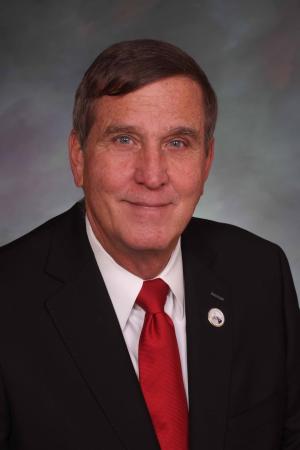
Photo of John Cooke
R Colorado Senate · District 13

Sen. John Cooke

Contact Email
Compare
Total votes
4,431
all sessions
Attendance
90%
367 missed
Lower than 86% of chamber peers
With party
95%
of cast votes
Near the chamber average
Bipartisan score
4%
crosses aisle rarely
Near the chamber average
Sponsored
173
bills & resolutions
Near the chamber average
Committees
0
assignments
173 bills and resolutions

Sponsored bills

Total
173
Primary
173
Co-sponsor
0
This page
173
matching current filters
Primary HB 22-1262
Signed into law · Colorado House · Lead sponsor
Sunset Continue Workers' Compensation Regulations

The act implements the recommendation of the department of regulatory agencies, as specified in the department's sunset review of the authority of the director of the division of workers' compensation to impose fines on an employer for a subsequent failure to carry workers' compensation insurance within 7 years after an initial failure to carry the required insurance, by continuing the director's authority for 11 years, until September 1, 2033. (Note: This summary applies to this bill as enacted.)

Signed into law Apr 12, 2022 0 co-sponsors
Primary HB 22-1150
Signed into law · Colorado House · Lead sponsor
Eliminate Signature Requirement Certain Citations

Under current law, a defendant is required to execute the defendant's signature on citations for a misdemeanor, petty offense, misdemeanor traffic offense, or traffic infraction to signify agreement to pay the penalties or appear in court. The act eliminates the defendant signature requirement. (Note: This summary applies to this bill as enacted.)

Signed into law Mar 30, 2022 0 co-sponsors
Primary SB 22-024
Signed into law · Colorado Senate · Lead sponsor
Intimidating A Witness Changes

The act expands the ways that intimidating a witness may be committed by stating that the threat or act that constitutes intimidation can be directed at a person the perpetrator believes may have information relevant to a criminal investigation or a person the perpetrator believes may be able to exert influence upon a witness or victim. The act also adds that the crime of intimidating a witness can be committed by intentionally attempting to influence, or actually influencing, a witness, victim, or any other person with knowledge of relevant information to withhold information from, or provide false information to, law enforcement, a defense attorney, or defense investigator. (Note: This summary applies to this bill as enacted.)

Signed into law Mar 17, 2022 0 co-sponsors
Primary SB 22-091
Signed into law · Colorado Senate · Lead sponsor
Nonsubstantive Changes To Rule Review Statutes

The act repeals a section of the "State Administrative Procedure Act" to remove obsolete or redundant provisions relating to the process for reviewing executive agency rules. The act also amends provisions in statute concerning executive agency rules to reflect current drafting practices relating to, among other practices, the use of gender-neutral language in statute. (Note: This summary applies to this bill as enacted.)

Signed into law Mar 17, 2022 0 co-sponsors
Primary SB 22-129
In committee · Colorado Senate · Lead sponsor
Process For Proposed Air Quality Rules

The bill requires the air quality control commission (commission) to include in a notice of proposed rule-making a description of the classes of persons, including businesses, that will be affected by the proposed rule. A person who proposes a rule differing from the rule proposed by the commission or a revision of limited applicability shall file the proposal by a deadline determined by the commission by rule, and must include a description of the classes of persons, including businesses, that will be affected by the proposal. If the proposal is an alternative proposal, as defined by the commission by rule, the person must include with the proposal an initial economic impact analysis of the proposed rule. The commission shall designate a hearing officer to consider proposals filed with the commission. Not later than 10 business days after the proposal is filed with the commission, the hearing officer shall determine if the proposal is an alternative proposal, warranting consideration by the commission. The hearing officer shall provide notice of its determination to persons that have filed written requests with the commission to receive notice. (Note: This summary applies to this bill as introduced.)

In committee Feb 22, 2022 0 co-sponsors
Primary SB 21-174
Signed into law · Colorado Senate · Lead sponsor
Policies For Peace Officer Credibility Disclosures

The act creates the peace officer credibility disclosure notification committee (committee), which is required to create a statewide model for peace officer credibility disclosure notifications (statewide model) by December 1, 2021. The statewide model must include policies and procedures that law enforcement agencies and district attorneys' offices are required to adopt and implement on or before January 1, 2022.The statewide model's policies and procedures must include:The circumstances that trigger a law enforcement agency to promptly notify a district attorney if a peace officer's credibility is called into question by a sustained finding; The circumstances that trigger a law enforcement agency's obligation to notify a district attorney when a peace officer's credibility is called into question by a criminal or administrative investigation; A process for district attorneys to follow for receiving credibility disclosure notifications and maintaining a current record of all credibility disclosure notifications; and A process for district attorneys to timely notify a defense attorney or defendant of credibility disclosure notification records (records) and to remove any records when appropriate and lawful. The act requires district attorneys to review the statewide model's policies and procedures at least every 4 years to ensure compliance with controlling federal and state case law, as well as the Colorado rules of criminal procedure. The act also requires a district attorney to make available to the public the adopted policies and procedures on or before February 1, 2022.The act, subject to available appropriations, requires the P.O.S.T. board to create and maintain a database, in a searchable format to be published on its website, containing information related to a peace officer's actions that resulted in a credibility disclosure notification.(Note: This summary applies to this bill as enacted.)

Signed into law Jul 2, 2021 0 co-sponsors
Primary HB 21-1050
Signed into law · Colorado House · Lead sponsor
Workers' Compensation

The act:Adds guardian ad litem and conservator services to the list of medical aid that an employer is required to furnish to an employee who is incapacitated as a result of a work-related injury or occupational disease; Requires an injured worker who is claiming mileage reimbursement for travel related to obtaining compensable medical care to submit a request to the employer or insurer within 120 days after the expense is incurred, and requires the employer or insurer to pay or dispute mileage within 30 days after submittal and to include in the brochure of claimants' rights an explanation of rights to mileage reimbursement and the deadline for filing a request; Clarifies that offsets to disability benefits granted by the federal "Old-Age, Survivors, and Disability Insurance Amendments of 1965" only apply if the payments were not already being received by the employee at the time of the work-related injury; Prohibits the reduction of an employee's temporary total disability, temporary partial disability, or medical benefits based on apportionment under any circumstances; limits apportionment of permanent impairment to specific situations; and declares that the employer or insurer bears the burden of proof, by a preponderance of the evidence, at a hearing regarding apportionment of permanent impairment or permanent total disability benefits; Adds the following conditions that must be met for an employer or insurer to request the selection of an independent medical examiner when an authorized treating physician has not determined that the employee has reached maximum medical improvement (MMI): An examining physician must have examined the employee at least 20 months after the date of the injury, have determined that the employee has reached MMI, and have served a written report to the authorized treating physician specifying that the examining physician has determined that the employee has reached MMI; and the authorized treating physician must have responded that the employee has not reached MMI or must have failed to respond within 15 days after service of the report; Changes the whole person impairment rating applicable to an injured worker from 25% to 19% for purposes of determining the maximum amount of combined temporary disability and permanent partial disability payments an injured worker may receive; Clarifies when benefits and penalties payable to an injured worker are deemed paid; Prohibits an employer or insurer from withdrawing an admission of liability when 2 years or more have passed since the date the admission of liability on the issue of compensability was filed, except in cases of fraud; Prohibits the director of the division of workers' compensation or an administrative law judge from determining issues of compensability or liability unless specific benefits or penalties are awarded or denied at the same time; Clarifies the scope of authority of prehearing administrative law judges; Increases the threshold amount that an injured worker must earn in order for permanent total disability payments to cease and allows for annual adjustment of the threshold amount starting in 2022; and Clarifies the orders that are subject to review or appeal.(Note: This summary applies to this bill as enacted.)


Signed into law Jun 30, 2021 0 co-sponsors
Primary SB 21-280
Signed into law · Colorado Senate · Lead sponsor
Bias-motivated Crimes

The act specifies that for harassment that is bias-motivated or a bias-motivated crime, the bias motivation only needs to be part of the defendant's motivation in committing the crime.The act makes the crime of harassment when the harassment is bias-motivated a victim rights act crime, which provides a victim certain statutory rights.(Note: This summary applies to this bill as enacted.)
Signed into law Jun 28, 2021 0 co-sponsors
Showing 21 to 30 of 173 bills
Previous 1 2 3 4 18 Next