

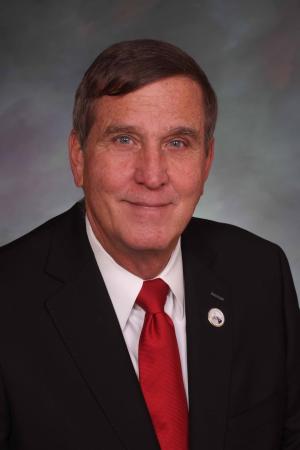
Photo of John Cooke
R Colorado Senate · District 13

Sen. John Cooke

Contact Email
Compare
Total votes
4,431
all sessions
Attendance
90%
367 missed
Lower than 86% of chamber peers
With party
95%
of cast votes
Near the chamber average
Bipartisan score
4%
crosses aisle rarely
Near the chamber average
Sponsored
173
bills & resolutions
Near the chamber average
Committees
0
assignments
173 bills and resolutions

Sponsored bills

Total
173
Primary
173
Co-sponsor
0
This page
173
matching current filters
Primary HB 22-1344
Signed into law · Colorado House · Lead sponsor
FDA-approved Prescription 3,4-Methylenedioxymethamphetamine Drug Use

The act states that if the United States food and drug administration approves a prescription medicine that contains 3,4-methylenedioxymethamphetamine (MDMA), and if that medicine has been placed on a schedule of the federal "Controlled Substances Act", other than schedule I, or has been exempted from one or more provisions of such act, then thereafter prescribing, dispensing, transporting, possessing, and using that prescription drug is legal in Colorado only if the medicine is possessed by a person authorized to legally possess such a controlled substance in Colorado. (Note: This summary applies to this bill as enacted.)

Signed into law Jun 8, 2022 0 co-sponsors
Primary SB 22-055
Signed into law · Colorado Senate · Lead sponsor
Alcohol Monitoring For Impaired Driving Offenders

The act permits a person whose driver's license has been revoked for one year or more because of a conviction for DUI, DUI per se, DWAI, or excess BAC, or for 9 months for a first offense, to immediately apply for an early license reinstatement with an interlock-restricted license. The act requires at least 90 days of continuous alcohol monitoring for a person sentenced to probation following a third or subsequent offense, or a felony offense, for DUI, DUI per se, or DWAI. The act adds an exception for any continuous alcohol monitoring if the court finds that ordering monitoring would not be in the interest of justice or if the person's residence is in an area where the person cannot reasonably acquire a monitoring device. The act requires the judicial district's probation department to pay the costs of continuous alcohol monitoring for a person who is unable to pay and clarifies that money in the offender services fund can be used to pay those costs. The bill appropriates $517,292 from the offender services fund to the judicial department and $10,294 from the general fund to the department of revenue, which includes $1,386 reappropriated funds to the office of the governor for use by the office of information technology. (Note: This summary applies to this bill as enacted.)

Signed into law Jun 8, 2022 0 co-sponsors
Primary HB 22-1285
Signed into law · Colorado House · Lead sponsor
Prohibit Collection Hospital Not Disclosing Prices

The act prohibits a hospital or other person or entity collecting on behalf of the hospital from initiating or pursuing collection actions against a patient or patient guarantor for debt incurred by the patient on the date or dates of service when the hospital was not in material compliance with federal hospital price transparency laws. Nothing in the act: Prohibits a hospital from billing a patient or health insurer for items or services provided to the patient; or Requires a hospital to refund a payment made to the hospital for items or services provided to a patient. If a patient believes that a hospital was not in material compliance with price transparency laws, the patient or patient guarantor may file a lawsuit. If a judge or jury finds the hospital out of material compliance with federal hospital price transparency laws, the hospital is subject to a penalty equal to the amount of the debt, must refund any amount paid on the debt, dismiss any court action initiated by the hospital, and pay attorney fees and costs the patient or patient guarantor incurred relating to the action. Critical access hospitals have until February 15, 2023, to comply with federal hospital price transparency laws before the provisions of the act apply. (Note: This summary applies to this bill as enacted.)

Signed into law Jun 8, 2022 0 co-sponsors
Primary HB 22-1063
Signed into law · Colorado House · Lead sponsor
Jail Standards Commission

The act creates the legislative oversight committee (committee) concerning Colorado jail standards and the Colorado jail standards commission (commission) in the legislative branch. The committee consists of 6 members of the General Assembly and oversees the commission. The committee may introduce up to 3 pieces of legislation in the 2024 session based on recommendations from the commission. The commission recommends standards for the operation of Colorado's county jails (jails). The commission consists of the following 22 members: 5 sheriffs or senior jail administrators; 2 county commissioners; 3 people with lived experience of being incarcerated or having a family member who is or was incarcerated in a jail; One mental health professional with experience working in a jail; One person representing competency services; One person representing the behavioral health administration; One person representing police officers; One person representing a lesbian, gay, bisexual, transgender, or queer advocacy organization; One person representing an organization advocating for the rights of people with disabilities; One person representing an organization advocating for the rights of communities of color; One person representing an organization advocating for the rights of persons with mental or physical disabilities; One non-law-enforcement person with experience working in a jail; The state public defender or the state public defender's designee; One district attorney; and One person representing the department of public safety with expertise in jail operations. The commission shall recommend standards for all aspects of jail operations as follows: Reception and release; Classification of inmates; Security; Housing; Sanitation and environmental conditions; Communication; Visitation; Health care, mental and behavioral health care, and dental care; Food service; Recreation and programming; Inmate disciplinary processes; Restrictive housing; Inmate grievances; Staffing; and Inmates' prerogatives. The commission shall complete a report that includes its recommendations regarding the feasability of jails of various sizes and their ability to implement the recommendations and present it to the committee for approval by November 15, 2023. The act repeals the committee and commission on July 1, 2024. The act appropriates $96,039 from the general fund to the legislative department. (Note: This summary applies to this bill as enacted.)

Signed into law Jun 7, 2022 0 co-sponsors
Primary SB 22-212
Signed into law · Colorado Senate · Lead sponsor
Revisor's Bill

To improve the clarity and certainty of the statutes, the act amends, repeals, and reconstructs various statutory provisions of law that are obsolete, imperfect, or inoperative. The specific reasons for each amendment or repeal are set forth in the appendix to the act. The amendments made by the act are not intended to change the meaning or intent of the statutes, as amended. (Note: This summary applies to this bill as enacted.)

Signed into law Jun 7, 2022 0 co-sponsors
Primary HB 22-1412
Signed into law · Colorado House · Lead sponsor
Sunset Division Of Gaming

The act implements the recommendations of the department of regulatory agencies in its sunset review and report on the division of gaming (division) in the department of revenue. Specifically, the act: Continues the division for 11 years, until 2033; Allows the Colorado limited gaming control commission (commission) to delegate licensing duties to the division; Lowers the minimum age for a casino employee from 21 years of age to 18 years of age; Designates the department of revenue's hearings division to conduct hearings under the "Fantasy Contests Act"; Repeals the requirement that internationally based internet sports betting personnel submit to a fingerprint-based criminal history record check; and Subjects payments of sports bet winnings to the "Gambling Payment Intercept Act" on and after July 1, 2023. The act also empowers the commission to determine whether persons that are not licensed by the commission to conduct sports betting or limited gaming operations are offering to one or more members of the public, in any city, town, city and county, or county: Unlicensed sports betting operations; Unlicensed internet sports betting operations; or Unlicensed establishments that allow the use of equipment or devices that qualify as slot machines or are used to play roulette or craps. The act also prohibits a person from offering sports betting or one or more games, authorized as "limited gaming", to the public without possessing the required license from the commission to conduct: Sports betting operations; Internet sports betting operations; or Operations using equipment or devices that qualify as slot machines or are used to play roulette or craps. The act also adjusts the elements of the existing offense of underage gaming and resets the penalties for the offense as follows: For a first offense, a civil penalty of $500; For a second offense, a civil penalty of $1,000; and For a third or subsequent offense, a class 2 misdemeanor.(Note: This summary applies to this bill as enacted.)

Signed into law Jun 7, 2022 0 co-sponsors
Primary SB 22-210
Signed into law · Colorado Senate · Lead sponsor
License Supplemental Health-care Staffing Agencies

The act requires supplemental health-care staffing agencies (staffing agencies) to complete initial and annual certification with the division of unemployment insurance in the department of labor and employment (department) prior to operating the staffing agency. A staffing agency that fails to comply with the certification requirements commits a civil infraction and may be assessed fines by the department. On or before September 1 of each year, the department of public health and environment and the department of health care policy and financing shall provide the department with a list of all known names of and the contact information for staffing agencies operating in the state. No later than October 1, 2022, each staffing agency shall begin maintaining detailed data necessary for required reporting to the department that includes, in part: A detailed listing of the average amount charged during each quarter of the reporting period to a health-care facility for each category of health-care worker providing services to the health-care facility; and A detailed listing of the average amount paid during each quarter of the reporting period to health-care workers for their services for each category of health-care worker providing services. Commencing April 30, 2023, each staffing agency shall submit biannual reports to the department with the required data. The act includes fines for staffing agencies that submit late or noncompliant biannual reports. The department shall provide copies of the staffing agencies' biannual reports to the department of public health and environment and to the department of health care policy and financing for purposes of analyzing the information provided by the staffing agencies and determining the need for regulation of staffing agencies. For the 2022-23 state fiscal year: $427,591 is appropriated from the general fund to the department of labor and employment for use by the division of labor standards and statistics to implement the act. The appropriation is based on an assumption that the division will require an additional 2.0 FTE; $39,358 is appropriated to the department of public health and environment for use by the health facilities and emergency medical services division for administration and operations and to purchase information technology services. The appropriation is based on an assumption that the division will require an additional 0.3 FTE. $15,545 is appropriated to the office of the governor for use by the office of information technology to provide information technology services to the department of public health and environment. This appropriation is from reappropriated funds received from the department of public health and environment.(Note: This summary applies to this bill as enacted.)

Signed into law Jun 3, 2022 0 co-sponsors
Primary HB 22-1031
Signed into law · Colorado House · Lead sponsor
Consumer Right To Repair Powered Wheelchairs

Usually, an owner of a powered wheelchair must seek diagnostic, maintenance, or repair services of the wheelchair from the manufacturer. Starting January 1, 2023, the act requires a manufacturer to provide parts, embedded software, firmware, tools, or documentation, such as diagnostic, maintenance, or repair manuals, diagrams, or similar information, to independent repair providers and owners of the manufacturer's powered wheelchairs to allow an independent repair provider or owner to conduct diagnostic, maintenance, or repair services on the owner's powered wheelchair. A manufacturer's failure to comply with the requirement is a deceptive trade practice. In complying with the requirement to provide these resources, a manufacturer need not divulge any trade secrets to independent repair providers and owners. Any new contractual provision or other arrangement that a manufacturer enters into on or after January 1, 2023, that would remove or limit the manufacturer's obligation to provide these resources to independent repair providers and owners is void and unenforceable. A manufacturer is not liable for faulty or otherwise improper repairs that an independent repair provider or owner performs on a powered wheelchair. (Note: This summary applies to this bill as enacted.)

Signed into law Jun 2, 2022 0 co-sponsors
Primary SB 22-005
Signed into law · Colorado Senate · Lead sponsor
Law Enforcement Agency Peace Officer Services

The act expands the purposes of the peace officers behavioral health support and community partnerships grant program to include hiring, contracting, or developing a remote network to provide behavioral health counseling, therapy, or other related support services to peace officers involved in job-related traumatic situations. The act appropriates $3 million from the general fund to the peace officers behavioral health support and community partnership fund. (Note: This summary applies to this bill as enacted.)

Signed into law May 31, 2022 0 co-sponsors
Showing 1 to 10 of 173 bills
1 2 3 18 Next