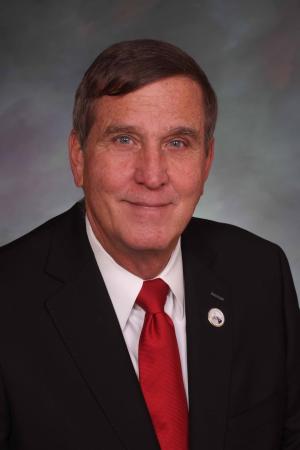
Photo of John Cooke
R Colorado Senate · District 13

Sen. John Cooke

Contact Email
Compare
Total votes
4,431
all sessions
Attendance
90%
367 missed
Lower than 86% of chamber peers
With party
95%
of cast votes
Near the chamber average
Bipartisan score
4%
crosses aisle rarely
Near the chamber average
Sponsored
173
bills & resolutions
Near the chamber average
Committees
0
assignments
173 bills and resolutions

Sponsored bills

Total
173
Primary
173
Co-sponsor
0
This page
173
matching current filters
Primary HB 18-1227
Signed into law · Colorado House · Lead sponsor
Real Estate Commission Flexibility In License Periods

Recent legislation changed the expiration dates of real estate licenses from an anniversary date 3 years after the date of initial issuance to December 31 of the third year after issuance and did not allow the real estate commission a period to transition licenses. To allow more flexibility in transitioning from the anniversary date system to the calendar-year system, the bill authorizes the commission to issue licenses that expire on December 31 of the year of issuance. (Note: This summary applies to the reengrossed version of this bill as introduced in the second house.) , Read More


Signed into law Apr 23, 2018 0 co-sponsors
Primary HB 18-1025
Signed into law · Colorado House · Lead sponsor
Relocate Title 12 Liquor Laws To Title 44

Committee on Legal Services. Current law directs the office of legislative legal services to study the organizational recodification of title 12 of the Colorado Revised Statutes, which relates to professions and occupations. One recommendation of the study is to relocate laws located in title 12 that are administered by the department of revenue to a new title 44, which will consist solely of laws administered by the department of revenue that regulate a variety of activities. To implement this recommendation, section 1 of the bill creates title 44, section 2 relocates laws related to the regulation of alcohol beverages from title 12 to the new title, and section 3 repeals the relocated laws from their current location. Sections 4 through 25 make conforming amendments. Section 26 appropriates $3,091 for the 2018-19 fiscal year from the liquor enforcement division and state licensing authority cash fund to the department of revenue for use by the liquor and tobacco enforcement division to implement the bill, allocated as follows: (a) $2,400 for personal services; and (b) $691 for operating expenses. (Note: This summary applies to the reengrossed version of this bill as introduced in the second house.) , Read More
Signed into law Apr 23, 2018 0 co-sponsors
Primary SB 18-014
Signed into law · Colorado Senate · Lead sponsor
Department Of Corrections Disclose Location Of Out-of-state Inmate

The bill states that if the department of corrections (department) relocates an inmate for incarceration or contracts with another state for the incarceration of an inmate in a penal institution in another state, then not later than 48 hours after such relocation, the department shall notify the prosecuting attorney and any registered victim of crimes for which the inmate is serving his or her sentence of the name and location of the penal institution where the inmate is to be housed. This disclosure requirement does not apply if: The inmate is a witness and the executive director of the department (executive director) determines that disclosing the inmate's location would pose a risk to the personal safety of the inmate, corrections staff, other inmates, or facilities; The prosecuting attorney requests in writing that the department not disclose the location of the penal institution where the inmate is located; The registered victim is currently incarcerated; or The inmate has been employed by the department or as a law enforcement officer and the executive director determines that disclosing the inmate's location poses a risk to the personal safety of the inmate, corrections staff, other inmates, or facilities. If the department relocates an inmate and the executive director determines that any of these factors applies, then not later than 48 hours after such relocation, the department shall notify the prosecuting attorney: That the inmate has been relocated; and Which of the factors the executive director has determined applies. If the prosecuting attorney agrees with the executive director's determination that a factor applies, then the prosecuting attorney shall confirm the executive director's determination in writing, the department shall retain such written confirmation, and the department shall notify any registered victim of one or more crimes for which the inmate is serving his or her sentence that: The inmate has been relocated; and The department is unable to disclose the inmate's location because one of the factors applies. If the prosecuting attorney disagrees with the executive director's determination that a factor applies, then the executive director has 30 days to review the notice of disagreement. If, after such review, the executive director still determines that a factor applies and the inmate's location should not be disclosed, the department shall notify the prosecutor of such fact and notify any registered victims that the prosecutor disagrees with the executive director's determination. Either the prosecutor or any registered victim of the inmate may bring an action in the district court from which the inmate's sentence was issued for the court to determine whether a substantial basis existed and still exists to support the executive director's determination. If the district court finds that no substantial basis exists, the executive director shall disclose the inmate's location to any registered victims. (Note: This summary applies to the reengrossed version of this bill as introduced in the second house.) , Read More

Signed into law Apr 23, 2018 0 co-sponsors
Primary HB 18-1109
Signed into law · Colorado House · Lead sponsor
Discretionary Parole Of Special Needs Offenders

Current law provides 2 definitions by which an offender in the custody of the department of corrections (department) may be considered a 'special needs offender'. The first definition describes a person 'who is 60 years of age or older and has been diagnosed by a licensed health care provider who is employed by or under contract with the department as suffering from a chronic infirmity, illness, condition, disease, or behavioral or mental health disorder and the department or the state board of parole (parole board) determines that the person is incapacitated to the extent that he or she is not likely to pose a risk to public safety'. The bill amends this definition by changing '60 years' to '55 years'. The bill also adds a third definition by which such an offender may be considered a 'special needs offender'. That is, an offender who, as determined by a licensed health care provider who is employed by or under contract with the department, on the basis of available evidence, not including evidence resulting from a refusal of the person to accept treatment, does not have a substantial probability of being restored to competency for the completion of any sentence and is not likely to pose a risk to public safety. Under current law, if the department recommends to the parole board that an offender be released to parole as a special needs offender, the parole board may deny parole only by a majority vote of the parole board. The bill states that to deny parole under such conditions, the parole board must also make a finding that granting parole would create a threat to public safety and that the offender is likely to commit an offense. The bill states that if, prior to or during any parole hearing, the parole board or any member of the parole board has a substantial and good-faith reason to believe that the offender is incompetent to proceed, the parole board shall suspend all proceedings and notify the trial court that imposed any active sentence, and the court shall determine the competency or incompetency of the offender. The court shall appoint counsel to represent the offender with respect to the determination of competency, but the presence of the offender is not required for any court proceedings unless good cause is shown. For any offender who is granted special needs parole, the parole board shall set the length of the parole for an appropriate time period of at least 6 months but not exceeding 36 months. At any time during such an offender's parole, the parole board may revise the duration of the offender's parole. However, in no case may such an offender be required to serve a period of parole in excess of the period of parole to which he or she would otherwise be sentenced, or 36 months, whichever is less. (Note: This summary applies to the reengrossed version of this bill as introduced in the second house.) , Read More

Signed into law Apr 23, 2018 0 co-sponsors
Primary HB 18-1056
Signed into law · Colorado House · Lead sponsor
FPPA Fire And Police Pension Association Statewide Standard Health History Form

Police Officers' and Firefighters' Pension Reform Commission. Every member of the fire and police pension association (FPPA), at the commencement of employment, is required to complete a health history on a statewide standard health history form (form). The purpose of the form is to notify FPPA of a member's health history as it exists at the commencement of employment. The employer of a member can be liable for the total payment of disability and survivor benefits that may be awarded to the member if, in addition to other factors, the employer did not file the form with the FPPA. The bill clarifies several aspects of the form. Specifically, the bill: Specifies that all newly hired members are required to fill out the form; Clarifies that the employer must require newly hired members to complete and file the form; Authorizes the board of directors of the FPPA to adopt an electronic format for the completion and filing of the form; and Specifies that any member who omits or conceals, rather than fraudulently conceals, a material fact concerning his or her health history on the form may be disqualified from receiving disability or survivor benefits.(Note: This summary applies to this bill as introduced.) , Read More

Signed into law Apr 12, 2018 0 co-sponsors
Primary HB 18-1018
Signed into law · Colorado House · Lead sponsor
Human Trafficking Commercial Driver's License

Transportation Legislation Review Committee. The bill requires that the training to obtain a commercial driver's license to drive a combination vehicle contain education to prevent human trafficking if the training is conducted in a driving school. The department must also publish information about human trafficking for commercial driver's license holders and trainees.(Note: This summary applies to the reengrossed version of this bill as introduced in the second house.) , Read More

Signed into law Apr 12, 2018 0 co-sponsors
Primary SB 18-116
Passed · Colorado Senate · Lead sponsor
Capitol Identification Card

On and after January 1, 2019, the bill authorizes security personnel at the state capitol building, including the Colorado state patrol (CSP), to allow any member of the public who holds a capitol identification card (card) to enter the capitol building, the state services building, or the legislative services building without submitting to a search of his or her person or property by security personnel, electronic weapons screening devices, or other means. The secretary of the senate (secretary) or the chief clerk of the house of representatives (chief clerk) may issue a card to any member of the public who applies for the same, pays a fee, and completes a fingerprint-based criminal history record check. Each card is issued for a 2-year period. The bill sets the initial amount of the fee at $100. The amount of the fee must be set at a level that includes the actual costs incurred by the Colorado bureau of investigation (CBI) in completing the fingerprint-based criminal history record check. The legislative council of the general assembly may adjust the amount of the fee not to exceed $500 for any 2-year period for which the card is issued. As part of the application submitted by an individual for a card, the individual is required to have his or her fingerprints taken by a local law enforcement agency or any third party approved by the CBI for the purpose of obtaining a fingerprint-based criminal history record check. The costs of completing the check are paid by the applicant. The bill specifies how the record check is completed. The bill requires the CBI to forward the results of the criminal history record check to the secretary and the chief clerk. The issuance of a card is conditional upon a satisfactory criminal history record check that demonstrates the applicant has not been convicted of a felony. An applicant who fails his or her criminal history record check is not entitled to a refund of any money the applicant has paid to complete the record check. The card must list the name of the card holder and show a photograph of the card holder's face. The record check must be conducted each year for which a card has been issued. The applicant is responsible for payment covering the costs of the record check for each year in which the record check is conducted. A card expires on the second anniversary of its date of issuance unless it has been renewed. The bill specifies procedures by which the card may be renewed and imposes additional restrictions governing issuance, use, and cancellation of the card. All fees collected from issuance of the card are credited to the capitol identification card account, which is created within the existing legislative department cash fund. (Note: This summary applies to the reengrossed version of this bill as introduced in the second house.) Read More

Passed Apr 4, 2018 0 co-sponsors
Primary SB 18-134
Signed into law · Colorado Senate · Lead sponsor
Public Utilities Commission Deregulate Nonprofit Water Utilities

Under current law, the public utilities commission is directed to grant simplified regulatory treatment to water companies that serve fewer than 1,500 customers. The bill expands on this concept by deregulating water companies that are registered as nonprofits, so long as their rates, charges, and terms and conditions of service are just and reasonable. The commission retains the right to entertain a complaint of unjust or unreasonable rates or practices, and to take remedial action, if the complaint is authorized by specified public officials or other persons. (Note: This summary applies to the reengrossed version of this bill as introduced in the second house.) , Read More

Signed into law Apr 2, 2018 0 co-sponsors
Primary HB 18-1066
Signed into law · Colorado House · Lead sponsor
Clarify Sexually Exploitative Material Discovery

Last session, Senate Bill 17-115 expanded the group of people who, if they possessed sexually exploitative material in the performance of their duties, could not commit sexual exploitation of a child to all law enforcement personnel and defense counsel personnel. The bill clarifies that the sexual exploitation of a child statute does not change the discovery procedure for sexually exploitative materials and that the defendant and defense counsel personnel are not allowed to receive copies of the materials. (Note: This summary applies to the reengrossed version of this bill as introduced in the second house.) Read More

Signed into law Mar 22, 2018 0 co-sponsors
Primary HB 18-1210
Signed into law · Colorado House · Lead sponsor
Administrator Of Judicial Security Peace Officer Status

The bill designates an administrator of judicial security in the Colorado judicial department as a peace officer who must be certified by the peace officer standards and training board. (Note: This summary applies to the reengrossed version of this bill as introduced in the second house.) , Read More

Signed into law Mar 22, 2018 0 co-sponsors
Showing 111 to 120 of 173 bills
Previous 1 11 12 13 18 Next