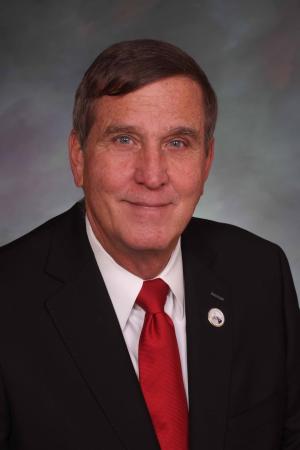
Photo of John Cooke
R Colorado Senate · District 13

Sen. John Cooke

Contact Email
Compare
Total votes
4,431
all sessions
Attendance
90%
367 missed
Lower than 86% of chamber peers
With party
95%
of cast votes
Near the chamber average
Bipartisan score
4%
crosses aisle rarely
Near the chamber average
Sponsored
173
bills & resolutions
Near the chamber average
Committees
0
assignments
173 bills and resolutions

Sponsored bills

Total
173
Primary
173
Co-sponsor
0
This page
173
matching current filters
Primary HB 18-1300
Signed into law · Colorado House · Lead sponsor
Bachelor Nursing Completion Degree Local District College

The bill allows a local district college (college), such as Aims community college, to offer a bachelor of science degree in nursing program as a completion degree in nursing to students who have or are pursuing an associate degree in nursing, provided that the college's board of trustees determines it is appropriate to address the needs of the communities within its service area, as approved by the Colorado commission on higher education based on existing criteria. (Note: This summary applies to the reengrossed version of this bill as introduced in the second house.) , Read More


Signed into law May 29, 2018 0 co-sponsors
Primary HB 18-1316
Signed into law · Colorado House · Lead sponsor
Extend Colorado Department Of Labor And Employment Skilled Worker, Outreach, Recruitment, and Key Training Grant Program

Under current law, the department of labor and employment (department) administers the skilled worker, outreach, recruitment, and key training (WORK) grant program, which provides matching grants to eligible public or private entities or organizations that provide skilled worker training programs in partnership with industry. The general assembly is directed to appropriate $10 million for the WORK grant program for the 2015-16, 2016-17, and 2017-18 fiscal years. The bill: Extends the program for 3 fiscal years; Specifies deadlines for the department to award and issue matching grants to recipients; Requires the department to develop an expedited application process for eligible applicants; Specifies that the state work force development council (council), rather than the governor, is to appoint members to the WORK grant review committee; Authorizes the executive committee of the council to make grant award determinations; Requires the WORK grant review committee to submit its annual report to the general assembly by December 31 instead of by May 1 and to include the report as part of the Colorado talent pipeline report; Requires the general assembly to appropriate an additional $7.6 million for the WORK grant program for the 2018-19, 2019-20, and 2020-21 fiscal years, with not more than $3.3 million in any fiscal year; specifies how the money available for matching grants must be allocated, to the extent possible; and allows the department to expend in the next fiscal year, without further appropriation, money that was not expended or encumbered in the fiscal year for which it was appropriated. $1,000,000 is appropriated from the general fund to the WORK fund and is further appropriated to the department for the WORK grant program. (Note: This summary applies to the reengrossed version of this bill as introduced in the second house.) , Read More
Signed into law May 24, 2018 0 co-sponsors
Primary HB 18-1349
Signed into law · Colorado House · Lead sponsor
Department Of Transportation Waiver Valuations

Subject to certain specified conditions, federal law and regulations authorize a state department of transportation to prepare a waiver valuation, rather than a formal appraisal, to value both real property that it seeks to acquire for a federal aid transportation project and real property that it owns and seeks to dispose of if the anticipated value of the real property is $25,000 or less. Accordingly, current state law allows the department of transportation (CDOT) to prepare a waiver valuation for real property with an anticipated value of $25,000 or less when valuing real property that it seeks to acquire. However, current state law is more restrictive than federal law and regulations with respect to property that CDOT owns and seeks to dispose of and allows CDOT to use waiver valuations to value such property only if the anticipated value of the real property is $5,000 or less. In order to fully harmonize state law governing waiver valuations with federal law and regulations, the bill authorizes CDOT to use waiver valuations for the valuation of real property that CDOT owns and seeks to dispose of if the real property is anticipated to have a value of $25,000 or less. The bill also: Clarifies that a waiver valuation is not an appraisal; and Amends the definition of 'real estate appraiser' to clarify that an individual, including an individual who is a licensed or certified real estate appraiser, is not an appraiser for purposes of the state laws regulating appraisers when the individual performs a waiver valuation.(Note: This summary applies to the reengrossed version of this bill as introduced in the second house.) , Read More

Signed into law May 24, 2018 0 co-sponsors
Primary HB 18-1394
Signed into law · Colorado House · Lead sponsor
Update Colorado Disaster Emergency Act

The bill updates the Colorado disaster emergency act to include provisions related specifically to recovery, mitigation, and resiliency and to establish the roles and responsibilities of state and local agencies at all stages of emergency management. Section 3 of the bill adds language defining the stages of response and recovery, as well as definitions of emergency, resiliency, and mitigation. Section 4 allows the governor to convene a disaster policy group to coordinate the response and recovery from disaster emergencies. If the governor convenes the policy group, the governor is required to appoint a chair and to delegate to the chair the authority to manage cross-departmental and interjurisdictional coordination of recovery efforts. Sections 5 and 21 repeal and relocate existing language establishing the governor's expert emergency epidemic response committee, update the language to reflect amendments throughout the bill, and add the executive director of the department of local affairs or his or her designee to the committee. Subject to available grant funding, the bill creates the Colorado resiliency office in the division of local government within the department of local affairs in sections 17 and 18. Subject to the availability of grant funding or within existing resources, the office is required to develop a resiliency and community recovery program for the state that must address coordination among state and local agencies and risk and vulnerability reduction. The office is required to consult with other state agencies and stakeholders in developing the program. Sections 6, 8, 9, 10, 12, 13, and 14 amend existing statutes concerning disaster planning and response at the state and local level to include references to recovery, mitigation, and preparedness. The requirement for a state disaster plan is amended to require a comprehensive emergency management program that addresses preparation, prevention, mitigation, response, and recovery from emergencies and disasters. Local and interjurisdictional disaster agencies are renamed as emergency management agencies. The emergency management agencies are required to develop a local or interjurisdictional plan that includes provisions for preparation, prevention, mitigation, response, and recovery from emergencies and disasters. Agencies may incorporate by reference existing locally adopted plans, plans approved by the office of emergency management or the federal emergency management agency, and other relevant plans. Section 15 amends a requirement in existing law that the governor consider steps that could be taken on a continuing basis to prevent and reduce the harmful consequences of disasters and adds language requiring the governor to also consider mitigation and recovery from disasters. Sections 16, 19, and 20 make conforming amendments.(Note: This summary applies to the reengrossed version of this bill as introduced in the second house.) , Read More

Signed into law May 24, 2018 0 co-sponsors
Primary HB 18-1255
Signed into law · Colorado House · Lead sponsor
Childhood Cancer Awareness Special License Plate

The bill creates the childhood cancer awareness license plate. A person becomes eligible to use the plate by providing a certificate confirming that the person has made a donation to an organization chosen by the department of revenue based on the organization's assistance to children with cancer. In addition to the standard motor vehicle fees, the plate requires 2 one-time fees of $25. One of the fees is credited to the highway users tax fund and the other to the licensing services cash fund. (Note: This summary applies to the reengrossed version of this bill as introduced in the second house.) , Read More

Signed into law May 22, 2018 0 co-sponsors
Primary SB 18-039
Signed into law · Colorado Senate · Lead sponsor
Continue The Wildfire Matters Review Committee

Wildfire Matters Review Committee. The wildfire matters review committee (WMRC) is currently scheduled to repeal on July 1, 2018. The bill defers the repeal date to September 1, 2025. The bill also eliminates obsolete provisions relating to the WMRC's consideration of codifying the wildland and prescribed fire advisory commission, an entity created by executive order. The WMRC discharged its obligation by considering this issue during the 2014 legislative session. The bill also appropriates $49,125 from the general fund to the legislative department for the 2018-19 state fiscal year for its implementation. (Note: This summary applies to the reengrossed version of this bill as introduced in the second house.) , Read More

Signed into law May 18, 2018 0 co-sponsors
Primary HB 18-1307
Signed into law · Colorado House · Lead sponsor
Limit Access To Products With Dextromethorphan

The bill states that it is unlawful for a seller, retailer, or vendor to knowingly or willfully dispense, sell, or distribute a finished drug product containing any quantity of dextromethorphan to a person less than 18 years of age. A seller, retailer, or vendor making a retail sale of a finished drug product containing any quantity of dextromethorphan must require and obtain proof of age from the purchaser before completing the sale unless the seller, retailer, or vendor reasonably presumes from the purchaser's outward appearance that the purchaser is at least 25 years of age. A seller, retailer, or vendor who violates the prohibition or who fails to obtain proof of age when required to do so commits an unclassified petty offense and, upon conviction thereof, shall be punished as follows: For a first offense, the court shall warn the seller, retailer, or vendor in writing; and For a second or subsequent offense, the seller, retailer, or vendor shall pay a fine of not more than $200. The prohibition does not apply to a medication containing dextromethorphan, which medication is sold pursuant to a valid prescription. It is an affirmative defense if the seller, retailer, or vendor is an employer and trains its employees concerning the bill's restrictions on the distribution of medications containing dextromethorphan. (Note: This summary applies to the reengrossed version of this bill as introduced in the second house.) , Read More

Signed into law May 11, 2018 0 co-sponsors
Primary HB 18-1115
Passed · Colorado House · Lead sponsor
Department of Public Safety Human Trafficking-related Training

The bill requires the division of criminal justice to provide human trafficking training to law enforcement agencies and entities that provide services to human trafficking victims. The training may include: Train-the-trainer programs; Direct trainings; and Online training programs. The training may be provided to law enforcement agencies, organizations that provide direct services to human trafficking victims, school personnel and parents or guardians of students, and any other organization, agency, or group that would benefit from such training. The training must be developed in consultation with the Colorado human trafficking council. When considering requests for training, the division should give priority to requests from areas of the state that have limited access to training resources. Beginning in 2019, the council's annual human trafficking report must include an update on the training provided. The bill requires the school safety resource center to include awareness and prevention of human trafficking in the materials and training that it provides. The bill appropriates $69,922 and 0.8 FTE to the division of criminal justice in the department of public safety from the general fund to implement the bill. (Note: This summary applies to the reengrossed version of this bill as introduced in the second house.) Read More

Passed May 8, 2018 0 co-sponsors
Primary SB 18-222
Passed · Colorado Senate · Lead sponsor
Reimburse Attorney General Or District Attorneys For Rule 35 Motion Costs

The bill requires the judicial department to reimburse a district attorney for costs associated with litigating postconviction rule 35 of the Colorado criminal procedure motions. Costs include lay and expert witness expenses, travel expenses, subpoena expenses, required transcript costs, and attorney time billed at the same rate as the alternate defense counsel rate. The bill has an effective date of July 1, 2019. (Note: This summary applies to the reengrossed version of this bill as introduced in the second house.) Read More

Passed May 8, 2018 0 co-sponsors
Showing 91 to 100 of 173 bills
Previous 1 9 10 11 18 Next