Currently, the 'Workers' Compensation Act of Colorado' provides that certain cancers contracted by firefighters are considered occupational diseases presumed to have been a result of the firefighters' employment. A firefighter's employer or an insurer may rebut this presumption by showing by a preponderance of the medical evidence that the cancer did not occur on the job. The act expands the types of cancer that are considered occupational diseases and strengthens the rebuttable presumption to require an employer to show clear and convincing evidence that the cancer did not occur on the job. The act exempts firefighters who are employed by the state.(Note: This summary applies to this bill as enacted.)
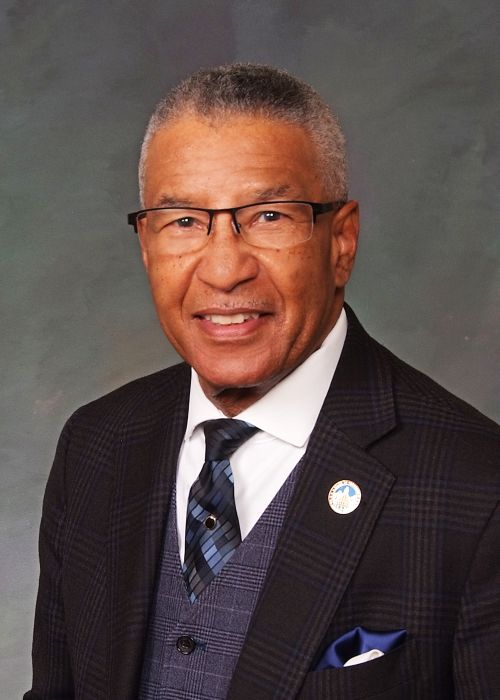
Sen. Tony Exum
Sponsored bills
The act requires the attorney general to submit to the peace officers standards and training board (P.O.S.T. board) a proposal by December 31, 2030, to update current basic, reserve, and refresher law enforcement training academy programs and improve the peace officer performance of future academy graduates. The act changes the makeup of the P.O.S.T. board by reducing the number of law enforcement head officials, reducing the number of non-law-enforcement persons, increasing the number of line officers, and adding representatives from law enforcement training academies and reserve officers. A person who has had their P.O.S.T. certification revoked is not eligible to serve on the P.O.S.T. board. The P.O.S.T. board is prohibited from approving skill instructors whose P.O.S.T. certification has been revoked for training academies and from approving training academies with an instructor whose P.O.S.T. certification has been revoked after September 1, 2026. The act requires that a person be at least 21 years old in order to be a certified peace officer. The act makes a peace officer academy full-time instructor eligible to attend P.O.S.T. certification classes funded with grant money, but the instructor is not eligible to receive individual grant funding from the P.O.S.T. board.(Note: This summary applies to this bill as enacted.)
The act creates the retail theft prevention advisory board (advisory board) in the division of criminal justice in the department of public safety (division). The advisory board shall develop procedures related to applying for a grant for the retail theft prevention grant program created in the act; review grant applications and award grants; collect and analyze data related to organized felony-level retail theft and gift card fraud trends, losses, prosecutions, and outcomes in Colorado; and develop policy recommendations in coordination with state and federal partners on how to combat felony-level retail theft and gift card fraud. The act creates the retail theft prevention grant program in the division. A state or local law enforcement agency, district attorney's office, multijurisdictional or regional task force, or tribal law enforcement agency may apply for a grant, which may be used to investigate and prosecute organized felony-level retail theft or gift card fraud; develop or invest in technology, data-sharing systems, and analytics tools to analyze felony-level retail theft and gift card fraud metrics; provide training and technical assistance to retailers or law enforcement agencies; and develop prevention and deterrence initiatives specific to felony-level retail theft and gift card fraud. Beginning January 2028, the act requires the division to annually report during its 'SMART Act' hearing certain information about the retail theft prevention grant program and felony-level retail theft in Colorado. The act extends the crime prevention through safer streets grant program (safer streets grant program) to November 1, 2029, and makes the retail theft prevention grant program an allowable use of the money appropriated for the safer streets grant program. On July 1, 2027, $200,000 of the unexpended and unencumbered money remaining at the end of the 2026-27 state fiscal year from the money appropriated for the safer streets grant program reverts to the general fund.(Note: This summary applies to this bill as enacted.)
On or before December 1, 2026, and annually thereafter, the act requires each transportation broker that administers nonemergency medical transportation to medicaid members to submit certain information to the department of health care policy and financing (state department) regarding transportation providers that the transportation broker contracts with. Beginning January 1, 2027, the state department is required to include this information in its annual 'SMART Act' presentation. The act changes the term 'qualified alien' to 'qualified noncitizen' to align with federal requirements. If the state department plans to implement, apply, or enforce new multiple procedure payment reductions for outpatient therapy services, the act requires the state department to provide notice to the impacted providers of the changes at least 6 months prior to implementing the changes and to hold at least one stakeholder meeting to discuss the payment reductions. The act requires the state department to reimburse a provider who is licensed and authorized to prescribe, dispense, compound, or administer medication-assisted treatment in a jail setting. The act requires the medical services board to adopt rules before January 1, 2027, to comply with federal community engagement requirements and requires the state department make available on its website data on the community engagement requirements and their impact on medical assistance enrollment. The act requires the state department to collect direct care service cost to administrative cost ratio information from home- and community-based service provider agencies and submit a report to the general assembly detailing the information collected. The act repeals the state medical assistance and services advisory council.(Note: This summary applies to this bill as enacted.)
With certain exceptions, the act prohibits an employer or an employer's agent from demanding, confiscating, retaining, or otherwise requiring an individual who is an employee or an applicant for employment or who is performing work or seeking to perform work for the employer in any capacity, including a migrant worker or seasonal employee, to surrender the individual's government-issued identification card. A person that knowingly violates the act's prohibition commits criminal possession of an identification document, which is a class 2 misdemeanor. A person commits a bias-motivated crime if, with the intent to intimidate or harass another individual, in whole or in part, because of that individual's actual or perceived race, color, religion, ancestry, national origin, physical or mental disability, sexual orientation, or transgender identity, the person:Violates the act's prohibitions; orProvides, or threatens to provide, an individual's government-issued identification document to federal immigration authorities, except where required or permitted by state or federal law. Such a bias-motivated crime is a class 1 misdemeanor, and a victim may seek additional remedies available under law.(Note: This summary applies to this bill as enacted.)
The act requires that school districts test the vision of students in pre-kindergarten, in addition to testing the vision of students in kindergarten and the first, second, third, fifth, seventh, and ninth grades. The act updates terminology by replacing the word 'sight' with the word 'vision'.(Note: This summary applies to this bill as enacted.)
The act prohibits individuals lawfully permitted to provide psychotherapy services in the state (regulated professionals) from allowing an artificial intelligence system (AI system) to interact with clients in any form of therapeutic communication without synchronous, real-time interaction between the regulated professional, the AI system, and the client, or generate therapeutic recommendations or treatment plans without review and approval by the regulated professional. Except for educational, administrative, simulation, or training purposes or as part of a research program, a regulated professional shall not use an AI system to provide, direct, or guide psychotherapy, clinical intervention, counseling, diagnosis, treatment planning, or other activity that constitutes the practice of psychotherapy with an individual or group unless the use satisfies the conditions specified in the act. At initial client contact, a regulated professional shall inform clients of the prohibitions regarding use of AI systems in the practice of psychotherapy. Regulated professionals may be disciplined by the appropriate licensing board in the department of regulatory agencies for violations of this act. The act allows regulated professionals to use an AI system to assist in providing administrative support or supplementary support, as these terms are defined in the act, for psychotherapy services if the regulated professional maintains responsibility for reviewing any outputs of the AI system used to provide administrative support or supplementary support. If a client's therapeutic session will be recorded or transcribed through the use of an AI system, the regulated professional must disclose in advance the use of an AI system and the purposes for its use, and obtain written, informed consent from the client. The act does not prohibit a regulated professional from using an AI system within accredited or approved educational, instructional, or professional training programs, so long as the AI system is used solely for educational, administrative, simulation, or training purposes and is not deployed, marketed, or represented as a tool for use with clients, patients, or the public. Further, a regulated professional may be involved in the development, testing, or evaluation of an AI system solely for research purposes under the oversight of a federally registered institutional review board, so long as the AI system is not offered to consumers or used outside of the research setting. The act does not apply to regulated professionals who use or recommend the use of technology in the state that does not diagnose or treat mental health disorders, clearly discloses that the technology is not a substitute for clinical care, and:Provides self-help, therapeutic homework, coaching, patient navigation, guided meditation, journaling, or other tools specified in the act; orIs regulated by the federal food and drug administration. Except as provided in the act, the act also makes it an unfair or deceptive trade practice under the 'Colorado Consumer Protection Act' for an individual, corporation, or entity (person) to use any term, letter, or phrase in the use of an AI system in a manner that:Indicates or implies that the AI system's outputs are provided by, endorsed by, or equivalent to services provided by a regulated professional;Represents that the AI system provides psychotherapy services; orRepresents that a user's data is confidential in a manner that would lead a reasonable user to believe that the privacy of their data is protected in a manner similar to therapist-client confidentiality. The act does not impose liability on a regulated professional for defects in or failures of an AI system that are attributable to the developer or deployer of the AI system. Further, under conditions specified in the act, nothing in the act prohibits a person from developing, testing, or evaluating an AI system solely for research purposes or using an AI system in educational, instructional, or training programs. In addition, it is not an unfair or deceptive trade practice for a person to use a technology that does not diagnose or treat mental health disorders, clearly discloses that the technology is not a substitute for clinical care, and:Provides self-help, therapeutic homework, coaching, patient navigation, guided meditation, journaling, or other tools specified in the act; orIs regulated by the federal food and drug administration.(Note: This summary applies to this bill as enacted.)

The act implements the recommendation of the Colorado office of policy, research, and regulatory reform in the department of regulatory agencies in its sunset review and report by continuing the regulation of hemodialysis clinics and technicians for 11 years, until September 1, 2037.(Note: This summary applies to this bill as enacted.)

The act implements the recommendations of the department of regulatory agencies in its 2025 sunset review and report by:Continuing the fire suppression programs of the division of fire prevention and control (division) for 11 years until September 1, 2037, pursuant to the provisions of the sunset law; andModifying certain provisions of the fire suppression programs of the division to replace gender-specific terminology with gender-neutral terminology.(Note: This summary applies to this bill as enacted.)
The act requires an entity that requires an individual to provide a social security number for a background check for a non-employment-based educational opportunity to accept an individual's taxpayer identification number in lieu of a social security number, including in clinical educational experiences for health-related academic programs, subject to certain exceptions. A licensed or certified hospital or covered school, or a state institution of higher education or local district college that offers a non-employment-based educational opportunity that involves work with a vulnerable population, shall accept either an applicant's taxpayer identification number or a fingerprint-based background check in lieu of a social security number. An applicant for a non-employment-based educational opportunity that involves work with a vulnerable population at a licensed or certified hospital or covered school, or a state institution of higher education or local district college, is permitted to have their fingerprints taken by a local law enforcement agency or an entity approved by the Colorado bureau of investigation for taking fingerprints for the purpose of a background check. A licensed or certified hospital or covered school, or state institution of higher education or local district college, must determine who pays the fee for the fingerprint-based background check. The attorney general is authorized to bring a civil action to enforce the provisions of the act. An entity that violates this act is subject to a civil penalty of $2,000 for the first violation and $5,000 for each subsequent violation.(Note: This summary applies to this bill as enacted.)