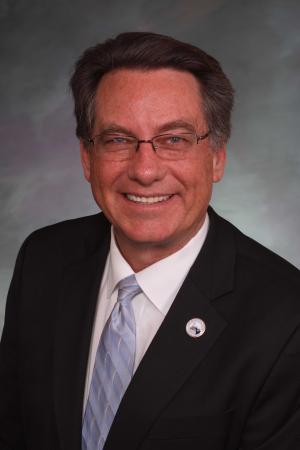
Photo of Jerry Sonnenberg
R Colorado Senate · District 1

Sen. Jerry Sonnenberg

Contact Email
Compare
Total votes
4,687
all sessions
Attendance
89%
392 missed
Near the chamber average
With party
91%
of cast votes
Lower than 84% of chamber peers
Bipartisan score
6%
crosses aisle rarely
Higher than 83% of chamber peers
Sponsored
129
bills & resolutions
Near the chamber average
Committees
0
assignments
129 bills and resolutions

Sponsored bills

Total
129
Primary
129
Co-sponsor
0
This page
129
matching current filters
Primary HCR 22-1001
In committee · Colorado House · Lead sponsor
Statutory Initiative Petition Signature Requirements

The Colorado constitution currently requires any petition for a citizen-initiated constitutional amendment to be signed by at least 2% of the registered electors who reside in each state senate district for the change to be placed on the ballot. If approved by the voters at the November 2022 general election, the concurrent resolution would extend this requirement to a citizen-initiated statutory change. (Note: This summary applies to this concurrent resolution as introduced.)

In committee Jan 31, 2022 0 co-sponsors
Primary HB 21-1278
Signed into law · Colorado House · Lead sponsor
Special District Meeting Requirements

The act clarifies what qualifies as a meeting and a location for purposes of the meeting of a board of a special district. The act also prohibits a challenge to the method of conducting any special district board meeting that was held virtually before the effective date of the act.(Note: This summary applies to this bill as enacted.)

Signed into law Jul 7, 2021 0 co-sponsors
Primary SB 21-063
Signed into law · Colorado Senate · Lead sponsor
Multiple Employer Welfare Arrangements Offer Insurance

Current law allows an existing association consisting of multiple employers, referred to as a "multiple employer welfare arrangement" (MEWA), to offer health-care benefits to the association's members only if, among other requirements, the MEWA has been in existence continuously since at least January 1, 1983, and is engaged in substantial activities for its employer members other than the sponsorship of an employee welfare benefit plan.The act allows a MEWA that does not meet these requirements to file an application for a waiver with the commissioner of insurance that, if granted, would enable the MEWA to offer health-care benefits to its members' employees. The act specifies the application requirements, substantive requirements that a MEWA must comply with to qualify for a waiver, and factors that the commissioner will consider in determining whether to grant a waiver. If a waiver is granted, the MEWA is subject to the division of insurance's full enforcement authority, and the MEWA may operate for 2 years. To operate past the 2 years, a MEWA must reapply for a waiver, but if the commissioner grants 5 consecutive waivers, a MEWA may continue to operate without again applying for a waiver.The act also appropriates $13,352 from the division of insurance cash fund to the department of regulatory agencies for use by the division of insurance to implement the act.(Note: This summary applies to this bill as enacted.)

Signed into law Jul 7, 2021 0 co-sponsors
Primary HB 21-1297
Signed into law · Colorado House · Lead sponsor
Pharmacy Benefit Manager And Insurer Requirements

The act enacts the "Pharmacy Fairness Act" (act), which:Requires a health insurer to submit to the commissioner of insurance (commissioner) a list of pharmacy benefit managers (PBMs) the health insurer uses to manage or administer prescription drug benefits under its health benefit plans offered in this state; Prohibits PBMs from: Restricting a covered person's access to prescription drug benefits at an in-network retail pharmacy, except as permitted in limited circumstances; Charging a pharmacy or pharmacist a fee for adjudicating a claim, other than a one-time fee of not more than the lesser of 25% of the pharmacy dispensing fee or 25 cents for receipt and processing of the same pharmacy claim; or Requiring stricter pharmacy accreditation standards or certification requirements than the standards or requirements that are applicable to similarly situated PBM-affiliated pharmacies within the same PBM network. A PBM that administers the drug assistance program operated by the department of public health and environment is exempt from the requirements and prohibitions of the act with regard to the PBM's administration of that program only.The act also precludes a health insurer, a PBM, or an entity acting for a health insurer or PBM to conduct on-site audits of pharmacies within 12 months after a prior on-site audit except in specified circumstances.Additionally, the act requires a health insurer or PBM to respond in real time to a request from an insured, the insured's health-care provider, or a third party acting on behalf of the insured or provider for data regarding the cost, benefits, and coverage under the insured's health benefit plan for a particular drug.(Note: This summary applies to this bill as enacted.)

Signed into law Jul 6, 2021 0 co-sponsors
Primary HB 21-1262
Signed into law · Colorado House · Lead sponsor
Money Support Agricultural Events Organization

The act creates the agricultural events relief program in the department of agriculture to provide COVID-19 relief payments to agricultural events organizations, and appropriates $2 million from the general fund for the program. In addition, the act appropriates:$5 million for the Colorado state fair and industrial exhibition; $25 million for aiding the national western stock show event in constructing the national western stock show's campus; and $3.5 million for the national western stock show.(Note: This summary applies to this bill as enacted.)

Signed into law Jun 29, 2021 0 co-sponsors
Primary SB 21-236
Signed into law · Colorado Senate · Lead sponsor
Increase Capacity Early Childhood Care & Education

The act creates 4 new grant programs to increase capacity for early childhood care and education, improve recruitment and retention rates for early childhood educators (educators), and improve salaries for educators. The act makes an appropriation.Specifically, the act creates the following programs:The employer-based child care facility grant program; The early care and education recruitment and retention grant and scholarship program; The child care teacher salary grant program; and The community innovation and resilience for care and learning equity (CIRCLE) grant program. The act also eliminates the repeal dates for the child care sustainability grant program and the emerging and expanding child care grant program.The act appropriates money for the grant programs from the general fund as well as from federal funds from the child care development fund.The act makes the following appropriations:During the 2020 special session, the general assembly appropriated money for early childhood education. The act states that any of that money not expended prior to July 1, 2021, is further appropriated to the department of human services for the next fiscal year for the same purpose. For the 2020-21 state fiscal year, $8,800,000 is appropriated to the department of human services for use by the office of early childhood. This appropriation is from the general fund. To implement this act, the office of early childhood may use this appropriation as follows: $100,000 for administration, which amount is based on an assumption that the office will require an additional 1.0 FTE; and $8,700,000 for the employer-based child care facility grant program. Any money appropriated but not expended prior to July 1, 2021, is further appropriated to the department of human services for use by the office of early childhood for the 2021-22 state fiscal year for the same purposes. For the 2021-22 state fiscal year, $320,241,576 is appropriated to the department of human services for use by the office of early childhood. This appropriation is from federal funds from child care development funds. To implement this act, the office of early childhood may use this appropriation as follows: $292,700,664 for the child care sustainability grant program, which amount is based on an assumption that the office will require an additional 3.0 FTE. Any money appropriated for the child care sustainability grant program but not expended prior to July 1, 2022, is further appropriated for use by the office of early childhood for the 2022-23 state fiscal year for the same purposes; $16,800,000 for the community innovation and resilience for care and learning equity (CIRCLE) grant program, which amount is based on an assumption that the office will require an additional 1.0 FTE. Any money appropriated to the community innovation and resilience for care and learning equity (CIRCLE) grant program but not expended prior to July 1, 2022, is further appropriated for use by the office of early childhood for the 2022-23 state fiscal year for the same purposes; $7,200,000 for the early care and education recruitment and retention grant and scholarship program, which amount is based on an assumption that the office will require an additional 4.0 FTE; $3,000,000 for the child care teacher salary grant program, which amount is based on an assumption that the office will require an additional 1.0 FTE; and $540,912 for the administration, monitoring, compliance, and reporting requirements associated with the money appropriated in this subsection (3), which amount is based on an assumption that the office will require an additional 4.0 FTE. For the 2021-22 state fiscal year, $58,622,936 is appropriated to the department of human services for use by the office of early childhood. This appropriation is from federal funds from child care development funds. The office of early childhood may use this appropriation as follows: $23,845,252 for the child care assistance program; $32,455,511 for child care grants for quality and availability and federal targeted funds requirements, which amount is based on an assumption that the office will require an additional 6.0 FTE; $2,150,000 for the early childhood mental health consultation program, which amount is based on an assumption that the office will require an additional 1.0 FTE; and $172,173 for the administration, monitoring, compliance, and reporting requirements associated with the money appropriated in this subsection (4), which amount is based on an assumption that the office will require an additional 2.0 FTE.(Note: This summary applies to this bill as enacted.)


Signed into law Jun 16, 2021 0 co-sponsors
Primary HB 21-1043
Failed · Colorado House · Lead sponsor
Study Underground Water Storage Maximum Beneficial Use

The bill directs the Colorado water conservation board (board), in consultation with the state engineer, to contract with a Colorado institution of higher education (institution) to conduct a study to: Evaluate ways to maximize the beneficial use of water within Colorado and implement the storage recommendations of the Colorado water plan by storing water underground when water is available; Evaluate ways to minimize the amount of water that flows out of Colorado to downstream states, without risking noncompliance with applicable interstate compacts, United States supreme court rulings, other federal law, decreed absolute and conditional water rights, the prior appropriation system, and Colorado's anti-speculation doctrine; Identify: Specific aquifers that are hydrologically and legally available to be used for underground storage and subsequent beneficial use; Sources of revenue that could be used to pay for the underground storage projects; and Planned potential or existing underground storage projects that would meet the objectives identified in the study; Examine the role that various water entities might play in financing and implementing underground storage projects; and Recommend legislative changes needed to implement managed underground storage projects in the identified aquifers. The bill directs the board or the institution to submit a report summarizing the results of the study to the water resources review committee by August 1, 2022, which shall either have legislation drafted to implement the study's recommendations or submit the study along with its own recommendations to the committees of the general assembly with jurisdiction over water resources by January 1, 2023. (Note: This summary applies to this bill as introduced.)

Failed Jun 15, 2021 0 co-sponsors
Primary SB 21-033
Failed · Colorado Senate · Lead sponsor
Conservation Easement Working Group Proposals

A working group was convened over the 2019 interim pursuant to House Bill 19-1264 to develop proposed statutes to address certain issues affecting the creation, valuation, tax treatment, and stewardship of conservation easements in the state. The bill implements the recommendations of the working group by creating a new state income tax credit (new credit) for certain taxpayers who were denied state income tax credits for conservation easements donated between 2000 and 2013 (original credit) if the federal internal revenue service allowed a federal income tax deduction for the same donation. The amount of the new credit is based upon the amount of the original credit that could have been claimed at the time of the original donation based upon the value of the donation accepted by the internal revenue service. The amount of the new credit is reduced by any amount that was allowed to be claimed against Colorado income tax or otherwise reinstated to the claimant of the original credit. The new credit is not refundable but may be carried forward or transferred in the same manner as original credits. New credits allowed count against a portion of the existing cap on the total amount of original conservation easement credits that may be claimed each year. The department of revenue is required to make information about the new credit available online. The bill establishes a process for applying to the division of conservation to claim the new credit. If the original credit that was denied was transferred to another taxpayer as transferee, the bill provides a process for all parties to the transaction to submit a mutual application to claim the new credit or, if there is objection, an ombudsman process to resolve disputes about the distribution of the credit. (Note: This summary applies to the reengrossed version of this bill as introduced in the second house.)

Failed Jun 15, 2021 0 co-sponsors
Primary SB 21-234
Signed into law · Colorado Senate · Lead sponsor
General Fund Transfer Agriculture And Drought Resiliency

The act creates the agriculture and drought resiliency fund (fund), directs the state treasurer to transfer $3 million from the general fund to the fund, and appropriates the money from the fund to the department of agriculture (department). The department will use the fund to anticipate, prepare for, mitigate, adapt to, or respond to any event, trend, or climatological disturbance related to drought or climate. The department will distribute $15,000 from the fund to each conservation district by July 1, 2021. The fund is repealed, effective September 1, 2022.(Note: This summary applies to this bill as enacted.)
Signed into law Jun 15, 2021 0 co-sponsors
Showing 31 to 40 of 129 bills
Previous 1 3 4 5 13 Next