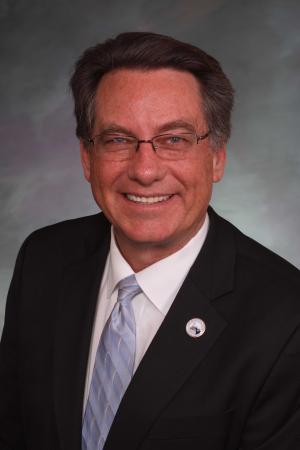
Photo of Jerry Sonnenberg
R Colorado Senate · District 1

Sen. Jerry Sonnenberg

Contact Email
Compare
Total votes
4,687
all sessions
Attendance
89%
392 missed
Near the chamber average
With party
91%
of cast votes
Lower than 84% of chamber peers
Bipartisan score
6%
crosses aisle rarely
Higher than 83% of chamber peers
Sponsored
129
bills & resolutions
Near the chamber average
Committees
0
assignments
129 bills and resolutions

Sponsored bills

Total
129
Primary
129
Co-sponsor
0
This page
129
matching current filters
Primary SB 22-209
Signed into law · Colorado Senate · Lead sponsor
Meat Processing Grant And Loan Assistance

The act instructs the commissioner of agriculture to hire an employee or engage a contractor to provide grant and loan application assistance to small meat processors or people attempting to start a small meat processor business. The grant or loan must be used to start, expand, or support a small meat processor business. The employee or contractor may also assist agricultural producers and agricultural businesses in applying for and obtaining grants. The grant and loan application assistance program repeals on July 1, 2024. To implement the act, $62,885 is appropriated to the department of agriculture for use by the agricultural markets division. (Note: This summary applies to this bill as enacted.)

Signed into law Jun 8, 2022 0 co-sponsors
Primary SB 22-053
Signed into law · Colorado Senate · Lead sponsor
Health Facility Visitation During Pandemic

Subject to the limitations in state and federal law and state or local public health orders, the act specifies that a patient or resident of a hospital, a nursing care facility, or an assisted living residence (collectively referred to as "health-care facility") may have at least one visitor of the patient's or resident's choosing during the stay or residency. A health-care facility is required to have written policies and procedures that are consistent with state and federal law regarding the visitation rights of patients and residents, including policies and procedures setting forth any necessary or reasonable restriction or limitation to ensure the health and safety of patients, staff, or visitors that the health-care facility may need to place on patient and resident visitation rights and the reasons for the restriction or limitation. The act allows a health-care facility to impose specific requirements on visitors during a period when the risk of transmission of a communicable disease is heightened, including the requirement to wear medical masks or other protective equipment and be screened or tested for a communicable disease. A health-care facility may impose visitation restrictions for a patient or resident with a communicable disease who is isolated. $45,409 is appropriated from the general fund to the department of public health and environment for use by the health facilities and emergency medical services division for the nursing and acute care facility survey. (Note: This summary applies to this bill as enacted.)

Signed into law Jun 8, 2022 0 co-sponsors
Primary SB 22-110
Signed into law · Colorado Senate · Lead sponsor
Equip Wind Turbine Aircraft Detection Lighting System

The act requires that an owner or operator of a new wind-powered energy generation facility (facility) install light mitigating technology (technology) at the facility if vertical construction of the first wind turbine included in the facility begins on or after April 1, 2022, and the owner or operator is required to obtain a land-use permit from a local government or is an independent power producer. The act defines technology as a sensor-based system that is designed to detect approaching aircraft, that keeps the lights off when it is safe to do so, and that meets federal aviation administration (FAA) requirements. An owner or operator of a facility is responsible for obtaining FAA approval for the installation of approved technology and may request from the governing body of the local government an extension of time up to 24 months if the owner or operator can demonstrate that, despite its commercially reasonable efforts, the technology was not available within the time frame afforded. The board of county commissioners in the county in which a facility is located may adopt and enforce an ordinance or resolution to authorize the board to impose civil penalties of $1,000 per day against a facility owner or operator if the board determines that the owner or operator has failed to comply with the act. (Note: This summary applies to this bill as enacted.)

Signed into law Jun 8, 2022 0 co-sponsors
Primary SB 22-195
Signed into law · Colorado Senate · Lead sponsor
Modifications To Conservation District Grant Fund

The act repeals the provision that repeals the conservation district grant fund (fund) on December 31, 2022. The act also requires, on an annual basis: The state treasurer to transfer $148,000 from the general fund to the fund; and The department of agriculture to distribute $2,000 from the fund to each conservation district.(Note: This summary applies to this bill as enacted.)

Signed into law Jun 8, 2022 0 co-sponsors
Primary HB 22-1314
Signed into law · Colorado House · Lead sponsor
Towing Carrier Nonconsensual Tows

Colorado law requires a towing carrier (carrier) to notify law enforcement, within 30 minutes after towing an abandoned vehicle, of the carrier's name and the storage location and description of the vehicle. The act clarifies that the carrier is deemed to have complied if: The carrier gave the location of the storage facility to law enforcement when obtaining authorization for the tow; or The carrier made 2 or more attempts within the 30 minutes after the tow to notify a law enforcement agency but was unsuccessful for reasons beyond the control of the carrier. When a carrier tows a vehicle without the owner's or lienholder's consent, current law requires the carrier to notify the department of revenue (department), the owner, and the lienholder of the tow between 2 and 10 days after the tow, thus imposing a 2-day waiting period before notification. The act repeals this waiting period and instead requires notice within 10 days after the tow and caps at $75 the amount the carrier may charge for sending this notice; however, the act encourages carriers to wait 24 hours after a tow to notify the owner and lienholder of the tow. Except for the first 24 hours, daily storage fees are forbidden until the carrier has sent the required notice to the owner and lienholder. A carrier's mechanic's lien does not attach to a vehicle for 30 days after notice was sent to the owner or lienholder of the vehicle if the carrier tows a vehicle from private property without the owner's, operator's, or lienholder's consent. If the owner or lienholder fails to retrieve the towed vehicle for 30 days, Colorado law authorizes the carrier to sell the vehicle to recover the carrier's fees. The act requires the carrier to set the sale price at the time of sale, list the fair market price at the time of sale, and report the sale price to the department within 5 business days after the sale. The law also requires the vehicle to be appraised by an independent third-party. Before the act, the balance of the money from the vehicle sale, after the carrier and law enforcement were reimbursed, was sent to the department to pay any taxes or fees. The act repeals this requirement and replaces it with a requirement that the carrier give the money to the lienholder or owner, depending on any lien. If the money is never claimed, it is sent to the unclaimed property program. The amount of the fee that a carrier must pay to have a carrier's permit is changed from $150 to being set by the public utilities commission (PUC), and approved by the executive director of the department of regulatory agencies, to cover the cost of regulating carriers. The PUC is authorized to deny an application for a carrier permit or to refuse to renew a carrier permit when a carrier has been convicted of a towing-related offense. The PUC may deny an application or refuse to renew a permit of a towing carrier based on a determination that there is good cause to believe the issuance of or renewal of the permit is not in the public interest. The act requires that carriers that are towing a vehicle from private property without the owner's, operator's, or lienholder's consent must: Display at their place of business and on any website the current maximum rates permitted by rule of the PUC for each tow service provided by the towing carrier, and the sign must include information about how to make a complaint to the PUC; Accept cash and major credit cards, as defined by rule of the PUC, and, upon request, disclose the accepted forms of payment; Not charge storage fees for a day on which the carrier did not store the vehicle; Before connecting to a vehicle, photographically document the vehicle's condition and the reason for the tow. Failure to produce documentation of the vehicle's condition or the reason for the tow creates a rebuttable presumption that any damages to the vehicle were caused by the carrier or that the tow was not authorized. Maintain an area at each storage facility with lighting adequate to inspect a vehicle for damage; Upon demand of the owner within 30 days after providing the owner notice that the vehicle has been towed, retrieve the contents of the towed vehicle or allow the owner to retrieve the vehicle or the contents; Upon the owner paying 15 percent of the fees or $60, whichever is less, and signing a form acknowledging the remainder of the debt, retrieve the towed vehicle or the contents of the towed vehicle or allow the owner to retrieve the vehicle or the contents; Obtain authorization from the property owner, leaseholder, or common interest community within 24 hours before towing a vehicle from private property; With certain exceptions, give 24 hours' written notice before removing a vehicle from a parking spot or the common areas of a condominium, cooperative, apartment, or mobile home park; Post adequate signs that a vehicle may be towed if parked inappropriately; Upon request, provide evidence of the carrier's insurance coverages; Have a sign at storage facilities that states the name, telephone number, and hours of operation of the carrier's business; Upon request, provide an itemized bill showing each charge and the rate for each fee that the person has incurred; Give written notice of the ability to make a complaint to the PUC; For a carrier to perform a nonconsensual tow, other than for an abandoned motor vehicle, from private property normally used for parking, the property owner or carrier must have provided adequate signs communicating the parking regulations that subject a vehicle to being towed; and Unless ordered by a peace officer, not tow a vehicle from private property because the rear license plate shows the vehicle registration is expired. If a carrier fails to comply with the provisions of the act, the carrier may not charge or retain any fees or charges for the services performed with respect to the vehicle and must return any fees it collected with respect to the vehicle. It is an affirmative defense in any action to collect towing fees that the carrier failed to comply with these provisions. If a carrier damages a vehicle or violates these provisions in a manner that causes damages and refuses to reimburse the owner, operator, or lienholder, the owner or lienholder may recover attorney fees. Carriers are required to record certain information about each nonconsensual tow, retain the information in their records for 3 years, and produce the records within 48 hours upon request. A carrier is prohibited from paying money or other valuable consideration to a landowner or business for the privilege of nonconsensually towing vehicles. It is a deceptive trade practice to violate the provisions of the act, and the attorney general is responsible for enforcement. Upon making a finding that a towing practice harms the public interest, the PUC may promulgate rules to stop or change the practice. The act appropriates $109,475 to the department of regulatory agencies for use by the PUC for implementation of this act and reappropriates $5,733 of the money to the department of personnel for vehicle replacement lease and purchase services. (Note: This summary applies to this bill as enacted.)


Signed into law Jun 7, 2022 0 co-sponsors
Primary SB 22-213
Signed into law · Colorado Senate · Lead sponsor
Child Care Support Programs

The act supports various aspects of early childhood and child care by extending current grant programs and developing new programs by making the following appropriations: $50 million from federal funds from child care development funds for the purposes of implementing the child care sustainability grant program; $16 million from the economic recovery and relief cash fund for the emerging and expanding child care grant program. $10 million from the economic recovery and relief cash fund to implement the employer-based child care facility grant program; $15 million from the economic recovery and relief cash fund to implement the early care and education recruitment and retention grant and scholarship program. Of the $15 million, $5 million must be dedicated for home visiting workforce, early childhood mental health consultants, and early intervention providers. $7.5 million from the economic recovery and relief cash fund to implement the family, friend, and neighbor training and support programs; and One million dollars from the economic recovery and relief cash fund for the purposes of implementing the home visiting grant program. The act creates the family, friend, and neighbor (FFN) support programs, which include an advisory group and a training and support program. The family, friend, and neighbor advisory group is created to advise the department on the needs of FFN providers and to make recommendations on changes to regulations, policies, funding, and procedures that would benefit the FFN community. The family, friend, and neighbor support program is created to allow community-based organizations and nonprofit organizations that have expertise working with FFN providers to provide them with information, training, materials, and technical assistance to support best practices. Subject to available appropriations, the department of early childhood shall make existing state programs available to the FFN community, including, but not limited to, home visitation, early intervention, early childhood mental health, workforce recruitment and retention, and family resource center services. The act creates the home visiting grant program, in which "home visiting" means a voluntary, evidence-based, 2-generation, and home-based prevention program for families with children from prenatal to 6 years of age. The purpose of the home visiting grant program is to support school readiness, social-emotional growth, and age-appropriate child development delivered by a trained home visitor. (Note: This summary applies to this bill as enacted.)
Signed into law Jun 3, 2022 0 co-sponsors
Primary HB 22-1369
Signed into law · Colorado House · Lead sponsor
Children's Mental Health Programs

The act directs the department of early childhood to contract with a Colorado-based nonprofit entity to provide children's mental health programs. $2,000,000 is appropriated to the department of early childhood from the economic recovery and relief cash fund for use by the community and family support division to implement the provisions of the act. (Note: This summary applies to this bill as enacted.)

Signed into law Jun 3, 2022 0 co-sponsors
Primary SB 22-028
Signed into law · Colorado Senate · Lead sponsor
Groundwater Compact Compliance Fund

The act creates the groundwater compact compliance and sustainability fund (fund) to help finance groundwater use reduction and sustainability efforts in the Rio Grande river basin and the Republican river basin, such as efforts to buy and retire irrigation wells and irrigated acreage in the river basins. The Colorado water conservation board (board) administers the fund and can make expenditures from the fund based on recommendations from the board of directors of the Rio Grande water conservation district or the Republican river water conservation district. A conservation district's recommendations must first be approved by the state engineer. For the 2022-23 state fiscal year, $60 million is appropriated from the economic recovery and relief cash fund to the fund and, on August 15, 2024, up to $20 million of any unobligated money in the fund is transferred to the water plan implementation account, which account the board administers to finance efforts to help accomplish critical actions identified in the state water plan. The board and any recipient of money from the fund or the account must comply with the compliance, reporting, record-keeping, and program evaluation requirements that the office of state planning and budgeting and the state controller establish for use of money allocated to the state pursuant to the "American Rescue Plan Act of 2021". (Note: This summary applies to this bill as enacted.)

Signed into law May 23, 2022 0 co-sponsors
Showing 1 to 10 of 129 bills
1 2 3 13 Next