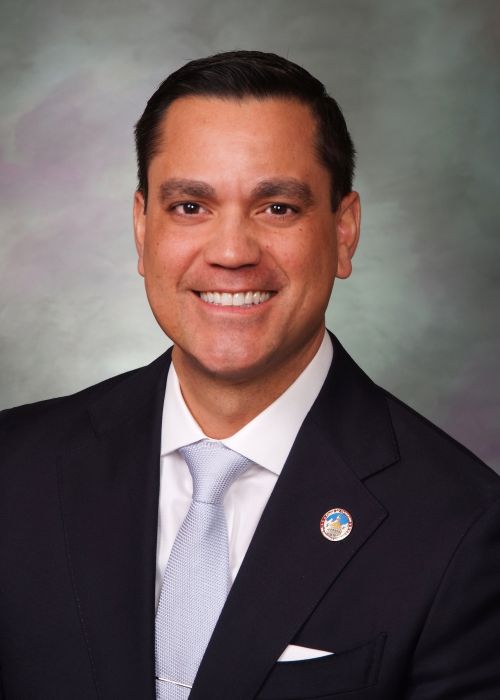
Photo of Sean Camacho
D Colorado House · District 6

Rep. Sean Camacho

Compare
Total votes
1,710
all sessions
Attendance
99%
20 missed
Near the chamber average
With party
98%
of cast votes
Higher than 80% of chamber peers
Bipartisan score
1%
crosses aisle rarely
Lower than 77% of chamber peers
Sponsored
359
bills & resolutions
Near the chamber average
Committees
4
assignments
359 bills and resolutions

Sponsored bills

Total
359
Primary
53
Co-sponsor
306
This page
359
matching current filters
Co-sponsor HB 1265
Signed into law · Colorado House · Co-sponsor
Law Enforcement National Electronic Tracing System & Share Program

The act requires each local law enforcement agency, on or before September 1, 2026, to register for the United States bureau of alcohol, tobacco, firearms, and explosives national electronic tracing system and transmit to the electronic tracing system information about each firearm it recovers or confiscates within 90 days after recovery or confiscation of a firearm, subject to certain exceptions.(Note: This summary applies to this bill as enacted.)

Signed into law Jun 1, 2026 1 co-sponsor
Co-sponsor HB 1227
Signed into law · Colorado House · Co-sponsor
Minors' Rights in Dependency & Neglect Proceedings

Current law states that a child or youth named in a petition related to dependency and neglect proceedings is a party to the proceedings and has a right to attend and fully participate in all hearings related to the case. The act affirms that as a party to the proceedings, the child or youth has legal standing regarding all matters related to the child's or youth's interests and the right to have the child's or youth's interests fully represented by the guardian ad litem or counsel for youth throughout the proceedings, including appeals.     If a county department of human or social services (county department) seeks dismissal of a petition prior to the adjudicatory hearing and the child or youth, through the child's or youth's guardian ad litem or counsel for youth, objects to the dismissal and articulates a basis upon which the child is abused or neglected, the court shall set a hearing to determine whether or not the county department has a reasonable basis to dismiss the case. If the court determines that the county department shows a reasonable basis for dismissal, the court shall dismiss the case. If the county department does not show a reasonable basis to dismiss the case, the court must allow the case to proceed.(Note: This summary applies to this bill as enacted.)

Signed into law Jun 1, 2026 1 co-sponsor
Co-sponsor HB 1006
Signed into law · Colorado House · Co-sponsor
Thriving Institution Designations for Higher Education

On or before December 31, 2027, the act requires the department of higher education (department) to establish thriving institution designations and, on or before January 1, 2027, to establish an advisory committee to provide input to the department on the outcome and recognition standards and continuous improvements set by the department to identify institutions of higher education (institutions) that meet the requirements for one or more thriving institution designations.     The act requires the department, with input from the advisory committee, to:Identify institutions that meet the outcome and recognition standards to be designated as a thriving institution;Notify each institution that meets the outcome standards to be designated as a thriving institution and request the institution to respond within 10 calendar days with the institution's decision of whether to be recognized as a thriving institution;Post on the department's website the names of the institutions that earn a thriving institution designation and agree to be listed as a thriving institution; andNotify the general assembly of the names of the institutions that are recognized as thriving institutions.(Note: This summary applies to this bill as enacted.)

Signed into law Jun 1, 2026 1 co-sponsor
Co-sponsor SB 36
Signed into law · Colorado Senate · Co-sponsor
Prison Population Management Measures

When the prison bed vacancy rate in correctional facilities and state-funded private contract prisons falls below 3% for 30 consecutive days, current law requires the department of corrections (department) to notify certain individuals and entities (notification) and implement prison population management measures. The act increases the threshold prison bed vacancy rate to 4% before the prison population management measures to go into effect. The act includes additional individuals and entities that are required to receive the notification and requires the notification to occur within 48 hours of the vacancy rate falling below 4% for 30 consecutive days. The act requires the individuals and entities that receive the notification to acknowledge receipt of the notification and confirm compliance with the prison population management measures. The act requires additional prison population management measures, including requiring the department to request expanding community corrections capacity and make referrals to the parole board, and requiring notified individuals and entities to consider alternatives to prison sentences for certain offenders.     The act appropriates $303,812 to the department to implement the act. The act decreases the appropriation for the 2026-27 state fiscal year to the department for inmate daily rate payments to local jails by $478,778.(Note: This summary applies to this bill as enacted.)

Signed into law Jun 1, 2026 1 co-sponsor
Co-sponsor HB 1026
Signed into law · Colorado House · Co-sponsor
Expanding Plan Options for PERA

Under current law, a member of the public employees' retirement association (PERA) earns service credit for each year worked during which the member makes contributions to PERA. A member may purchase additional years of service credit for any previous period of public or private employment during which the member was not making contributions to PERA, subject to certain conditions. The act allows a member of PERA to also purchase service credit for previous periods of unemployment during which the member was 21 years old or older, subject to certain conditions.     The act requires PERA's voluntary investment program to include options for an employee to make tax-deferred voluntary contributions and Roth voluntary contributions. The act requires PERA employers to affiliate with PERA's deferred compensation plan and requires PERA employers to offer the deferred compensation plan to employees. The deferred compensation plan must include options for an employee to make pre-tax voluntary contributions and Roth voluntary contributions.(Note: This summary applies to this bill as enacted.)

Signed into law Jun 1, 2026 1 co-sponsor
Co-sponsor HB 1016
Signed into law · Colorado House · Co-sponsor
Continuation of Open Educational Resources Program

The act extends the repeal date of the open educational resources grant program and the Colorado open educational resources council (council) to November 1, 2031. The act increases representation from public institutions of higher education on the council from 12 to 15 members.     The act extends the requirement for the department of higher education (department) to prepare and submit an annual report regarding open educational resources to December 31, 2031.     The act appropriates $275,000 to the department for use by the Colorado commission on higher education and higher education special purpose programs.(Note: This summary applies to this bill as enacted.)

Signed into law Jun 1, 2026 1 co-sponsor
Co-sponsor HB 1401
Signed into law · Colorado House · Co-sponsor
Transfers from Unclaimed Property Trust Fund

On June 30, 2026, the state treasurer is required to transfer the following amounts from the unclaimed property trust fund (UPTF):$72.8 million to the general fund; and$2.2 million to the division of housing to be deposited into the housing development grant fund (grant fund).     On July 1, 2026, the act repeals the statutory provisions that authorize future transfers from the UPTF to the grant fund and to the adult dental fund.     For the 2026-27 state fiscal year, $63,491,322 is appropriated from the general fund to the department of health care policy and financing (HCPF), and an appropriation to HCPF from the adult dental fund is decreased by a corresponding amount. The appropriation takes effect only if the annual general appropriation act for the 2026-27 state fiscal year becomes law.(Note: This summary applies to this bill as enacted.)

Signed into law May 29, 2026 1 co-sponsor
Co-sponsor SB 147
Vetoed · Colorado Senate · Co-sponsor
Lobbyist Regulation

The act requires a volunteer lobbyist to register and file a registration statement attesting they are not being compensated. The act exempts volunteer lobbyists from registration fees.     The act provides that the judicial department may designate one individual for the judicial department and one individual for each independent agency in the judicial department who may lobby on behalf of the judicial department or an independent agency in the judicial department (judicial lobbyist). A person designated by a principal executive department to be responsible for lobbying a state official or employee on behalf of the department (legislative liaison), a judicial lobbyist, or an individual who lobbies on behalf of the offices of the governor or lieutenant governor as a member of the governor's cabinet or as a personal staff employee in the offices of the governor or the lieutenant governor (governor's lobbyist) must register with the secretary of state annually.     In addition to annually registering with the secretary of state, a legislative liaison, judicial lobbyist, or a governor's lobbyist must file a monthly disclosure statement with the secretary of state (disclosure statement). The act provides that a legislative liaison, judicial lobbyist, or a governor's lobbyist must indicate on the disclosure statement the bill number of any legislation for which they have lobbied or will lobby a covered official and their position regarding the legislation. The legislative liaison, judicial lobbyist, or a governor's lobbyist must update their position on the disclosure statement within 72 hours of a change in position.     The act prohibits a statewide elected official or member of the general assembly from being a legislative liaison or governor's lobbyist for a period of 2 years following vacation of office.     $91,000 is appropriated from the department of state cash fund to the department of state.(Note: This summary applies to this bill as enacted.)

Vetoed May 29, 2026 1 co-sponsor
Co-sponsor HB 1318
Signed into law · Colorado House · Co-sponsor
Traffic Safety Near Schools

The act defines school zones as all roadways within at least 1,000 feet of a school property boundary, except state highways unless they are designated as part of a school zone with the written approval of the Colorado department of transportation, and including school zones established before August 12, 2026, that are 200 feet or more from a school property boundary. A school zone must have appropriate signs posted indicating it is a school zone and that the penalties and surcharges within the school zone will be doubled.     The act allows a local government that has jurisdiction over a school zone to reduce the size of a school zone after first holding a public hearing, but the act does not allow a school zone to be reduced to less than 200 feet from a school property boundary. Additionally, the act does not prohibit local governments from expanding school zones to beyond 1,000 feet from a school property boundary.     The act limits requirements the state, a county, a city and county, or a municipality must complete regarding placing and using an automated vehicle identification system along a safe route to school.     The act allows a local government to designate a portion of a roadway immediately adjacent to a school property boundary as a school street and requires the local government to post signs indicating it is a school street if the local government has jurisdiction to do so. The local government may close a school street to traffic. If there is traffic on the school street, the maximum speed limit is 10 miles per hour and vehicles must yield the right-of-way to pedestrians, bicyclists, or micromobility users. The local government may suspend additional traffic provisions on the school street that endanger pedestrians, bicyclists, or micromobility users.(Note: This summary applies to this bill as enacted.)

Signed into law May 29, 2026 1 co-sponsor
Co-sponsor HB 1338
Signed into law · Colorado House · Co-sponsor
2026 Water Projects Bill

The act appropriates the following amounts for the 2026-27 state fiscal year from the Colorado water conservation board (CWCB) construction fund to the CWCB or the division of water resources in the department of natural resources for the following projects:Continuation of the satellite monitoring system, $380,000 (section 1 of the act);Continuation of the floodplain map modernization program, $500,000 (section 2);Continuation of the weather modification permitting program, $500,000 (section 3);Continuation of the Colorado Mesonet project, $200,000 (section 5);Continuation of the water forecasting partnership project, $2,500,000 (section 6);Continuation of Colorado decision support system operation and maintenance, $750,000 (section 7);Support for water plan agency actions, $1,350,000 (section 9);Continuation of the Colorado watershed restoration and flood mitigation projects, $5,000,000 (section 10); andContinuation of the upper Colorado river commission planning, $750,000 (section 11).     Section 4 directs the state treasurer to transfer up to $6,000,000 from the CWCB construction fund to the CWCB litigation fund on or before July 1, 2026.     Section 8 restores the fish and wildlife resources fund balance by transferring $2,000,000 from the CWCB construction fund to the fish and wildlife resources fund.     Section 12 authorizes the CWCB to make a loan in an amount of $151,500,000 from the severance tax perpetual base fund to the city of Fort Collins to support the Halligan water supply project.     Section 13 authorizes the CWCB to make a loan in an amount of $20,166,670 from the severance tax perpetual base fund to the Lower Latham Reservoir Company for the Jurgens reservoir construction project.     Section 14 appropriates $37,700,000 from the water plan implementation cash fund to the CWCB to award grants that will help implement the state water plan.     Section 15 clarifies that the money that is currently in the turf replacement fund is appropriated for designated purposes to the CWCB until June 30, 2028. Any money remaining in the turf replacement fund on July 1, 2028, is transferred to the CWCB construction fund.     Section 16 makes technical corrections so that money appropriated in 2025 is available to the department of natural resources executive director's office for the purpose of paying for a study by the Colorado water center at Colorado state university.     Under current law, the CWCB may authorize loans up to $10 million from the CWCB construction fund or severance tax perpetual base fund without legislative authorization. The act increases that amount to $30 million (section 17).(Note: This summary applies to this bill as enacted.)


Signed into law May 29, 2026 1 co-sponsor
Showing 51 to 60 of 359 bills
Previous 1 … 5 6 7 … 36 Next