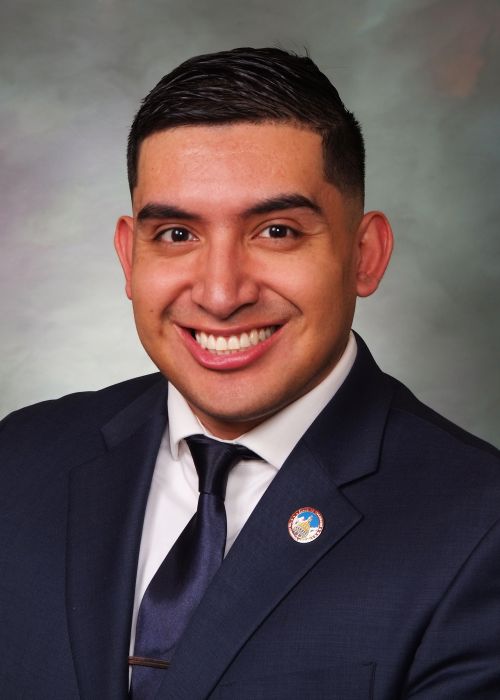
Photo of Ryan Gonzalez
R Colorado House · District 50 On the 2026 ballot

Rep. Ryan Gonzalez

Compare
Total votes
1,712
all sessions
Attendance
93%
103 missed
Lower than 87% of chamber peers
With party
87%
of cast votes
Lower than 94% of chamber peers
Bipartisan score
8%
crosses aisle rarely
Higher than 95% of chamber peers
Sponsored
259
bills & resolutions
Near the chamber average
Committees
2
assignments
259 bills and resolutions

Sponsored bills

Total
259
Primary
29
Co-sponsor
230
This page
259
matching current filters
Co-sponsor HJR 1031
Passed · Colorado House · Co-sponsor
2027 Session Convening Date & Deadlines

Maddy summaryThis bill sets the official start date for Colorado's 2027 legislative session to Monday, January 11, 2027, and establishes a detailed schedule of deadlines for introducing and passing laws. It directly affects state legislators and legislative staff by creating a new set of rules that specify when bills must be filed, introduced, and passed by various committees. The bill includes specific dates for actions such as submitting bill drafts, introducing new legislation, and final passage, with special provisions for school funding bills and appropriation bills. These deadlines are designed to organize the legislative process and ensure timely completion of the session's work.

Passed Jun 3, 2026 1 co-sponsor
Co-sponsor SB 167
Signed into law · Colorado Senate · Co-sponsor
Prescription Drug Out-of-Pocket Expense Credit

Beginning on January 1, 2028, a health insurance carrier (carrier) of an individual or group health benefit plan in Colorado (plan) shall, when calculating a covered person's contribution to an out-of-pocket maximum or cost-sharing requirement under the plan, account for and credit to the covered person's contribution an out-of-pocket expense that the covered person incurs by purchasing a prescription drug directly from a pharmacy or direct-to-consumer platform (contribution credit). The carrier shall apply the contribution credit to the out-of-pocket maximum or cost-sharing requirement that is applicable in the plan year in which the out-of-pocket expense was incurred.     To receive a contribution credit, a covered person must provide to the carrier proof of payment for a direct purchase of a prescription drug, such as an itemized receipt or pharmacy record, within 90 days after making the purchase (proof of payment). The carrier may request additional information or documentation if the proof of payment is insufficient or incomplete.     The carrier shall not apply a contribution credit in the following circumstances:For an amount of a covered person's out-of-pocket expense incurred by the direct purchase of a prescription drug that is greater than the amount the covered person would have incurred if they had obtained the same prescription drug in the same plan year from an in-network pharmacy and pursuant to the terms of their plan;If the covered person does not provide proof of payment;If the covered person incurred the out-of-pocket expense by purchasing a prescription drug that is not covered under the formulary of the covered person's plan, unless the carrier grants an exception; orIf the covered person does not comply with the carrier's utilization management processes, including prior authorization and step therapy protocols required under the covered person's plan.(Note: This summary applies to this bill as enacted.)

Signed into law Jun 3, 2026 1 co-sponsor
Co-sponsor HR 1007
Passed · Colorado House · Co-sponsor
Colorado 150th Anniversary

Maddy summaryHR 1007 is a commemorative resolution honoring Colorado's 150th anniversary of statehood in 2026. The bill directly affects the people of Colorado and various government officials by formally recognizing the state's history, culture, and achievements. Its key provisions call on citizens to celebrate this milestone with gratitude and dedication to liberty while committing to preserve natural resources, promote civic education, and strengthen infrastructure. The resolution does not create new laws or funding but serves as a symbolic acknowledgment of the state's legacy and future goals.

Passed Jun 3, 2026 1 co-sponsor
Co-sponsor HR 1006
Passed · Colorado House · Co-sponsor
Supporting Law Enforcement

Maddy summaryThis bill is a resolution that formally honors Colorado law enforcement officers for their service and sacrifices. It expresses gratitude for their role in protecting communities and encourages residents to engage with police to build trust. The measure does not create new laws or funding but serves as a public acknowledgment of officers' work and challenges.

Passed Jun 3, 2026 1 co-sponsor
Co-sponsor HB 1213
Signed into law · Colorado House · Co-sponsor
Sunset Biomass Utilization Grant Program

The act implements the recommendation of the department of regulatory agencies' 2025 sunset review and report on the biomass utilization grant program by repealing the biomass utilization grant program.(Note: This summary applies to this bill as enacted.)

Signed into law Jun 3, 2026 1 co-sponsor
Co-sponsor HB 1138
Signed into law · Colorado House · Co-sponsor
Retail Theft Prevention Program

The act creates the retail theft prevention advisory board (advisory board) in the division of criminal justice in the department of public safety (division). The advisory board shall develop procedures related to applying for a grant for the retail theft prevention grant program created in the act; review grant applications and award grants; collect and analyze data related to organized felony-level retail theft and gift card fraud trends, losses, prosecutions, and outcomes in Colorado; and develop policy recommendations in coordination with state and federal partners on how to combat felony-level retail theft and gift card fraud.     The act creates the retail theft prevention grant program in the division. A state or local law enforcement agency, district attorney's office, multijurisdictional or regional task force, or tribal law enforcement agency may apply for a grant, which may be used to investigate and prosecute organized felony-level retail theft or gift card fraud; develop or invest in technology, data-sharing systems, and analytics tools to analyze felony-level retail theft and gift card fraud metrics; provide training and technical assistance to retailers or law enforcement agencies; and develop prevention and deterrence initiatives specific to felony-level retail theft and gift card fraud.     Beginning January 2028, the act requires the division to annually report during its 'SMART Act' hearing certain information about the retail theft prevention grant program and felony-level retail theft in Colorado.     The act extends the crime prevention through safer streets grant program (safer streets grant program) to November 1, 2029, and makes the retail theft prevention grant program an allowable use of the money appropriated for the safer streets grant program. On July 1, 2027, $200,000 of the unexpended and unencumbered money remaining at the end of the 2026-27 state fiscal year from the money appropriated for the safer streets grant program reverts to the general fund.(Note: This summary applies to this bill as enacted.)

Signed into law Jun 3, 2026 1 co-sponsor
Primary HB 1077
Signed into law · Colorado House · Lead sponsor
Average Market Rate of Unprocessed Retail Marijuana

Current law imposes a tax on the first sale or transfer of unprocessed retail marijuana at a rate of 15% of the average market rate of the unprocessed retail marijuana. The 'average market rate' is currently defined as the average price, as determined by the department of revenue (department), of all unprocessed retail marijuana that is sold or transferred from retail marijuana cultivation facilities in the state to retail marijuana product manufacturing facilities or retail marijuana stores.     The act specifies that 'outdoor unprocessed retail marijuana' is cultivated under natural sunlight and weather conditions without artificial light or structures, except under limited specified circumstances, and 'indoor unprocessed retail marijuana' is cultivated in any manner other than 'outdoor unprocessed retail marijuana.'     The act also amends the existing definition of 'average market rate' to require separate rates for fresh frozen indoor unprocessed retail marijuana and fresh frozen outdoor unprocessed retail marijuana. The act requires the department to adopt rules to establish the rates for fresh frozen indoor unprocessed retail marijuana and fresh frozen outdoor unprocessed retail marijuana on or before July 1, 2027. In addition, the existing definition of 'average market rate' requires that unprocessed retail marijuana for extractions have a separate average market rate that is lower than the rate for unprocessed retail marijuana for direct sale to consumers. The act maintains this requirement.     The act also requires the department to publish a general description of the methodology and data sources used to establish the rate for each average market rate category of unprocessed retail marijuana.(Note: This summary applies to this bill as enacted.)

Signed into law Jun 3, 2026 0 co-sponsors
Co-sponsor SB 3
Signed into law · Colorado Senate · Co-sponsor
End-of-Life Management of Electric Vehicle Batteries

Senate Bill 25-163, concerning the establishment of battery stewardship programs for the disposal of certain batteries, created the 'Battery Stewardship Act', which requires the establishment of battery stewardship organizations and the submittal of battery stewardship plans to the executive director of the department of public health and environment (executive director) for the collection, transportation, processing, and recycling of certain batteries.     The act expands the scope of the 'Battery Stewardship Act' to cover the end-of-life management of propulsion batteries, which are batteries that are primarily used to supply power to an electric or hybrid vehicle, and establishes requirements concerning propulsion batteries that differ from the requirements for the batteries currently contemplated by the 'Battery Stewardship Act'.     On or before July 1, 2027, a person selling, offering for sale, or distributing propulsion batteries or vehicles containing a propulsion battery in or into the state (propulsion battery provider) is required to register with the department of public health and environment (department).     On or before January 2, 2029, a propulsion battery provider or group of propulsion battery providers must submit to the executive director an education and outreach plan that contains certain information about the management of propulsion batteries. On and after July 1, 2029, the act prohibits a propulsion battery provider from selling, making available for sale, or distributing a propulsion battery in or into the state unless the propulsion battery provider has submitted an education and outreach plan that meets the requirements of the act. The act also requires a propulsion battery provider to develop and maintain at least one website that, among other things, includes the information in the propulsion battery provider's education and outreach plan.     The act requires propulsion battery providers to collect certain unwanted propulsion batteries and ensure the responsible management of the unwanted propulsion batteries collected. In addition, the act requires a propulsion battery provider to, on and after July 1, 2029, label a propulsion battery and specifies the information that must be included on the label. On or before June 1, 2030, and on or before each June 1 thereafter, a propulsion battery provider is directed to submit an annual report to the executive director covering the preceding calendar year of the responsible management of the propulsion batteries collected by the propulsion battery provider.     A propulsion battery provider is required to pay a program initiation fee to the department. The amount of the program initiation fee for each propulsion battery provider is based on each propulsion battery provider's percentage of all propulsion battery vehicles registered in the state. On or before July 1, 2030, and on or before each July 1 thereafter, a propulsion battery provider is also required to pay an annual fee to cover the department's cost of implementing, administering, and enforcing the act. The solid and hazardous waste commission is directed to establish the annual fee amount by rule on or before July 1, 2029.     The act specifies how the department is required to implement, administer, and enforce the act. For example, the department is required to assess annual reports submitted by propulsion battery providers, compile a list of entities registered with the department, provide a digital registration form that an entity can use to register, and conduct an email survey with registered entities to request feedback on the functioning of the propulsion battery management program.     The act also sets forth requirements for persons that remanufacture a propulsion battery; persons that use a propulsion battery for a different use than the use for which the propulsion battery was originally designed; commercial entities that take possession of a propulsion battery for the purpose of selling, dispositioning, repairing, reusing, or recycling the propulsion battery; and entities that conduct propulsion battery recycling.     On and after July 1, 2029, the disposal of propulsion batteries at a solid waste disposal site and facility is prohibited.(Note: This summary applies to this bill as enacted.)


Signed into law Jun 3, 2026 1 co-sponsor
Co-sponsor SB 15
Signed into law · Colorado Senate · Co-sponsor
Commercial Sexual Activity with a Child Offenses

The act changes terminology related to child prostitution to commercial sexual activity with a child in the crimes of soliciting for child prostitution, pandering of a child, keeping a place of child prostitution, pimping a child, inducement of child prostitution, and patronizing a prostituted child, including changing the name of the offenses for soliciting for child prostitution, keeping a place of child prostitution, inducement of child prostitution, and patronizing a prostituted child.     A court is required to sentence an offender convicted of one of the listed offenses, other than soliciting for commercial sexual activity with a child, to at least the minimum of the presumptive range for the level of offense associated with the crime. For an offense of soliciting for commercial sexual activity with a child, if the court sentences the person to probation, the court shall order as a condition of probation that the person serve 364 days in the county jail.     In the crime of soliciting for commercial sexual activity with a child, the act adds knowingly soliciting a child for commercial sexual activity as a means of committing the offense and requires that when arranging or offering to arrange a meeting, the offender must know that meeting will facilitate commercial sexual activity with a child. The act removes the spousal exception from the crime of engaging in commercial sexual activity with a child.     The act makes the penalty for internet luring of a child a class 3 felony when the offense is committed with the intent to meet for the purpose of engaging in commercial sexual activity. In this circumstance, a court is required to sentence the offender to at least the minimum of the presumptive range for the class 3 felony.(Note: This summary applies to this bill as enacted.)
Signed into law Jun 3, 2026 1 co-sponsor
Primary HB 1009
Signed into law · Colorado House · Lead sponsor
Colorado Mandatory Lethality Assessment Act

The act creates the 'Colorado Mandatory Lethality Assessment Act', which requires peace officers to conduct a lethality assessment when responding to a domestic violence incident and include the completed lethality assessment in the incident report. A peace officer is not required to administer a lethality assessment if a victim is unavailable, not at the scene, incapacitated, or if circumstances otherwise make the administration of the lethality assessment impossible or impracticable. If the lethality assessment indicates that an individual is a high-risk victim, or if the lethality assessment does not indicate a victim is high-risk but a peace officer determines an individual is a high-risk victim based on the totality of the circumstances, the peace officer is required to immediately contact a community-based victim's advocate either by phone or in person and provide the high-risk victim the opportunity to speak with the advocate.     The act requires the attorney general's office, in consultation with a Colorado-based coalition that advocates for survivors of domestic violence, to develop a mandatory training for peace officers to learn how to administer the lethality assessment and provide victim referrals. No later than June 1, 2027, the attorney general is required to make the training available and offer assistance to law enforcement agencies in providing the training. Beginning July 1, 2027, the act requires each law enforcement agency to ensure that each peace officer employed by the agency has completed the mandatory training; except that a law enforcement agency that has provided training on the administration of lethality assessments prior to July 1, 2027, is not required to provide additional training.     Beginning January 2028, and each January thereafter, the act requires the attorney general's office to report to the general assembly certain information related to lethality assessments conducted in the previous calendar year. No later than January 31, 2030, the domestic violence fatality review board shall evaluate the effectiveness of mandatory lethality assessments and referrals to resources and submit the evaluation to the general assembly.     The act does not impose criminal, administrative, or civil liability on any person for an act or omission made in good faith related to administering a lethality assessment.(Note: This summary applies to this bill as enacted.)

Signed into law Jun 3, 2026 0 co-sponsors
Showing 11 to 20 of 259 bills