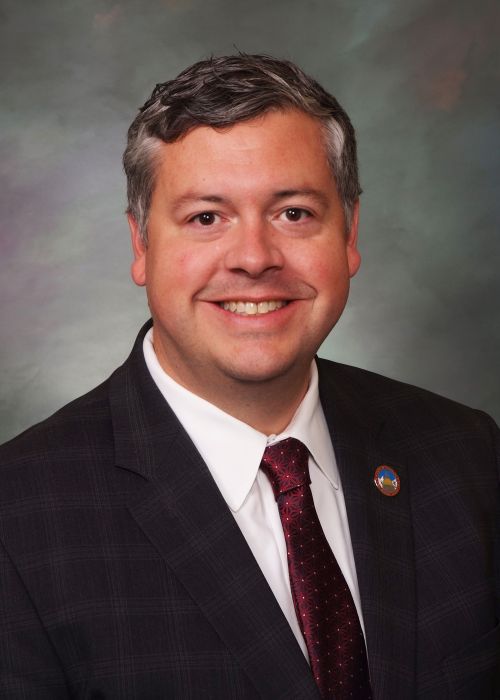
Photo of Alex Valdez
D Colorado House · District 5

Rep. Alex Valdez

Compare
Total votes
7,205
all sessions
Attendance
95%
373 missed
Among the lowest in the chamber
With party
97%
of cast votes
Near the chamber average
Bipartisan score
2%
crosses aisle rarely
Near the chamber average
Sponsored
360
bills & resolutions
Near the chamber average
Committees
2
assignments
360 bills and resolutions

Sponsored bills

Total
360
Primary
113
Co-sponsor
247
This page
360
matching current filters
Primary SCR 24-003
Passed · Colorado Senate · Lead sponsor
Protecting the Freedom to Marry

The Colorado constitution states that a marriage is valid only if it is between one man and one woman. That provision has been unenforceable since the United States supreme court decision in Obergefell v. Hodges, 576 U.S. 644 (2015). The concurrent resolution repeals the provision.(Note: This summary applies to this concurrent resolution as adopted.)

Passed May 17, 2024 0 co-sponsors
Primary HB 24-1069
Failed · Colorado House · Lead sponsor
Recycling of Single-Use Electronic Smoking Devices

The bill establishes the electronic smoking device recycling strategies advisory group (advisory group). The advisory group is tasked with conducting an analysis of methods and strategies for the recycling of single-use electronic smoking devices (devices). The advisory group shall develop a report that: Evaluates the extent of pollution caused by the disposal of devices; Reviews existing practices and capacity for the recycling of devices; Considers methods and strategies for recycling devices that are protective of the public health and environment; Considers whether Colorado should establish a deposit and recycle program that charges consumers a fee for recycling devices; Recommends any state or local government policies related to the recycling of devices; and Identifies any existing state or federal grant programs or other programs that may be available to assist in the development of strategies for the recycling of devices. The advisory group must submit the report to the general assembly, the department of public health and environment, and the governor's office on or before October 31, 2025. (Note: This summary applies to this bill as introduced.)

Failed May 14, 2024 0 co-sponsors
Primary HB 24-1125
Failed · Colorado House · Lead sponsor
Tax Credit Commercial Building Conversion

The bill creates a new refundable tax credit to be claimed in tax years commencing on or after January 1, 2026, and before January 1, 2036. The credit may be claimed for certain costs related to the conversion of a commercial structure to a residential structure. In order to claim the credit, a person must submit an application, a conversion plan, and an estimate of the qualified conversion expenditures under the conversion plan (documents) to the governor's office of economic development (office). Within 90 days of receiving documents, the office shall review the documents, determine whether to reserve a tax credit for the applicant, and provide written notice to an applicant for whom the office determines to reserve a tax credit. The office may not reserve a tax credit in excess of $3 million for any one project and may not reserve more than $5 million of tax credits during any calendar year. If the office reserves less than $5 million in a calendar year, the office may reserve a total of $5 million plus the amount less than $5 million that the office did not reserve in the previous calendar year. An applicant for whom the office reserves a tax credit shall commence a conversion plan and incur 20% or more of the estimated qualified conversion expenditures (expenditures) within 18 months of receiving notice from the office that it is reserving a tax credit for the applicant. Such an applicant shall place in service the conversion set forth in a conversion plan on or before December 31, 2035. After an applicant has placed a conversion in service, the applicant shall notify the office and provide the office with documentation of the applicant's certification of the expenditures and a certified public accountant's review of the expenditures. Within 90 days of receiving this documentation, the office shall review this documentation and issue a tax credit certificate to the applicant in an amount equal to 25% of the expenditures. If, as of the last day of any taxable year within 15 taxable years from when the applicant placed a conversion in service, the structure that is the subject of the conversion plan is not a qualified residential structure, the qualified applicant shall add the full amount of the credit to its return as a recaptured credit for that taxable year. The bill requires the office, in consultation with the department of revenue, to submit an annual report to the general assembly on the impact of the tax credit and to promulgate any policies and procedures necessary to implement the tax credit. (Note: This summary applies to this bill as introduced.)

Failed May 14, 2024 0 co-sponsors
Primary HB 24-1239
In committee · Colorado House · Lead sponsor
Single-Exit Stairway Multifamily Structure

On or before December 1, 2026, the bill requires a board of county commissioners or the governing body of a municipality to adopt a building code, or amend an existing building code, to allow up to 5 stories of a multifamily residential building to be served by a single exit. To satisfy this requirement, a local government shall incorporate by reference and adopt or adapt and adopt language from a portion of an existing building code that allows a single exit to serve no more than 5 stories of a group r-2 occupancy in the same building. If a local government so requests, the department of local affairs shall provide technical assistance to the local government in satisfying this requirement. The bill also clarifies that the adoption or amendment of a building code to satisfy the requirements of the bill does not qualify as adopting or enforcing a building code for the purpose of determining whether a board of county commissioners or the governing body of a municipality is required to adopt an energy code. (Note: This summary applies to this bill as introduced.)

In committee Apr 10, 2024 0 co-sponsors
Primary HB 23-1068
Signed into law · Colorado House · Lead sponsor
Pet Animal Ownership In Housing

The act prohibits insurers from denying a homeowner's insurance policy or a dwelling fire insurance policy or increasing the premium for such a policy based on the breed or mixture of breeds of dog that resides at the insured dwelling, while allowing denial if a specific individual dog is a dangerous dog. Insurers are also prohibited from asking or otherwise inquiring about the specific breed or mixture of breeds of dog kept at a dwelling except to ask if the dog is known to be or has been declared a dangerous dog. For purposes of these provisions, a dwelling includes a dwelling unit that is a structure or part of a structure that is used as a home, residence, or sleeping place by a tenant. The act also requires that an officer executing a writ of restitution inspect the premises for pet animals and give any pet animal found to the tenant of the premises if the tenant is present at the time the writ is executed. If a tenant is not present, the officer must contact a local authority in charge of animal control to take custody of any pet animal. The landlord shall provide the local animal control authority with access to the premises to allow the pet animals to be removed or secured and with the name and contact information for the tenant and shall leave contact information for the tenant as to where the pet animal has been taken by posting notice in a visible place at the premises. The act provides that no pet animal shall be removed from the premises during the execution of a writ and left unattended on public or private property. The act also limits the amount of an additional security deposit a landlord can receive from a prospective or current tenant as a condition of permitting the tenant's pet animal to reside at the residential premises to a refundable $300. Additionally, a landlord is prohibited from demanding or receiving additional rent from a tenant as a condition of permitting the tenant's pet animal to reside at the residential premises in an amount that exceeds $35 per month or 1.5% per month of the tenant's monthly rent, whichever is greater. The act also excludes pet animals from the categories of a tenant's personal property that a person who rents furnished or unfurnished rooms or apartments may place a lien on for unpaid board, lodging, or rent. APPROVED by Governor June 7, 2023 EFFECTIVE January 1, 2024 NOTE: This act was passed without a safety clause. (Note: This summary applies to this bill as enacted.)

Signed into law Jun 7, 2023 0 co-sponsors
Primary SB 23-277
Signed into law · Colorado Senate · Lead sponsor
Public Safety Programs Extended Uses

The crime prevention through safer streets grant program (safer streets program) exists within the department of public safety (DPS) and repeals on November 1, 2023. The act extends the safer streets program, extends reporting requirements, and extends the DPS's authority to use the appropriation received in the 2022-23 state fiscal year to pay for the safer streets program until the appropriation is fully expended. Two additional grant programs exist within DPS: A law enforcement workforce recruitment, retention, and tuition grant program (workforce program) to award grants to law enforcement agencies to address workforce shortages, improve training to P.O.S.T.-certified peace officers, and improve relationships between law enforcement and impacted communities; and A state's mission for assistance in recruitment and training policing grant program (SMART program) to award grants to law enforcement agencies to increase the number of P.O.S.T.-certified and non-certified officers who are representative of the communities they serve and to provide training for those additional law enforcement officers. The act extends the workforce program and the SMART program and their reporting requirements, specifies additional permissible uses for the workforce program and SMART program grant awards, permits DPS to set workforce program and SMART program deadlines, and permits DPS to provide technical support to workforce program and SMART program applicants. The behavioral health information and data-sharing program (information program) exists within the DPS and repeals on June 30, 2024. The act extends the information program and the DPS's authority to use the appropriation until December 30, 2024. APPROVED by Governor June 7, 2023 EFFECTIVE June 7, 2023 (Note: This summary applies to this bill as enacted.)

Signed into law Jun 7, 2023 0 co-sponsors
Primary SB 23-306
Signed into law · Colorado Senate · Lead sponsor
Buildings In The Capitol Complex

The act modifies the requirement that the office of legislative legal services have suitable office space in the capitol building by allowing the office space for the office of legislative legal services to be in the state capitol complex and within one-quarter mile of the state capitol building. The act requires the general assembly to provide funding for annual depreciation-lease equivalent payments for appropriations from the revenue loss restoration cash fund in the capital construction section of the annual general appropriation act. In addition, for the 2023-24 fiscal year through the 2028-29 fiscal year, the state controller is required to transfer the money for all annual depreciation-lease equivalent payments for the applicable fiscal year on July 1 rather than on June 30. On July 1, 2023, and each July 1 thereafter through July 1, 2028, the state treasurer is required to transfer to the capitol complex renovation fund the amount transferred to the capitol complex master plan implementation fund that was not required for the financing of the development of the national western center in the applicable fiscal year. The act repeals the specific designation of 2 floors in the capitol building annex at 1375 Sherman street as legislative space and requires the executive committee of the legislative council, the director of the division of capital assets, the secretary of the senate, the chief clerk of the house of representatives, the director of the office of legislative legal services, the director of research of the legislative council, and the state auditor to determine, prior to the beginning of the 2025 legislative session and with the approval of the executive committee of the legislative council and the governor, which areas in the capitol building annex are legislative space. The general assembly is required to vacate the legislative space at the state office building at 1525 Sherman street within one year after the completion of the renovation of the capitol building annex at 1375 Sherman street and thereafter, such space in the office building at 1525 Sherman street will be executive space. For the 2023-24 state fiscal year, the act appropriates $20,479,729 to the department of personnel from the capitol complex renovation fund for capital construction related to specific capitol complex renovation projects. APPROVED by Governor June 6, 2023 EFFECTIVE June 6, 2023 (Note: This summary applies to this bill as enacted.)

Signed into law Jun 6, 2023 0 co-sponsors
Primary HB 23-1285
Signed into law · Colorado House · Lead sponsor
Store Use Of Carryout Bags And Sustainable Products

Currently, a grocery store, supermarket, convenience store, liquor store, dry cleaner, pharmacy, drug store, clothing store, or other type of retail establishment at which carryout bags are traditionally provided to customers (store) is required to collect a fee for each carryout bag the store provides to a customer. The store must remit a portion of that fee to the municipality or county (local government) in which the store is located. When the local government has not established a process to accept the remitted fees, the act requires the store to retain and use the portion of the fee that would otherwise be remitted to a local government: For any recycling, composting, or other waste diversion programs and related outreach and education activities; and To purchase reusable bags. APPROVED by Governor June 1, 2023 EFFECTIVE June 1, 2023 (Note: This summary applies to this bill as enacted.)

Signed into law Jun 1, 2023 0 co-sponsors
Primary HB 23-1233
Signed into law · Colorado House · Lead sponsor
Electric Vehicle Charging And Parking Requirements

Section 2 of the act requires the state electrical board (board) to adopt rules requiring compliance, starting March 1, 2024, with the provisions of the model electric ready and solar ready code that require multifamily buildings to comply with the electric vehicle (EV) power transfer infrastructure requirements. The board is precluded from adopting rules that prohibit the installation or use of EV charging stations unless the rules address a bona fide safety concern. Sections 3 and 4 expand the prohibition against a landlord of rental property or a management association (association) of a common interest community from unreasonably prohibiting the installation of EV charging equipment in the leased premises or a unit in the common interest community (unit) to also apply to an assigned or a deeded parking space for the leased premises or unit, to parking spaces accessible to both the tenant or unit owner and other tenants or unit owners, and to commercial rental property.A landlord or association must also allow an EV or a plug-in hybrid vehicle to park on the premises. Colorado law grants a local government the ability to regulate parking, and this regulation includes requiring that buildings meet minimum parking standards. Sections 5, 6, and 7 require a local government, when counting minimum parking spaces, to count: Any parking space that is served by an EV charging station as at least one standard automobile parking space; and Any van-accessible parking space that is wheelchair accessible and served by an EV charging station as at least 2 standard automobile parking spaces. Sections 8 and 9 prohibit local governments from adopting an ordinance or a resolution that prohibits the installation or use of EV charging stations or restricts parking based on a vehicle being a plug-in hybrid vehicle or plug-in electric vehicle unless the ordinance or resolution addresses a bona fide safety concern. The decision is subject to judicial review. Sections 10 and 11 give local governments that have electrical, elevator and escalator, and plumbing codes adopted by reference to state codes the option to not adopt certain energy efficiency codes when their electrical, elevator and escalator, and plumbing codes are automatically updated because the state has updated these codes. Section 12 exempts, until 2030, EV charging systems from the levy and collection of property tax. Federal law prohibits the construction of automotive service stations or other commercial establishments for serving motor vehicle users along interstate highway rights-of-way, including rest areas. Due to this prohibition, the state cannot construct EV charging systems along interstate highway rights-of-way, including rest areas, in the state. Section 13 specifies that, when the federal law no longer prohibits the construction of EV charging systems along interstate highway rights-of-way, the department of transportation may collaborate with public or private entities to develop projects for the construction of EV charging systems along interstate highway rights-of-way. In addition, the department of transportation may develop these types of projects along state highways. Section 14 defines the phrase "disproportionately impacted community" for state government to include communities in which: The proportion of households that are below 200% of the federal poverty level is greater than 40%; The proportion of households that spend more than 30% of household income on housing is greater than 50%; The proportion of the population that identifies as people of color is greater than 40%; The proportion of the population that is linguistically isolated is greater than 20%; The population has a history of being subject to environmental racism perpetuated through redlining or through anti-indigenous, anti-immigrant, anti-Latino, or anti-Black laws, policies, or practices and that present-day demographic factors and data demonstrate that the community currently faces environmental health disparities; The community is identified by a statewide agency as being one where multiple factors, including socioeconomic stressors, vulnerable populations, disproportionate environmental burdens, vulnerability to environmental degradation or climate change, and lack of public participation, may act cumulatively to affect health and the environment and may contribute to persistent disparities; The community is a mobile home park; or The community is located on the Southern Ute or Ute Mountain Ute Indian reservation. All statewide agencies are required to use the definition of disproportionately impacted community, but the agencies are given flexibility in applying the definition. APPROVED by Governor May 23, 2023 EFFECTIVE May 23, 2023(Note: This summary applies to this bill as enacted.)


Signed into law May 23, 2023 0 co-sponsors
Showing 271 to 280 of 360 bills
Previous 1 … 27 28 29 … 36 Next