The act repeals an obsolete provision that: Authorized the department of public health and environment to award grants to 3 state institutions of higher education in state fiscal year 2006-07; and Required each recipient of a grant award to report to committees of the general assembly on or before March 15, 2007, regarding the use of the grant money awarded.(Note: This summary applies to this bill as enacted.)
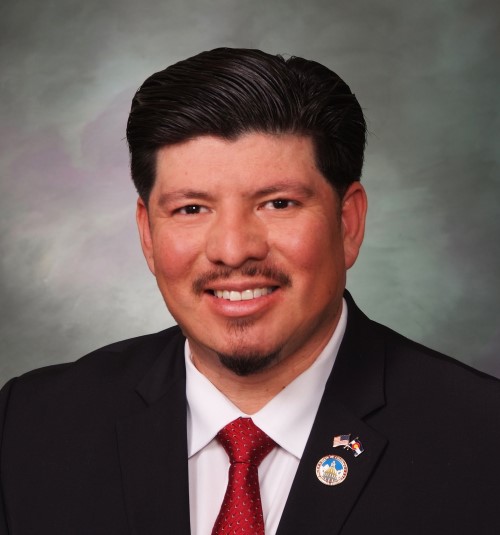
Rep. Carlos Barron
Sponsored bills
The act changes the term "epinephrine auto-injector" to "emergency-use epinephrine" in order to encompass alternatives to injecting epinephrine as a means to treat anaphylaxis in school settings. (Note: This summary applies to this bill as enacted.)
For ground ambulance services (ambulance services), the act: Allows a political subdivision or an ambulance service providing ambulance services on behalf of the political subdivision to submit to the division of insurance (division) the established rates for the ambulance services, if the rates meet specified conditions; Requires the division to publish reimbursement rates on the division's public-facing website; Establishes reimbursement rates for ambulance services that are out of network; and Prohibits an out-of-network ambulance service from billing an individual covered under a health insurance coverage plan (covered person) any outstanding balance for a covered service not paid for by an insurance carrier, except for any coinsurance, deductible, or copayment amount required to be paid by the covered person. If a covered person makes a payment for an out-of-network ambulance service, the payment must be applied to the covered person's in-network deductibles and in-network out-of-pocket maximum amounts. For the 2025-26 state fiscal year, $38,149 is appropriated from the division of insurance cash fund to the department of regulatory agencies for use by the division to implement the act. VETOED by Governor 5/29/2025(Note: This summary applies to this bill as enacted.)
The act requires that, in addition to notice requirements under the Colorado open meetings law, notice of annual public meetings held by metropolitan districts be mailed, at the lowest-cost option, to eligible electors within the metropolitan district or sent by email to any email addresses that eligible electors have provided to the metropolitan district for the purpose of receiving communication from the metropolitan district. Additionally, notice of the annual meeting must be either posted on the homepage of the metropolitan district's website or accessible by a link on the homepage. The act also requires, for any special district, that, if the annual meeting is held at a physical location and in a year immediately preceding a year in which a regular special district election will be held, there be available hard copies of self-nomination and acceptance forms, which are forms required to be filed for an eligible elector to be a candidate for a board position at a special district election. The act also requires that metropolitan districts that are required to have a publicly accessible website must establish a system or a process for residents to contact someone associated with the metropolitan district during regular business hours to address any questions or concerns regarding services of the metropolitan district. Further, these metropolitan districts must establish a system or process for residents to contact someone associated with the metropolitan district outside of regular business hours or when metropolitan district personnel are otherwise unavailable or unreachable to address emergent matters that cannot wait to be addressed until regular business hours resume. For a metropolitan district that is required to have a publicly accessible website, the act requires the following additional information to be provided on the website: The date, time, and location of the annual public meeting; An explanation of what a metropolitan district is, its services, debt, and public infrastructure, and how a resident can serve on its board; The names of the governmental entities that overlap the metropolitan district's boundaries; The name of the county or municipality with which the metropolitan district must file its annual report; and The name and contact information of someone who residents can contact with questions or concerns about the services of the district during regular business hours and outside of regular business hours or when district personnel are otherwise unavailable or unreachable for emergent matters. The act also specifies that the following information must be provided on the home page of the metropolitan district's website: The names, terms, and contact information of individuals serving on the board of directors and of any manager of the metropolitan district; The date, time, and location of scheduled regular meetings, including the annual meeting; The call for nominations for candidates to run for election to the board of directors; The names of the governmental entities that overlap the metropolitan district's boundaries; and The name and contact information of who residents can contact with questions or concerns about the services of the district during regular business hours and outside of regular business hours or when district personnel are otherwise unavailable or unreachable for emergent matters. The act adds to the requirements of what a metropolitan district must include in its service plan when seeking approval of the service plan a requirement to include the maximum term for imposing a debt service mill levy on any property developed for residential purposes after the initial year of imposition of such debt service mill levy. The act requires certain disclosures be made by all sellers of any residential real property located within the boundaries of a metropolitan district, including access to the annually required notice to electors and the metropolitan district's service plan; information on the authority the metropolitan district has to issue debt, levy property taxes, and impose fees, rates, tolls, penalties, or other charges; an estimate of property taxes levied by the metropolitan district for collection during the year the sale occurs; and a copy of the most current certificate of taxes due or tax statement to provide an estimate of the sum of additional mill levies levied by other taxing entities that overlap the property. Additionally, the act requires a written statement be included in the required disclosures that certain actions that the metropolitan district is authorized to take may increase costs to residents living in the metropolitan district, and the property tax estimate disclosure requirement is modified to require that the estimate be given in a dollar amount. (Note: This summary applies to this bill as enacted.)

The act allows a health-care provider to, under certain circumstances, adjust the dose or frequency of a chronic maintenance drug without needing prior authorization from an insurance carrier. (Note: This summary applies to this bill as enacted.)

The act prevents a pharmacy benefit manager (PBM) from prohibiting a rural independent pharmacy from using a private courier or a delivery service to deliver a prescription drug to a patient. A PBM is required to reimburse a rural independent pharmacy for a prescription drug in an amount not less than the national average drug acquisition cost for the dispensed prescription drug ingredients, plus pay a dispensing fee. When a PBM conducts an audit of a rural independent pharmacy and the audit results in a recoupment of more than $1,000 or a penalty of more than $1,000, the PBM must: Electronically notify the rural independent pharmacy of the rural independent pharmacy's rights to appeal at least 30 days before the recoupment of funds; If the rural independent pharmacy does not respond to the electronic notification within 30 days after the electronic notification, again electronically notify the rural independent pharmacy of the rural independent pharmacy's rights to appeal at least 30 days before the recoupment of funds; and If the rural independent pharmacy does not respond to the second electronic notification within 30 days after the second electronic notification, serve process on the rural independent pharmacy notifying of the rural independent pharmacy's rights to appeal at least 30 days before the recoupment of funds. The act allows a rural independent pharmacy to operate without being under the direct charge of a pharmacist if the initial interpretation and final evaluation of the prescription is done by a state-licensed pharmacist in person or remotely. (Note: This summary applies to this bill as enacted.)
For design-build transportation contracts administered by the department of transportation (department) "best value" means the overall maximum value of a proposal to the department after considering all of the evaluation factors described in the specifications for the transportation project or the request for proposals. The act requires that those evaluation factors include: Project schedule; Innovative solutions; Improved quality; Sustainability; Environmental impact; Initial cost; Long-term life-cycle cost of the transportation project; Resilience; Increased scope; and Aesthetics.(Note: This summary applies to this bill as enacted.)
The act allows, but does not require, an eligible patient to request from a manufacturer the manufacturer's individualized investigational drug, biological product, or device, which is a drug, biological product, or device that is unique and produced exclusively for use by an individual patient based on the patient's own genetic profile. The manufacturer must be operating within an institution that operates under federal rules for the protection of human subjects. An eligible patient is an individual who has: A life-threatening or severely debilitating illness, as attested to by the patient's treating physician; Considered all other treatment options currently approved by the United States food and drug administration; Received a recommendation from the patient's treating physician; Given written, informed consent for the use of the individualized investigational drug, biological product, or device; and Documentation from the treating physician that the individual meets the definition of "eligible patient". The act authorizes, but does not require, a manufacturer to make the individualized investigational drug, biological product, or device available to an eligible patient at no charge, but the manufacturer may require payment to cover the cost. If any harm is caused to the eligible patient resulting from the use of the individualized investigational drug, biological product, or device, a private right of action cannot be brought against the manufacturer or against any other individual or entity involved in the care of the eligible patient with regard to the eligible patient's use of the individualized investigational drug, biological product, or device, so long as the manufacturer, individual, or entity complied with the law and exercised reasonable care. The act prohibits disciplinary action against a health-care provider's license based on the health-care provider's recommendations regarding the use of the individualized investigational drug, biological product, or device. The act does not affect a health-care insurer's obligation under current law relating to coverage for an insured's participation in a clinical trial. (Note: This summary applies to this bill as enacted.)
The act allows a person who is 72 years of age or older to choose to temporarily or permanently opt out of jury service. The judge or jury commissioner may require documentation in support of the opt-out of jury service. For the 2025-26 state fiscal year, the act appropriates $10,066 from the general fund to the judicial department for use by the state courts to implement the act. VETOED by Governor May 16, 2025(Note: This summary applies to this bill as enacted.)
Current law requires a motor vehicle to be designed for operation on a highway to be covered by the "Uniform Motor Vehicle Law", which governs driver's licenses, registrations, and traffic regulation. The bill authorizes the owner of a surplus military vehicle to register the vehicle and be issued a license plate. If the vehicle is registered, it may be driven on the road but must comply with the registration provisions. The driver's license provisions and the traffic regulations apply to these vehicles.(Note: This summary applies to this bill as introduced.)